Islington is one of London's most architecturally layered boroughs. Georgian terraces in Barnsbury and Canonbury sit alongside Victorian and Edwardian housing stock, warehouse conversions, and contemporary infill developments. The borough has changed considerably over the past three decades, but its best streets retain a coherence and quality that reflects how seriously the area has always taken its built environment.
Working in Islington requires a specific kind of attention. The conservation areas are extensive, the listed buildings numerous, and the local planning authority rigorous. These aren't obstacles. They're the conditions that make good architecture in this context genuinely demanding, and genuinely interesting.
Working With Islington's Building Stock
The majority of our Islington work involves existing buildings. The Georgian townhouse is the dominant typology across much of the borough's most desirable residential areas: four or five storeys, generous floor-to-ceiling heights, sash windows, stock brick, and a plan that was designed around a way of life that bears very little resemblance to how people live now.
These buildings have real qualities. The room proportions are good. The relationship between front and back, between the formal rooms and the more private ones, has a logic to it. The materials, where they haven't been covered over or replaced, are excellent. What they typically lack is thermal performance, adequate daylight to the rear and lower ground floors, and any meaningful connection between the ground floor and the garden.
Our approach to working on these buildings starts with understanding what they already do well and where the real losses are. A well-considered renovation of a Georgian townhouse in Islington should improve its performance substantially, open up the relationship between the lower ground floor and the garden, and maintain the character of the street elevation without touching it. That's a more constrained brief than a new build, and it tends to produce better architecture.
Conservation Areas and Listed Buildings
Much of Islington's most significant residential stock sits within conservation areas. Barnsbury, Canonbury, Highbury, and de Beauvoir are all designated, and each has its own character and its own planning sensibility. Understanding the specific policy context of the site you're working on, rather than treating all conservation areas as interchangeable, is essential to making a successful application.
Listed buildings require a further layer of expertise. Listed building consent runs in parallel with planning permission and carries its own tests around significance, reversibility, and the justification for any intervention. We've worked on listed buildings across Islington and understand how to make the case for sensitive, high-quality interventions that improve performance without compromising significance.
The planning record for any architectural practice is publicly searchable on the council's portal. We'd encourage prospective clients to look at ours: the range of projects, the contexts we've worked in, and the outcomes of those applications tell you more about a practice's planning capability than any amount of self-description.
EnerPHit Retrofit in Islington
The Victorian and Georgian housing stock that makes up most of Islington's residential fabric is thermally poor by modern standards. Solid walls, uninsulated floors, single or poor double glazing, and draughty construction throughout: these buildings lose heat quickly and cost a great deal to run.
EnerPHit, the Passivhaus standard for retrofit, provides a rigorous methodology for improving this performance without compromising the character of the building. We've applied it to a Victorian townhouse in Islington, upgrading the fabric with super-insulation, airtight construction, and MVHR while retaining the building's historic character throughout. The reduction in energy consumption was substantial. The improvement in comfort was immediate and significant.
The embodied carbon argument for retrofit rather than demolition is also relevant here. Islington's Georgian and Victorian buildings represent carbon already committed. Working with that fabric carefully is the more sustainable choice, and it tends to produce buildings with a depth of character that new construction rarely achieves.
Sustainability in Practice
Our Islington projects integrate solar PV where the roof geometry and orientation allow it, air source heat pumps replacing gas boilers, rainwater harvesting on larger schemes, and a material specification that prioritises low embodied carbon alternatives: lime plaster rather than synthetic renders, European oak rather than imported hardwoods, reclaimed materials where they add quality rather than compromise it.
These decisions don't make headlines individually. They compound across a project into buildings that perform substantially better than standard renovation work and cost considerably less to run over their lifetime.
Green roofs and planted terraces are increasingly part of our Islington briefs, both for their contribution to biodiversity and for the way they extend the usable space of buildings on constrained urban plots. Islington's green spaces, Highbury Fields, Islington Green, the Regent's Canal corridor, reflect an area that values its natural environment. That value is worth reflecting in the buildings we design here.
The Bunker, Islington
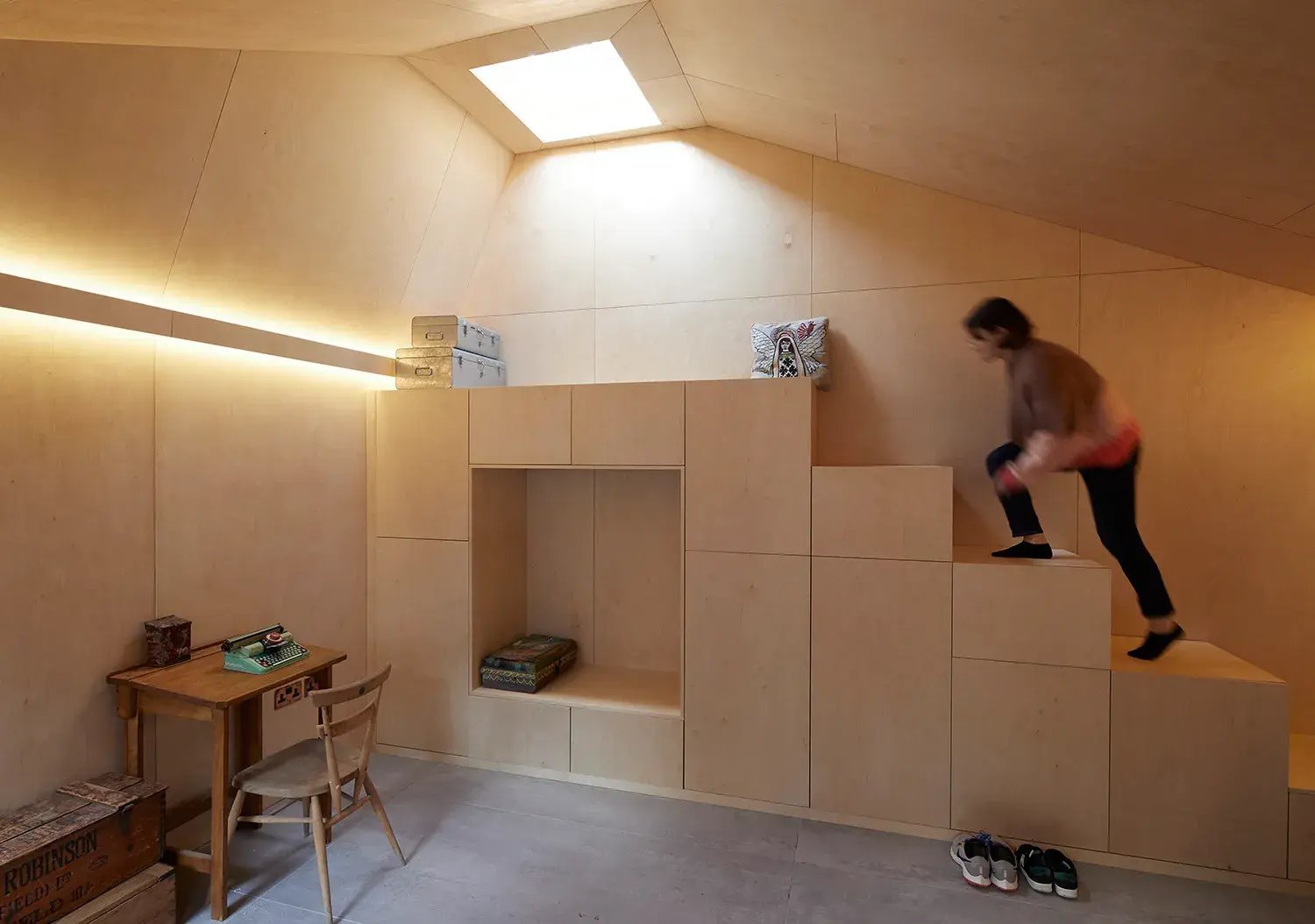
One of our more unusual Islington projects involved the conversion of a substantial outbuilding into a garden studio and office. The brief was to create a space that was genuinely comfortable to work in year-round, properly insulated and ventilated, without the visual and physical weight of a conventional extension. The result is a calm, well-lit studio that sits in the garden without dominating it, built to a performance standard that makes it usable in every season.
Working With RISE in Islington
We manage projects across the full scope of RIBA stages: feasibility, planning, building regulations, technical design, tender, and contract administration through construction. For clients who want a fully integrated service, we offer interior design and landscape coordination alongside the core architectural work.
We're direct about costs, timelines, and planning risks from the first conversation. If a budget and a brief aren't aligned, we say so early. If a planning context is difficult, we explain the realistic options rather than offering false reassurance.
If you're planning a project in Islington and want to understand what's possible, we'd be glad to have that conversation.