
Share this
by Sean Ronnie Hill on Aug 7, 2025
In London you can't easily build up or out, so a lot of homeowners end up looking down. A basement isn't the easy option, but on a constrained site it's often the only way to add real space, and done well it can change how the whole house works rather than just adding floor area.
It's also expensive and technically demanding, so it's worth being clear-eyed about the costs before you commit.
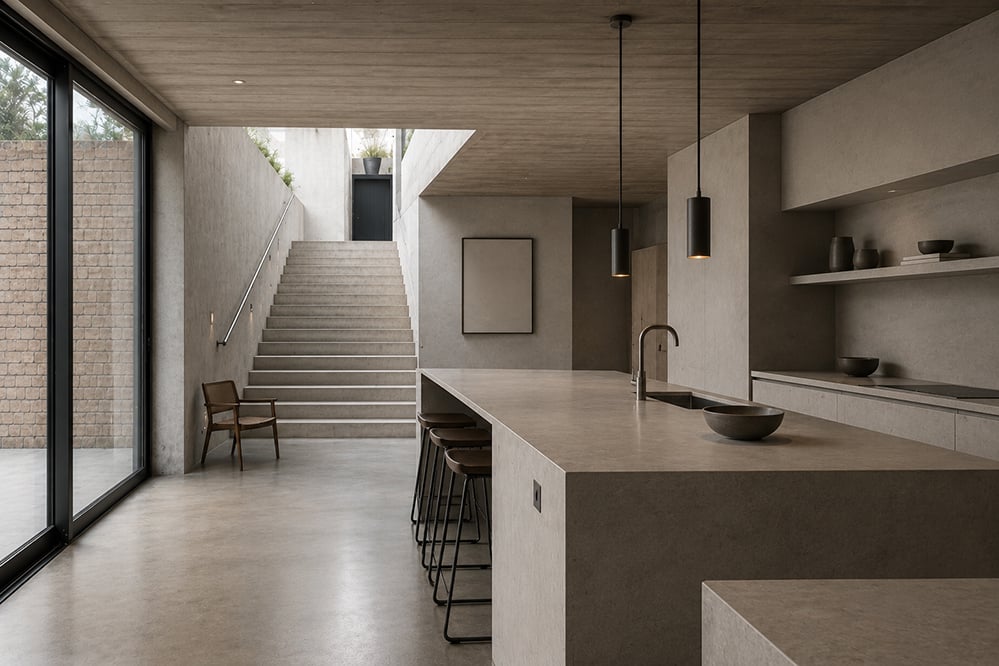
A basement kitchen lit from a lightwell and external stair, with a polished concrete floor and board-marked concrete ceiling. Designed well, a basement reads as a proper room rather than a cellar. RISE Design Studio.
Why a basement, and not an extension
London planning has become more protective of streetscapes, skylines and neighbours' amenity. In many conservation areas, rear and roof extensions face real resistance, while space below ground is often still achievable. For a lot of houses, that makes a basement less a luxury than the only practical way to gain room.
We don't treat it as pure volume, though. The useful question is what the space is actually for: a second living room, a music room, a guest suite, somewhere to work away from the rest of the house. A basement that's been designed around a real use feels like somewhere you'd choose to be, rather than a leftover you tolerate.
What it costs
To be direct about it, building below ground is expensive. As a 2025 benchmark, basement construction in London starts around £4,850 per m² plus VAT, and rises to about £8,400 per m² plus VAT on more complex or high-spec sites. For comparison, a straightforward above-ground extension starts nearer £2,675 per m².
Cost and value aren't the same thing, though. In prime London postcodes a well-designed basement has been shown to add somewhere between £8,500 and £10,000 per m² to a property's value, and in the strongest boroughs that can reach around £19,000 per m². So in the right location the numbers can stack up, but the real return is usually in what the space lets you do, not the resale figure alone.
What drives the cost
A basement is far more than a hole with a room in it. The money goes on a sequence of engineering and groundwork that you mostly never see:
- Excavation and disposal. The deeper you go, the more soil has to be dug out, hauled away and managed, with the traffic and disposal costs that come with it.
- Temporary works. The existing house has to be propped, protected and stabilised while the ground is dug out beneath it, which is skilled work and not cheap.
- Waterproofing. This is a system, not a line item: tanking membranes and cavity drainage that have to keep the space dry for decades, because a leak later costs far more than getting it right now.
- Structure. Basement walls hold back the weight and pressure of the surrounding earth, and that has to be engineered precisely.
- Ventilation and lighting. Once you're away from natural air and daylight, mechanical ventilation and a proper lighting design become essential rather than optional.
- Access and fire safety. You'll usually need new stairs and, in many cases, a secondary means of escape.
- External works. Lightwells, external steps and reinstating the garden afterwards all add up.
- High-spec uses. Pools, saunas, media rooms and wine stores each bring their own environmental and technical demands, and their own cost.
Plan the cost in early
The most common and most avoidable mistake is securing planning permission and only then discovering the scheme is unaffordable. We bring in a quantity surveyor and a structural engineer from the start, so the cost and the buildability are tested against the design ambition before it's fixed, rather than after.
The reports you'll need before you even apply
A basement application in London carries an unusually heavy documentation burden, because the council and your neighbours need to see that the scheme is safe and manageable. Depending on the site, you may need a basement impact assessment, a flood risk assessment, a sustainable drainage (SuDS) report, geotechnical surveys including boreholes and soil analysis, structural calculations, tree surveys and heritage statements (particularly in conservation areas), daylight and sunlight studies, a construction traffic management plan, and noise, vibration and dust reports. Together these can run to upwards of £6,500 before a single drawing is approved. They aren't optional, and they're what protects the project from far costlier problems later.
Sustainability below ground
Basements are too often spaces to put up with: artificially lit, stuffy and sealed off. They don't have to be. We use natural, breathable materials where we can, lime plaster, timber and stone, design lightwells that bring daylight deep into the plan, and install MVHR so the air stays fresh and filtered. A basement designed this way reads as a proper room, not a converted cellar.
Consultant and regulatory costs
On top of the build, budget for the professional and statutory costs. The design team, architect, structural engineer and quantity surveyor, typically comes to around 11 to 17% of the construction value. A householder planning application is around £528. Party wall surveyors run to roughly 0.6% of construction cost, and Building Control approval around the same. VAT applies to most of it. Some sites also need archaeological assessments or legal agreements, depending on how sensitive they are. Getting the team in place early tends to save more than it costs, because the coordination is where basement projects most often go wrong.
→ Let’s talk about how your basement could rise with purpose.
→ Email us at architects@risedesignstudio.co.uk
→ Or call the studio on 020 3947 5886
Basement Frequently Asked Questions
Can I build a basement under my house? It depends on what's underneath the plot. A site over or near a watercourse, or with a history of flooding, will need extra surveys and a flood strategy. Protected trees and tight site access can limit what's possible too. In a narrow house, the thickness of the retaining walls, which can be up to 700mm, eats noticeably into the usable width. The first step is always understanding what's below the surface.
Can I build a basement under permitted development? Sometimes, within limits. If the house has its permitted development rights, a basement might fall within them, but the moment you add external elements like lightwells, rooflights or railings, you're usually into planning permission territory. It's worth getting clear advice before assuming either way.
Can a basement have a bedroom? Yes, and many do, but it has to meet building regulations for daylight, ventilation, fire safety and ceiling height. Planning officers will also want to see how the room connects to the rest of the house and whether it has a secondary means of escape. Underground doesn't have to mean second-rate, but it does have to meet the standard.
How much value does a basement add? In London, a basement typically adds around £8,500 to £10,000 per m² to a property's value, rising to about £19,000 per m² in prime boroughs like Kensington and Chelsea, Camden or Westminster, depending on the quality and use of the space. It isn't guaranteed, but in the right place and done well, the return can be substantial.
Will I get planning permission for a basement? Most London boroughs set out clear guidance in their Supplementary Planning Documents. These often allow a basement under the footprint of the existing house, and in some cases under up to 50% of the rear garden, usually limited to a single storey. A well-prepared application with the right reports and a considered design gives you the best chance.
A basement is one of the most expensive ways to add space, and one of the most technical, so it lives or dies on the early decisions: the team, the surveys, the buildability and the cost plan. If you're thinking about building down, we'd be glad to talk it through.
RISE Design Studio, Interior Designers + Sustainability Experts
☉ Architecture for people and planet
☉ Trading since 2011
☉ Company reg no: 08129708
☉ VAT no: GB158316403