Water rarely comes up when people talk about sustainable homes in the UK. Energy dominates the conversation and carbon takes the headlines. But water is quietly becoming the next real constraint on how we design and build. We've built our homes to do one thing with rain, which is to get rid of it as fast as possible. It makes far more sense to treat it as a resource. None of this is new or experimental. The systems exist, they work, and much of Europe has used them for years.
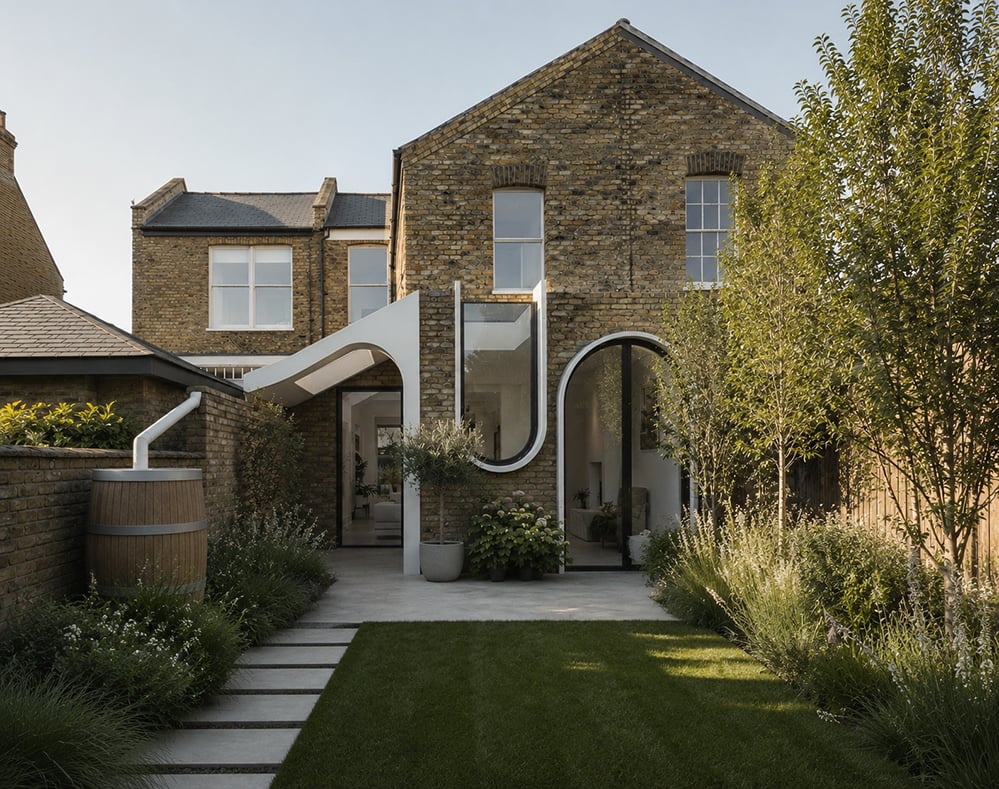
A water butt fed off the extension roof sits at the head of the garden. Designed in from the start, the downpipe, the storage and the planting read as one move rather than three. RISE Design Studio.
A rainy country with no strategy
The UK isn't short of rainfall. It's short of strategy. Most homes are designed around a single linear idea: gutters feed pipes, pipes feed sewers, and the sewers overflow when it rains hard. Meanwhile we use treated drinking water to flush toilets and run washing machines. That's a system built for a different era, when water felt limitless and storms were less intense.
The average person in the UK uses somewhere around 140 to 150 litres of water a day, well above the government's longer-term target of roughly 110 litres, and higher than most of our European neighbours. A good share of that never needed to be drinking quality in the first place.
What rainwater harvesting actually does
At its simplest, rainwater harvesting collects water off the roof and stores it for the jobs that don't need treated mains supply: flushing toilets, washing clothes, watering the garden and cleaning outside. Those aren't marginal uses. Toilet flushing alone accounts for roughly a quarter to a third of a household's water demand, and clothes washing adds around another 15%. Between them, that's getting close to half of what a typical home uses, all of it currently drawn from the same supply we drink.
The supply side is just as striking. An average UK roof sheds around 85,000 litres of rain a year. Captured and stored, that water can cover a meaningful share of non-potable demand without anyone changing how they live.
What it quietly prevents
The benefit people discuss least is what harvesting stops from happening. Heavy rainfall is becoming more frequent and more intense, and drainage networks designed decades ago can't always cope. The result is surface flooding and sewage discharged into rivers. By holding rain on site for a while, a harvesting system reduces the peak flow leaving the property, eases pressure on the drains, and lowers flood risk further downstream. It's a small building taking on a small piece of infrastructure's job, repeated across enough homes to add up.
Resilience, not purity
Harvesting isn't about cutting the mains off. A well-designed system switches back to mains supply when the stored water runs low, so it works with reality rather than against it. Paired with the rest of a fabric-first approach, a high-performance envelope, efficient appliances and sensible layouts, it becomes one more way a building does more with less, rather than a stand-alone gesture.
Designing with water from the start
Rainwater systems work best when they're part of the design from the first sketch, not bolted on at the end. The tank has to go somewhere, and where it goes affects the plan. The roof becomes a collecting surface, so its form and pitch matter. The system should be sized to what the household actually uses, not to a theoretical figure. Treated as an afterthought, it gets squeezed into leftover space and underperforms. Treated as a spatial decision early on, it disappears into the design and earns its place.
Why UK adoption is still slow
The barriers aren't technical, they're cultural and financial. Water still feels cheap, scarcity still feels like someone else's problem, and there's little incentive to reduce runoff or mains demand. So most people default to what they know. That's shifting as the climate picture gets harder to ignore and infrastructure failures become visible, and we're seeing more clients ask serious questions about resilience and long-term value. Buildings outlast the policies and incentives in place when they're built, so designing for water now is a reasonable read on where things are heading.
Rain falls for free. What a building does with it is a design decision, and at the moment most buildings make the lazy one. If you're thinking about how your home could use less mains water and handle rainfall more sensibly, we'd be glad to talk it through.