
Share this
by Sean Ronnie Hill on Dec 10, 2025
There is a particular pattern we see repeatedly in prime London residential projects. The design is considered. The materials are excellent. The kitchen is extraordinary. And the energy performance of the building has barely been thought about.
It is not that clients do not care. When we raise it, they almost always do. It is that the question tends not to get asked early enough, if at all. By the time a project reaches technical design, the key decisions that govern heat loss, airtightness, and long-term running costs have usually already been made, locked in by a floor plan and a structural strategy that were never stress-tested against energy performance.
This is the problem with how sustainable design tends to sit in the London residential market. It gets bolted on. A solar panel here, a heat pump there, a nod to an EPC rating at the end. The result is a home that looks forward-thinking but performs like it was built in 2005.
We think that is worth being direct about, because the alternative is genuinely better, and it does not cost as much as people assume.
The decisions that govern a building's energy performance are made in the first few weeks of a project. Change them later and you are working against the architecture, not with it.
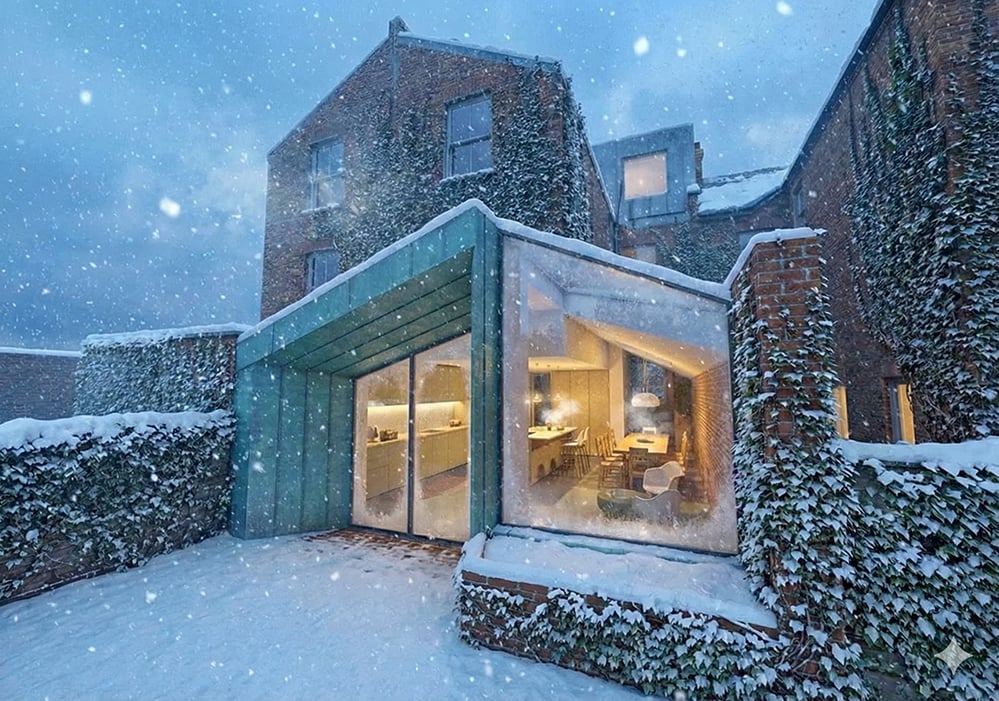
A low-energy extension in London, designed to hold steady warmth in winter and reduce energy demand year-round. High performance wrapped in calm, everyday family living.
Why fabric comes before technology
The instinct, when thinking about sustainable renovation, is to reach for technology. Heat pumps, solar panels, battery storage, mechanical ventilation. These are all valuable. But they are the second conversation, not the first.
The first conversation is about fabric: how well the building holds heat, how controlled the air movement is, how much daylight the plan captures, how the thermal mass of the materials moderates temperature swings through the day. Get the fabric right and every technology you subsequently install becomes more efficient. A heat pump running in a well-insulated, airtight building uses dramatically less energy than one working against poorly performing walls and a draughty floor. Solar charges a smaller battery. A heat recovery ventilation system maintains comfort with less effort.
This is the core of what Passivhaus methodology teaches, and it is the logic we apply to every project at RISE, including those where full certification is not the goal. Reduce demand first. Then meet that reduced demand with the cleanest, most efficient systems available.
The Victorian terrace that makes up most of Notting Hill's housing stock was not built with any of this in mind. Solid walls, minimal insulation, generous draughts, and a plan that was designed around coal fires rather than solar gain. The fabric of those buildings is, by modern standards, poor. But it is also improvable, often significantly, without touching the character of the house.
What this looks like in a real project
The rear extension is where most of this conversation becomes concrete. It is the part of the house the client is spending most on, and it is the part where the envelope decisions, the glazing specification, the roof construction, the floor build-up, have the greatest long-term impact on running costs and comfort.
A well-designed extension in this context does several things simultaneously. It brings controlled daylight deep into the ground floor plan through rooflights and generous glazed openings. It uses high-performance triple glazing that holds warmth in winter without cold downdrafts near the glass. It is built airtight, with a continuous insulated envelope, and ventilated through a heat recovery system that brings fresh air in without losing heat. The thermal mass of the floor slab and the stone or concrete finishes moderates temperature through the day, reducing the peaks that lead to overheating in summer.
The result is a space that feels qualitatively different to live in. Stable, quiet, comfortable in a way that is hard to attribute to any single decision. That quality of steadiness is what a well-performing building actually feels like from the inside, and it is something you notice from the first morning you spend in it.
Comfort is not a feeling you add. It is what happens when a building stops fighting the climate and starts working with it.
The financial case, plainly stated
We are cautious about quoting precise savings figures, because they depend heavily on the specific building, the energy tariff, and how a household actually lives. But the direction of travel is not in doubt.
A well-insulated, airtight extension with a heat pump and solar reduces energy bills meaningfully. In homes we have worked on, the combination of a high-performance fabric, solar generation, and battery storage has shifted households from significant monthly energy costs to near-zero in summer and substantially reduced bills in winter. Over the lifetime of the building, those numbers compound considerably.
There is also a growing body of evidence that low-energy performance adds measurable value at resale. EPC ratings are increasingly legible to buyers in prime London. A home with an A or B rating, solar on the roof, and a recent heat pump installation is a materially different proposition to one with an E or F. That gap is widening, not narrowing.
Where to start if you are planning a project
The most useful thing we can offer here is a sequencing suggestion, because the order in which you make decisions in a renovation project matters as much as the decisions themselves.
First: understand the existing fabric. Before choosing materials or systems, commission a measured survey and basic energy assessment. Know where heat is being lost and where it can be recovered.
Second: set a fabric-first brief. Ask your architect to design the envelope before specifying the systems. Insulation, airtightness, and glazing performance should be agreed in principle at concept stage.
Third: design for future systems. Even if a heat pump or solar array is not in this phase's budget, design the roof pitch, the services routes, and the electrical capacity so they can be added without disruption later.
Fourth: think in phases. Many of our clients treat the rear extension as the first phase of a whole-house retrofit. Get the new part right, then work back through the existing building over time.
A note on embodied carbon
Operational energy, the cost of running the building day to day, tends to get most of the attention. But embodied carbon, the carbon locked into the materials used to build or extend a home, is increasingly part of the picture too.
London's existing housing stock is, in this respect, an asset. Extending and retrofitting a Victorian terrace carries a fraction of the embodied carbon of demolishing it and building new. The bricks, the timber, the structure: all of it represents carbon already spent. Working with it, rather than against it, is both the more sustainable choice and usually the more characterful one.
At RISE, we specify with this in mind. European oak rather than imported hardwoods. Lime plaster and clay finishes rather than synthetic alternatives. Reclaimed materials where they add quality rather than compromise it. These decisions do not make headlines, but they compound across a project and across a practice.
Our Approach at RISE Design Studio
RISE Design Studio holds Passivhaus Designer accreditation. We have been working on low-energy residential projects across prime London for over a decade, and sustainability has been part of our design methodology from the beginning, not something we have added in response to market demand.
We typically begin new project conversations with a feasibility study that covers design direction, planning prospects, energy strategy, and indicative cost planning together. That early integration is, we think, the difference between a project that performs well and one that merely looks good.
We offer a free initial consultation for residential enquiries and are happy to discuss your project before any formal appointment is made.
→ Email us at architects@risedesignstudio.co.uk
→ Or call the studio on 020 3947 5886
RISE Design Studio, Architects, Interior Designers + Sustainability Experts
☉ Architecture for people and planet
☉ Trading since 2011
☉ Company reg no: 08129708
☉ VAT no: GB158316403