
Share this
by Sean Ronnie Hill on Mar 18, 2026
Somewhere between Instagram and the interiors press, biophilic design stopped meaning something. It became shorthand for a fiddle-leaf fig and a linen sofa. We want to unpick that, because the real thing, done properly, is one of the most transformative things you can do to a home.
Somewhere between Instagram and the interiors press, biophilic design stopped meaning something. It became shorthand for a fiddle-leaf fig and a linen sofa. We want to unpick that, because the real thing, done properly, is one of the most transformative things you can do to a home.
We hear the word in nearly every initial client conversation now. "We want it to feel biophilic." And when we ask what that means to them, the answers tend to cluster around the same things: houseplants, natural materials, lots of light. Which are not wrong, exactly. But they are about a tenth of it.
The honest problem with biophilic design in the UK is that it has been flattened into an aesthetic. A mood board category. Something you achieve by specifying an oak floor and leaving a trailing plant on a shelf. Developers use it in brochure copy. Contractors build it out of composite decking and call it done. Clients end up with spaces that look the part but do not feel any different to live in.
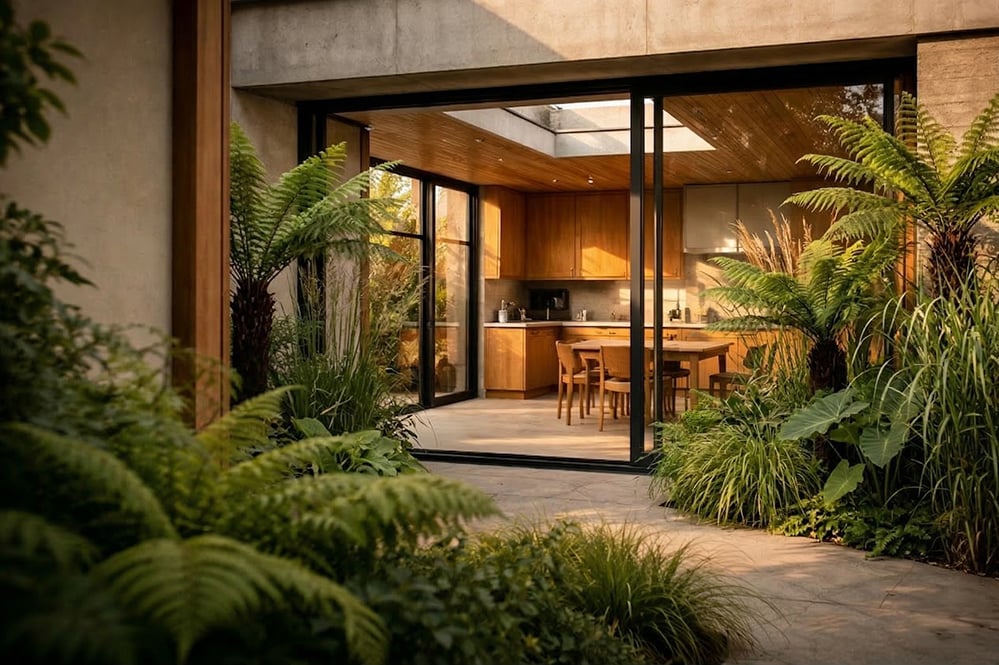
A warm timber kitchen pavilion opens fully to a lush planted garden through full-height sliding glazing - the indoor-outdoor threshold dissolved entirely. Biophilic design by RISE Design Studio, Notting Hill, London.
At RISE, we have been working on residential projects in Notting Hill and the wider Royal Borough for over a decade. And in that time, we have come to think of biophilic design not as a style but as a set of measurable spatial conditions. Either a room has them or it does not. The materials on the mood board are almost beside the point.
The question we ask is not "does this look natural?" It is "does this space make the body feel like it has arrived somewhere it was designed for?"
Why the UK context makes this harder than it looks
Biophilic design has its roots in a body of research, and a lot of its most compelling built examples, from climates very different to ours. California, Scandinavia, Singapore. Contexts with either consistent sun, radical transparency, or a cultural willingness to push what a building's envelope can do.
In London, we are working with something else entirely. A grey sky for six months of the year. A Victorian housing stock that was built to keep the outside out, not to invite it in. Conservation area constraints that limit what you can do to an external elevation. Party walls. North-facing gardens. Rooms that were designed around coal fires, not solar gain.
This is not a reason to give up on biophilic principles. It is a reason to apply them with more intelligence. A rooflight in a London terrace is not a concession to the climate. It is often the single best architectural move available, precisely because it brings the one thing those buildings were never designed to have: zenithal daylight. The quality of light that falls through a well-placed rooflight, tracking across a concrete worktop through the morning, is not decorative. It recalibrates the room entirely.
What biophilic design actually means, spatially
We structure our thinking around six spatial conditions. These are not a checklist. They are levers, and the skill is knowing which ones to pull hardest for a given project, a given orientation, a given client.
01 - Dynamic natural light Not just "lots of light" but light that moves. That tracks the sun across a surface. Rooflights, clerestories, angled reveals that shift the quality of a space through the day.
02 - Visual connection to nature A sightline to greenery from every principal room. Not a pot plant on the worktop but a genuine view out, or a planted threshold that brings the garden into peripheral vision.
03 - Materials with memory Oak that deepens over years. Limestone that holds warmth. Raw plaster that carries light differently to painted walls. Materials that age with the building, not against it.
04 - Indoor-outdoor continuity The threshold between inside and outside dissolved, or at least negotiated, through glazed systems, flush thresholds, and planting that reads as part of the interior.
05 - Living systems Not houseplants. Integrated planting such as living walls, planted courtyards, and rooftop meadows that bring seasonal change and biodiversity into the fabric of the home.
06 - Sensory richness Cross-ventilation that carries the scent of the garden. Acoustic softening through natural materials. Tactile variety in surfaces that you notice at the level of the hand, not the eye.
The Notting Hill Context
Most of the homes we work on in this part of London share the same fundamental problem: they were built to compartmentalise. Rooms stacked behind one another, a single-storey back addition blocking light to the rear, a garden glimpsed rather than felt. The Victorian terrace is a brilliant piece of urban design that is, spatially, almost the opposite of what biophilic thinking requires.
The rear wraparound extension is where most of the opportunity lives. By removing or restructuring the existing back addition and replacing it with a considered pavilion of full-height glazing, a timber soffit overhead, and a rooflight pulling sky into the heart of the plan, it becomes possible to reconnect the ground floor with the garden and the sky in a way the original building was never designed to allow.
In planning terms, RBKC operates one of the more nuanced frameworks in London. Much of Notting Hill falls within conservation areas, including the Norland, Pembridge, and St Peter's Park designations, and permitted development is more restricted than in many outer boroughs. The external materials, the relationship of any new structure to the existing building, the handling of the rear elevation: all of these require careful design and a confident planning strategy. We have made a significant number of successful submissions within RBKC and understand how to navigate it.
Biophilic design and low-energy thinking are the same conversation
We have long argued this at RISE, and the more projects we build, the more certain we are of it. The conditions that biophilic design prioritises, namely daylight, thermal comfort, fresh air, and connection to the outside, are exactly the conditions that a well-designed, low-energy building delivers as a matter of course.
A Passivhaus-certified extension demands exceptional daylighting, stable internal temperatures, and continuous fresh air through a heat recovery system. The rooflight that makes the kitchen feel alive also reduces dependence on artificial light. The cross-ventilation that brings the scent of the garden indoors also manages overheating. The planted courtyard also manages surface water and improves biodiversity. These are not parallel agendas. They are the same agenda.
RISE Design Studio holds Passivhaus Designer accreditation. Every project we take on, even those where full certification is not the primary goal, is assessed for its low-energy potential from the first conversation.
A home that makes you feel well is almost always a home that performs well. We have never found these to be in tension.
If you are starting to think about a project
A few things worth understanding before an initial conversation with your architect.
First, orientation matters enormously. A south or south-west facing garden offers considerably more scope for passive solar gain and dynamic daylighting than a north-facing one, though both can be designed well with the right approach.
Second, know your conservation area status early, as it will affect your design options from the outset.
Third, think about the garden relationship from the beginning. How the extension meets the garden is usually the most important spatial decision in the whole project, and it deserves real design resource.
We offer a free initial consultation for residential enquiries and are happy to discuss feasibility, planning prospects, and indicative budget ranges before any formal appointment.
→ Email us at architects@risedesignstudio.co.uk
→ Or call the studio on 020 3947 5886
RISE Design Studio, Architects, Interior Designers + Sustainability Experts
☉ Architecture for people and planet
☉ Trading since 2011
☉ Company reg no: 08129708
☉ VAT no: GB158316403