
Share this
Origami House: A Low-Energy Victorian House Extension in London
by Sean Hill on Dec 23, 2025
Victorian terraces are some of London’s most enduring buildings. Their calm brick façades, rhythmic windows and tight urban grain define whole neighbourhoods. Yet behind those familiar elevations, many struggle to meet the demands of modern life and a low-carbon future.
Origami House is a low-energy Victorian house extension in Haringey, North London, that explores how a traditional terrace can be carefully reworked to perform better environmentally, without losing its character. What began as a study in geometry and planning constraints has evolved into a fabric-first retrofit, drawing on AECB CarbonLite principles, on-site renewable energy and thoughtful material choices.
This is a project where architecture, energy and craft are folded together.
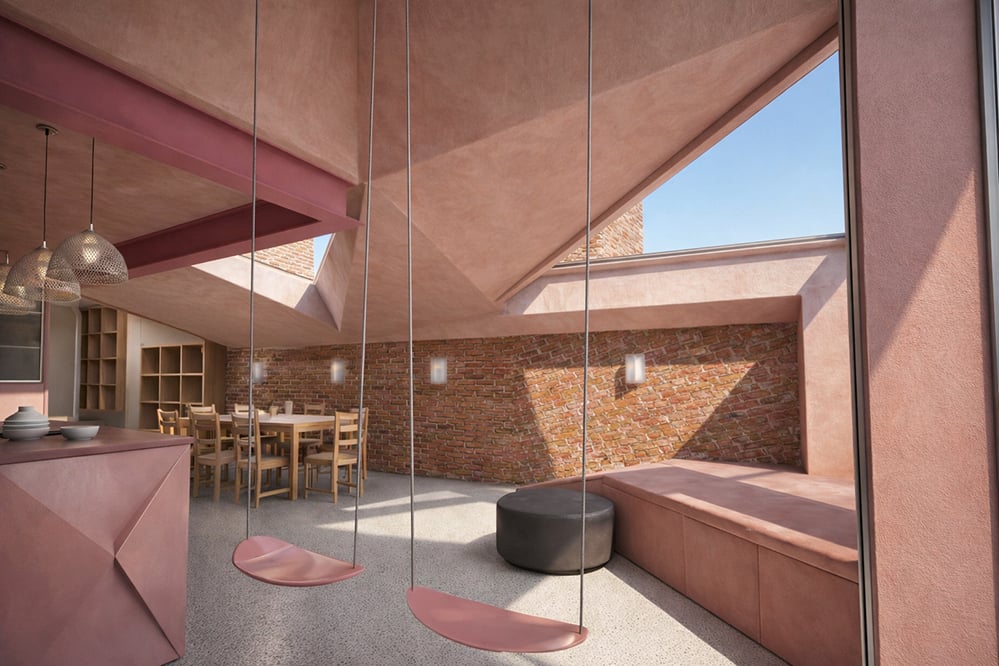
The origami interior creates moments for living, play and pause, where sculpted ceilings shape light, movement and comfort.
Designing a Low-Energy Victorian House Extension
The original concept for Origami House was shaped by constraint. Planning rules, daylight angles, boundary conditions and neighbouring amenity all played a defining role in the form of the extension. Rather than resisting these constraints, they were used as the generator of the architecture.
As the design progressed, performance became equally influential.
The extension has now evolved into a low-energy home renovation, where the geometry supports not just light and space, but thermal efficiency, comfort and long-term resilience. The result is a contemporary rear extension that responds directly to the realities of retrofitting Victorian housing stock in London.
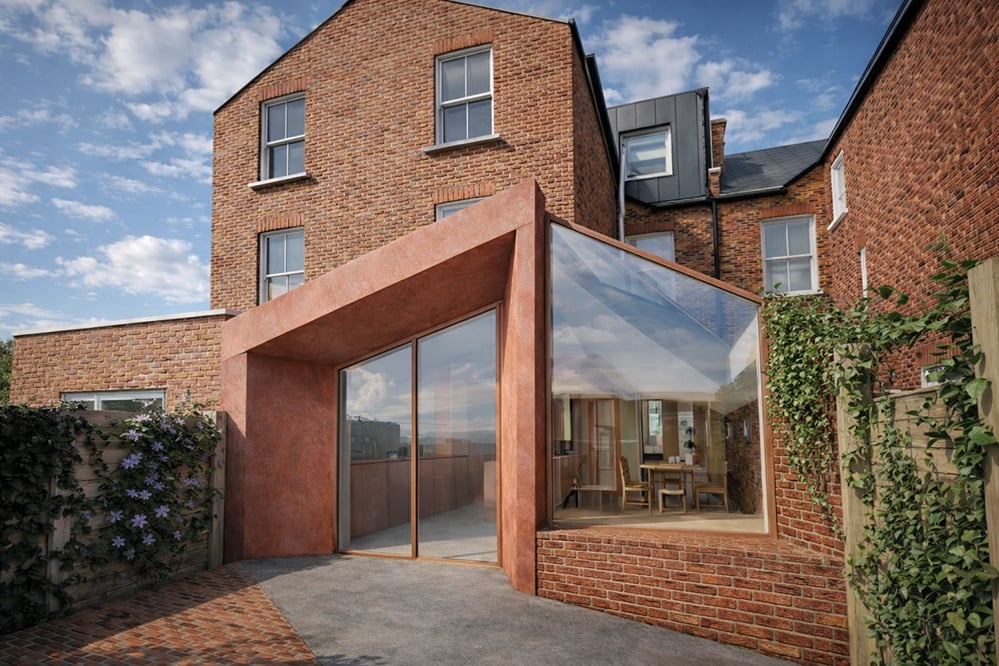
To the garden, the Victorian terrace opens into a contemporary, low-energy extension defined by folded geometry, generous glazing and material honesty.
From Geometry to Performance: A Fabric-First Retrofit Strategy
At the heart of Origami House is a fabric-first approach. Before introducing technology, the design focuses on reducing energy demand through the building envelope.
Key measures include:
-
significantly increased insulation to walls, roof and floors
-
careful detailing to reduce thermal bridging
-
improved airtightness through junction design
-
high-performance glazing throughout
This approach aligns closely with AECB CarbonLite principles, prioritising energy reduction before renewable generation. By treating the original house and extension as a single system, the retrofit avoids the piecemeal upgrades that often undermine performance in Victorian homes.
The outcome is a house that is warmer, quieter and more stable in temperature, with lower running costs and improved comfort year-round.
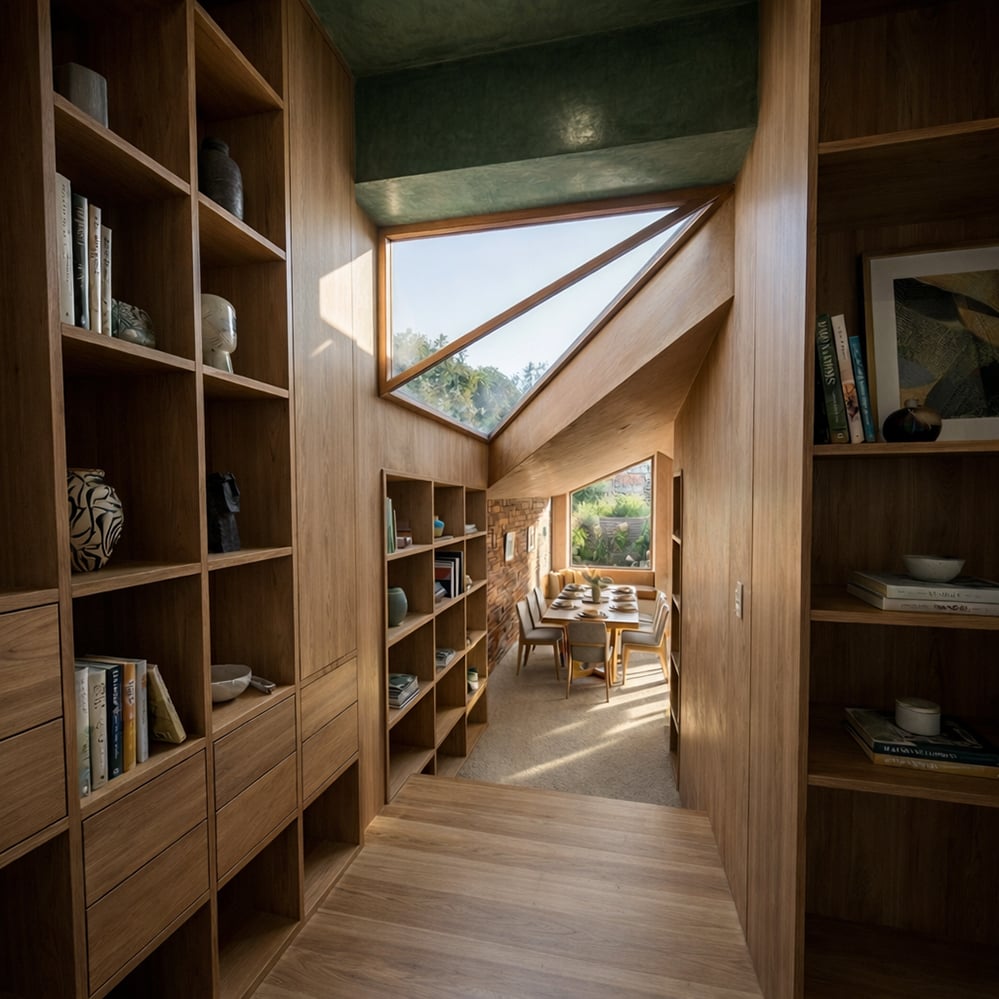
A folded rooflight draws daylight deep into the plan, with triangulated geometry shaping both space and environmental performance.
Air Source Heat Pump and Solar Panels in a Victorian Terrace
With heat demand substantially reduced, Origami House can rely on low-carbon building services.
An air source heat pump (ASHP) now provides efficient, low-temperature heating, replacing fossil-fuel systems with an electrically driven alternative that is future-proofed for a decarbonising energy grid.
Solar photovoltaic panels are integrated discreetly into the roofscape, generating on-site electricity to support the heat pump and reduce operational carbon emissions. Their placement balances performance with sensitivity to the surrounding Victorian context.
Together, these systems demonstrate how air source heat pumps and solar panels can work effectively in Victorian house extensions, when paired with a well-designed building fabric.
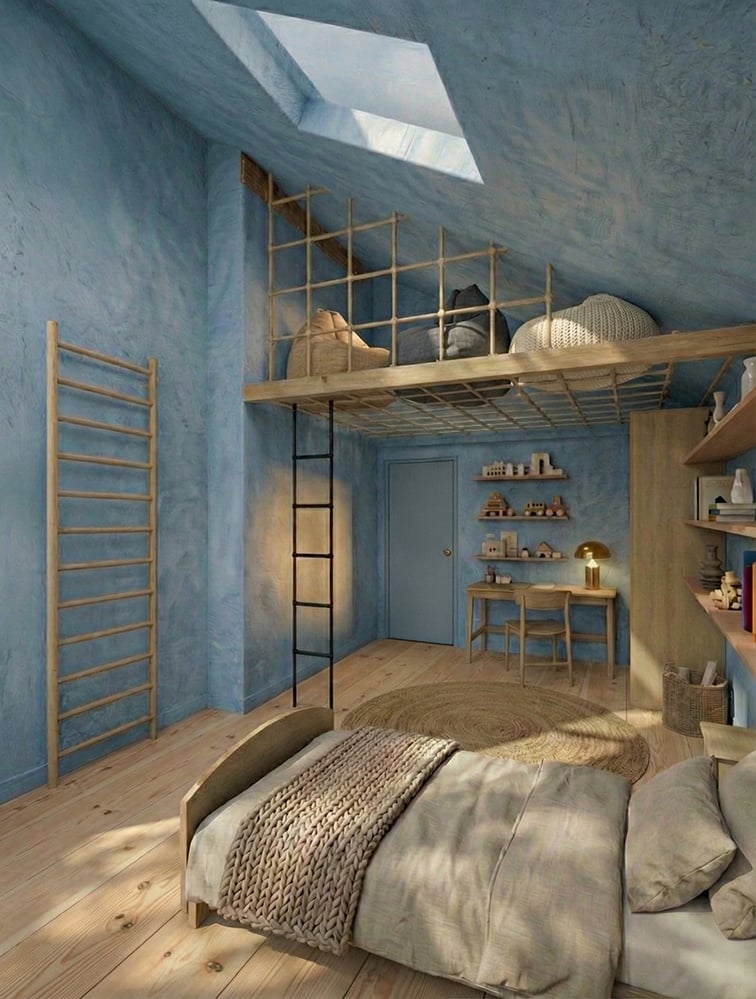
A calm, light-filled loft bedroom with a hammock mezzanine floor, shaped by angled ceilings, rooflight geometry and natural materials to improve comfort and daylight within the Victorian home.
Daylight, Rooflights and Folded Ceilings
The architectural language of Origami House remains defined by its folded geometry.
Triangulated roof planes, angled ceilings and carefully positioned rooflights bring daylight deep into the plan. The form is not decorative; it is the direct result of daylight studies, roof height restrictions and planning envelopes typical of London terraces.
Natural light enters the home from multiple directions:
-
large areas of garden-facing glazing
-
sloped rooflights set within folded ceilings
-
deep reveals that frame views and soften light
Throughout the day, light shifts across the interior surfaces, animating the space and reinforcing the connection between architecture and environment.
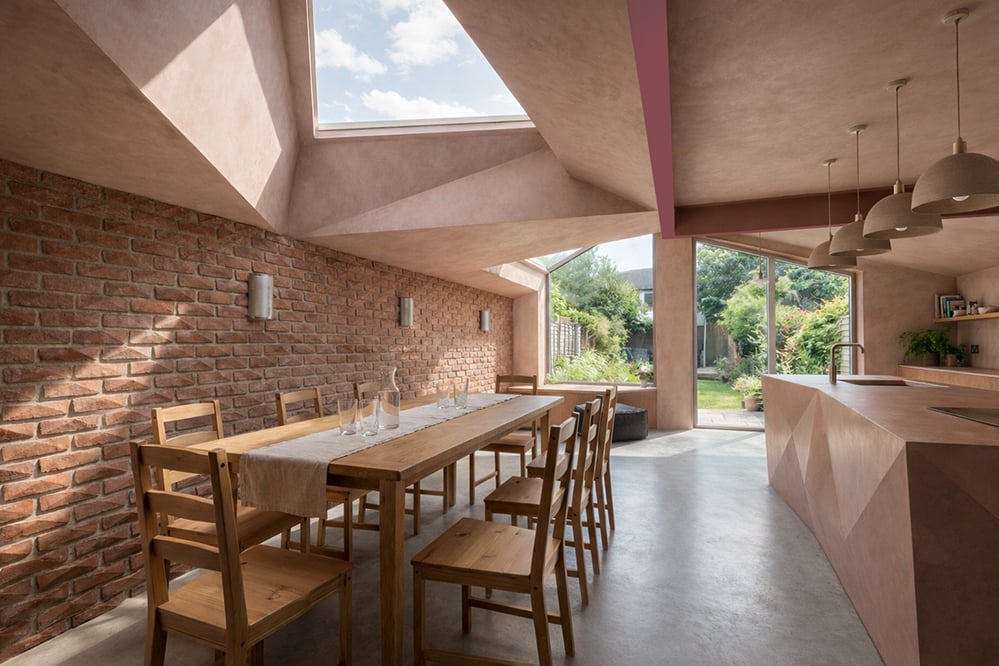
Kitchen and dining spaces are unified beneath folded ceilings and rooflights, bringing daylight deep into the heart of the Victorian home.
Precast Concrete, Thermal Mass and Material Honesty
Material choices at Origami House support both performance and atmosphere.
Alongside clay brick, timber and lime-based finishes, precast concrete elements are introduced internally. These provide useful thermal mass, helping to moderate temperature fluctuations by absorbing heat during the day and releasing it slowly as the house cools.
This is concrete used carefully and deliberately - not as spectacle, but as quiet environmental infrastructure. Paired with the folded geometry, it brings weight, calm and a sense of permanence to the interior.
The palette is restrained, tactile and durable, designed to age gracefully alongside the original Victorian fabric.
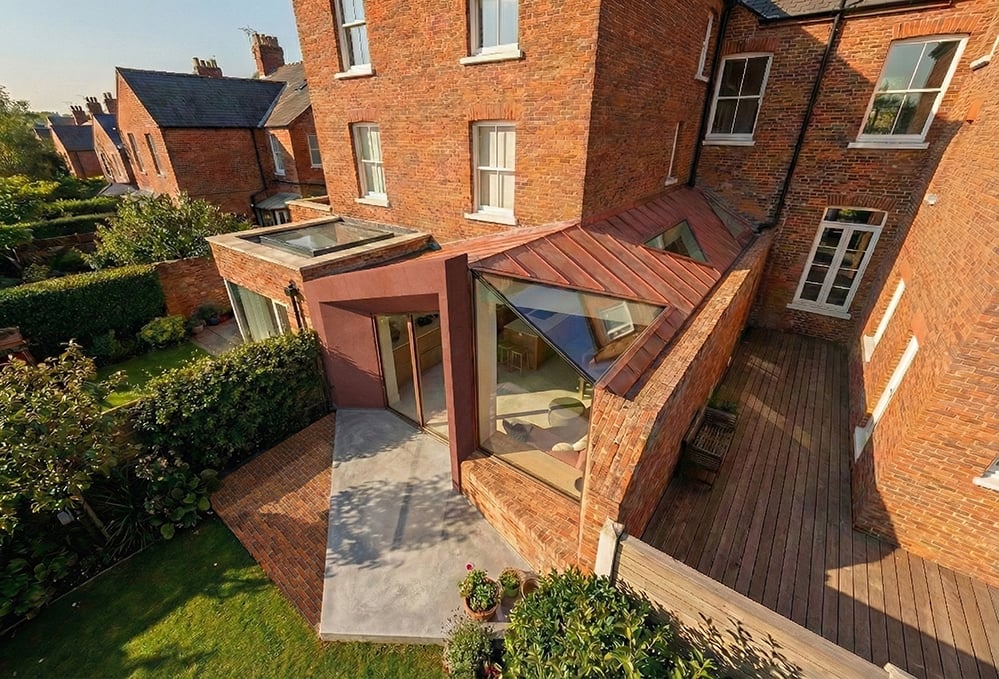
A folded, low-energy extension emerging behind a Victorian terrace in Haringey, where roof geometry, daylight and fabric-first retrofit strategies come together.
A Contemporary Garden Extension, a Victorian Street Presence
To the street, Origami House remains unmistakably Victorian. The original façade, proportions and materiality are retained, preserving the character of the terrace and its contribution to the wider streetscape.
To the garden, the house transforms.
Here, the low-energy extension opens up through generous glazing, framed views and sculpted roof forms. The folded architecture expresses its contemporary purpose while remaining grounded in material honesty and human scale.
This dual identity - traditional to the street, progressive to the garden - is key to successful Victorian house extensions in London.
Applying AECB CarbonLite Principles Without Dogma
Origami House is not about chasing certification for its own sake. Instead, AECB CarbonLite principles are used as a framework for decision-making, informing the balance between performance, cost and buildability.
The focus is on outcomes:
-
reduced operational energy
-
lower carbon emissions
-
improved thermal comfort
-
long-term adaptability
Sustainability here is not a checklist or an aesthetic. It is embedded in how the building works, how it feels to inhabit and how it will perform over decades.
A Low-Energy Retrofit for London’s Victorian Housing Stock
London’s Victorian terraces represent one of the city’s greatest retrofit opportunities. Origami House demonstrates how careful design, fabric-first thinking and modest technology can transform an existing home into a low-energy, future-ready dwelling.
By folding planning constraints, daylight studies and energy strategy into a single architectural idea, the project shows how sustainability can shape identity - not limit it.
This is a house that respects its past while preparing for a lower-carbon future.
Thinking About a Low-Energy Victorian House Extension?
At RISE Design Studio, we believe the most sustainable buildings are the ones already standing. Extending or retrofitting a Victorian home is not just about adding space - it’s about improving comfort, reducing energy use and creating places that will last.
If you’re considering a Victorian house extension, retrofit or low-energy renovation in London, we’d love to explore how architecture and performance can evolve together.
→ Email us at architects@risedesignstudio.co.uk
→ Or call the studio on 020 3947 5886
RISE Design Studio, Architects, Interior Designers + Sustainability Experts
☉ Architecture for people and planet
☉ Trading since 2011
☉ Company reg no: 08129708
☉ VAT no: GB158316403

Share this
- Architecture (151)
- Sustainable architecture (149)
- Passivhaus (68)
- Design (67)
- Sustainable Design (65)
- Retrofit (59)
- London (51)
- New build (51)
- Renovation (43)
- energy (39)
- interior design (37)
- Building materials (35)
- Planning (33)
- Environment (31)
- climate-change (30)
- Inspirational architects (27)
- Refurbishment (27)
- enerphit (27)
- extensions (27)
- Building elements (22)
- Inspiration (21)
- Rise Projects (16)
- Extension (15)
- Innovative Architecture (14)
- net zero (14)
- Carbon Zero Homes (13)
- London Architecture (13)
- low energy home (13)
- General (12)
- Philosophy (12)
- Sustainable Architect (12)
- sustainable materials (12)
- RIBA (11)
- Working with an architect (11)
- architects (10)
- Awards (9)
- Sustainable (9)
- Residential architecture (8)
- Sustainable Tennis Pavilion (8)
- architect (8)
- low carbon (8)
- Planning permission (7)
- Airtightness (6)
- BIM (6)
- Eenergy efficiency (6)
- Overheating (6)
- Passive house (6)
- Tennis Pavilion (6)
- Uncategorized (6)
- Virtual Reality (6)
- BIMx (5)
- Backland Development (5)
- Basement Extensions (5)
- Carbon Positive Buildings (5)
- Costs (5)
- RISE Sketchbook Chronicles (5)
- cinema design (5)
- construction (5)
- insulation (5)
- local materials (5)
- sustainable building (5)
- AECB (4)
- ARB (4)
- Feasibility Study (4)
- Home extensions (4)
- House cost (4)
- Paragraph 84 (4)
- concrete (4)
- constructioncosts (4)
- modular architecture (4)
- mvhr (4)
- natural materials (4)
- structural (4)
- structuralengineer (4)
- working from home (4)
- Brutalist Architecture (3)
- Building in the Green Belt (3)
- Chartered architect (3)
- Fees (3)
- Home improvement (3)
- Paragraph 79 (3)
- Paragraph 80 (3)
- Permitted development (3)
- Property (3)
- Social housing (3)
- Spain (3)
- Sustainable Extensions (3)
- Sustainable Interiors (3)
- Timber Structures (3)
- backland (3)
- circular economy (3)
- country house (3)
- countryside (3)
- furniture (3)
- listed buildings (3)
- plywood (3)
- sustainability (3)
- sustainable structure (3)
- zero waste (3)
- 3D models (2)
- Architects in Spain (2)
- Artificial Intelligence (AI) (2)
- BREEAM (2)
- Bespoke lighting (2)
- Biophilic Design (2)
- Bricks (2)
- Building energy (2)
- CLT (2)
- Chartered Practice (2)
- Clay Plaster (2)
- Commercial Architecture (2)
- Contractor (2)
- Covid-19 (2)
- Ecohouse (2)
- Furniture design (2)
- Garden studio (2)
- Heat Pumps (2)
- Heritage (2)
- Japanese Archiecture (2)
- Kensal Rise (2)
- Loft conversion (2)
- Mews House Retrofit (2)
- Modern Methods of Construction (2)
- Period Homes (2)
- Permitted development rights (2)
- Queen's Park Sustainable Architect (2)
- Recycling (2)
- Roof extension (2)
- Social Distancing (2)
- Store Design (2)
- Sustainable Affordable Homes (2)
- Sustainable Architect Fees (2)
- Sustainable Architect London (2)
- Sustainable Natural Materials (2)
- Timber Construction (2)
- Welbeing (2)
- West London Architect (2)
- ashp (2)
- barcelona (2)
- building information modelling (2)
- building regulations (2)
- co-working (2)
- design&build (2)
- epc (2)
- glazed-extensions (2)
- green architecture (2)
- greenbelt (2)
- health and wellbeing (2)
- historic architecture (2)
- house extension (2)
- interiorfinishes (2)
- light (2)
- living space (2)
- london landmarks (2)
- londoncinemas (2)
- openingupworks (2)
- peter zumthor (2)
- project management (2)
- rammed earth (2)
- renewable energy (2)
- self build (2)
- traditional (2)
- trialpits (2)
- waste (2)
- wooden furniture (2)
- #NLANetZero (1)
- 3D Printing (1)
- 3D Walkthroughs (1)
- Adobe (1)
- Agriculture and Architecture (1)
- Alvar (1)
- Architect Barcelona (1)
- Architecture Interior Design (1)
- Architraves (1)
- Area (1)
- Art (1)
- Audio Visual (1)
- Balconies (1)
- Biodiversity (1)
- Biophilic Architecture (1)
- Birmingham Selfridges (1)
- Boat building (1)
- Boats (1)
- Brass (1)
- Brent Planning (1)
- Brexit (1)
- Brownfield Development (1)
- Carpentry (1)
- Casting (1)
- Chailey Brick (1)
- Cold Water Swimming (1)
- Community Architecture (1)
- Concrete Architecture (1)
- Construction Costs (1)
- Copper (1)
- Cornices (1)
- Corten (1)
- Cowboy Builders (1)
- Czech Republic, (1)
- Data Centers (1)
- David Hockney (1)
- David Lea (1)
- Designing with Stone (1)
- Digital Twin (1)
- Domus Nova (1)
- Dormer extension (1)
- Embodied Carbon (1)
- EnvironmentalArchitecture (1)
- Flooding (1)
- Future of Housing (1)
- Gandhi memorial museum (1)
- Georgian Extension (1)
- Green Register (1)
- Green infrastructure (1)
- GreenDesign (1)
- History (1)
- India (1)
- Interior Finishes (1)
- Jan Kaplický (1)
- Japandi (1)
- Joinery (1)
- Kitchen Design (1)
- L-shaped dormer (1)
- Land value (1)
- Lord's Media Centre (1)
- Low Carbon Future (1)
- Mapping (1)
- Marseilles (1)
- Mary Portas (1)
- Metal (1)
- Micro Generation (1)
- Mid Century Retrofit (1)
- Monuments (1)
- Mouldings (1)
- Museum Architecture (1)
- Mycelium Architecture (1)
- NPPF (1)
- Nature (1)
- New Build House (1)
- Office to Homes (1)
- Office to Hotel Conversion (1)
- Offsite manufacturing (1)
- Origami (1)
- Padel Court (1)
- Party Wall Surveyor (1)
- PeopleFirstDesign (1)
- Place (1)
- Podcast (1)
- Porch (1)
- Prefab (1)
- Procurement (1)
- Public Housing (1)
- Queen's Park (1)
- RISE Team (1)
- Rebuild (1)
- Replacement Dwelling (1)
- ResilientFuture (1)
- Richard Rogers (1)
- Rural New Build (1)
- Sand (1)
- Scandinavian architecture (1)
- Selfbuild (1)
- Skirting (1)
- Slow Architecture (1)
- Small Sites Development (1)
- Solar Shading (1)
- Steel (1)
- Stone Architecture (1)
- Surveying (1)
- Sustainable Basement Extension (1)
- Sustainable Building Systems (1)
- Sustainable Housing (1)
- Sustainable Lighting (1)
- Sustainable Mews House (1)
- Sustainable Padel Court (1)
- Sustainable Retail Store (1)
- Sverre fehn (1)
- UFH (1)
- VR (1)
- Walkable Cities (1)
- West london (1)
- Whole Life Carbon (1)
- Wildlife (1)
- Wood (1)
- architect fees (1)
- architectural details (1)
- arne jacobsen (1)
- avant garde (1)
- basements (1)
- brentdesignawards (1)
- building design (1)
- built environment (1)
- carbonpositive (1)
- cement (1)
- charles correa (1)
- charles eames (1)
- charlie warde (1)
- charteredarchitect (1)
- climate (1)
- climate action (1)
- codes of practice (1)
- collaboration (1)
- covid (1)
- dezeenawards (1)
- drone (1)
- eco-living (1)
- emissions (1)
- finnish architecture (1)
- foundations (1)
- futuristic (1)
- georgian architecture (1)
- glazed envelope (1)
- good working relationships (1)
- green building (1)
- hampstead (1)
- happiness (1)
- home extension (1)
- homesurveys (1)
- imperfection (1)
- independentcinemas (1)
- innovation (1)
- inspirational (1)
- internal windows (1)
- jean prouve (1)
- kindness economy (1)
- kintsugi (1)
- landscape architecture (1)
- lime (1)
- local (1)
- lockdown (1)
- mansard (1)
- manufacturing (1)
- materiality (1)
- modern architecture (1)
- moderninst (1)
- modernism (1)
- moulded furniture (1)
- natural (1)
- natural cooling (1)
- natural light (1)
- nordic pavilion (1)
- northern ireland (1)
- palazzo (1)
- placemaking (1)
- planningpermission (1)
- plywood kitchen (1)
- post-Covid (1)
- poverty (1)
- powerhouse (1)
- preapp (1)
- preapplication (1)
- ray eames (1)
- reclaimed bricks (1)
- recycle (1)
- reuse (1)
- ricardo bofill (1)
- risedesignstudio (1)
- rooflights (1)
- room reconfiguration (1)
- rural (1)
- satellite imagery (1)
- selfbuildhouse (1)
- shared spaces (1)
- site-progress (1)
- solarpvs (1)
- space (1)
- stone (1)
- structuralsurvey (1)
- sun tunnel (1)
- terraces (1)
- thegreenregister (1)
- totality (1)
- wabi-sabi (1)
- December 2025 (5)
- November 2025 (14)
- October 2025 (7)
- September 2025 (9)
- August 2025 (13)
- July 2025 (23)
- June 2025 (10)
- May 2025 (22)
- April 2025 (16)
- March 2025 (8)
- February 2025 (12)
- January 2025 (6)
- December 2024 (6)
- November 2024 (8)
- October 2024 (5)
- September 2024 (3)
- August 2024 (2)
- July 2024 (2)
- June 2024 (2)
- May 2024 (1)
- April 2024 (1)
- March 2024 (1)
- February 2024 (1)
- January 2024 (3)
- November 2023 (1)
- October 2023 (5)
- September 2023 (7)
- August 2023 (7)
- July 2023 (6)
- June 2023 (8)
- May 2023 (14)
- April 2023 (11)
- March 2023 (8)
- February 2023 (6)
- January 2023 (5)
- December 2022 (3)
- November 2022 (3)
- October 2022 (3)
- September 2022 (3)
- July 2022 (2)
- June 2022 (1)
- May 2022 (1)
- April 2022 (1)
- March 2022 (1)
- February 2022 (2)
- January 2022 (1)
- November 2021 (1)
- October 2021 (2)
- July 2021 (1)
- June 2021 (1)
- May 2021 (1)
- April 2021 (1)
- March 2021 (1)
- February 2021 (1)
- January 2021 (2)
- December 2020 (1)
- November 2020 (1)
- October 2020 (1)
- September 2020 (2)
- August 2020 (1)
- June 2020 (3)
- April 2020 (3)
- March 2020 (2)
- February 2020 (3)
- January 2020 (1)
- December 2019 (1)
- November 2019 (2)
- September 2019 (1)
- June 2019 (1)
- April 2019 (2)
- January 2019 (2)
- October 2018 (1)
- September 2018 (1)
- August 2018 (2)
- July 2018 (1)
- March 2018 (1)
- February 2018 (2)
- December 2017 (1)
- September 2017 (1)
- May 2017 (1)
- January 2017 (1)
- December 2016 (1)
- November 2016 (1)
- September 2016 (1)
- August 2016 (2)
- June 2016 (2)
- May 2016 (1)
- April 2016 (1)
- December 2015 (1)
- October 2015 (1)
- September 2015 (1)
- August 2015 (1)
- June 2015 (1)
- January 2015 (1)
- September 2014 (2)
- August 2014 (1)
- July 2014 (4)
- June 2014 (9)
- May 2014 (2)
- April 2014 (1)
- March 2014 (1)
- February 2014 (1)
- December 2013 (1)
- November 2013 (5)
- October 2013 (5)
- September 2013 (5)
- August 2013 (5)
- July 2013 (5)
- June 2013 (2)
- May 2013 (2)
- April 2013 (4)
- March 2013 (5)
- February 2013 (2)
- January 2013 (3)