
Share this
by Sean Ronnie Hill on Mar 19, 2026
So you've decided to extend. Now comes the question nobody gives you a straight answer to.
Search online, and you'll find ranges so wide they're almost meaningless - "£30,000 to £150,000" - which tells you nothing useful about your specific project, your street, or your ambitions. This post won't do that to you.
What follows is an honest breakdown of what a house extension in London actually costs in 2026: what drives those costs up or down, when you may not need planning permission at all, and how to think about the investment before you speak to anyone.
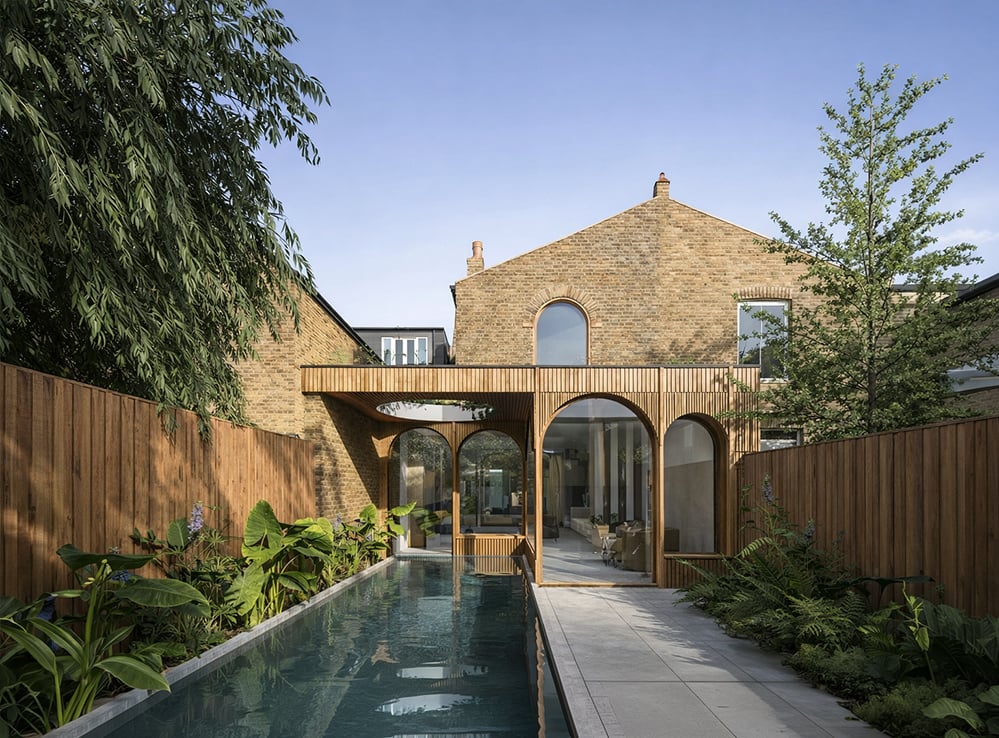
A rear extension to a Victorian terrace in London - a glazed pavilion with sculpted timber arches opening the house fully to the garden. Projects of this ambition and specification sit at the higher end of the cost ranges explored in this guide.
Start with the right number: cost per square metre
The most reliable way to think about construction cost is cost per square metre of new internal floor area (GIA - gross internal area).
Construction costs increased significantly through 2020 and 2021 due to a perfect storm of COVID-related supply chain disruption and the post-Brexit reduction in available skilled labour - two pressures that hit the construction industry simultaneously and hard. Costs have continued to rise since, and as of 2026, remain stubbornly high. The anticipated drop has not materialised. In London, a well-specified rear or side extension sits broadly in these ranges:
| Specification level | Cost per m² (construction only) |
|---|---|
| Standard | £2,750 - £3,050 |
| Good quality | £3,050 - £3,750 |
| High specification | £3,750 - £4,250+ |
A typical single-storey rear extension adding 25-35m² of space will therefore carry a construction cost of roughly £70,000 - £120,000 at a good quality specification. If you're adding a basement, budget from around £6,000 per m² for that element alone - it is a fundamentally different type of construction.
These figures are for construction only. They do not include architect fees, planning, structural engineering, or any of the other costs explored below.
Do I need planning permission?
A question worth addressing early, because a significant proportion of London extensions don't require it.
Under permitted development (PD) rights, many single-storey rear extensions can be built without a planning application, provided they stay within defined limits: typically no more than 3 metres beyond the rear wall for a terraced or semi-detached house, or 4 metres for a detached house, and no higher than 4 metres at the ridge.
The larger home extension scheme extends these limits to 6 and 8 metres respectively, subject to a 42-day consultation with adjoining owners.
Permitted development rights do not apply if your property is in a conservation area, an Area of Outstanding Natural Beauty, a World Heritage Site, or is listed. In those cases, a planning application is required, and the constraints are more exacting. Check your specific property via the Planning Portal or speak to us early - the answer shapes everything that follows.
Where a full application is required, a householder planning application in England now costs £548 (from 1 April 2026), and planning fees are indexed to inflation annually. A realistic timeline from instruction to decision is 4-6 months, including pre-application advice for anything complex.
The full picture: every cost you need to account for
Architect fees
A full architectural service from RIBA Stages 1-6 (client brief through to completion on site) typically runs 8-15% of construction cost for a straightforward extension, rising towards 13-17% for complex projects, listed buildings, or whole-house transformations. Many practices - including RISE - offer a fixed fee agreed at the outset, which provides cost certainty from the start.
The breadth of that range reflects how much an architectural service can vary in scope. At the lighter end, a practice may take you through design and planning and hand you over to manage the rest yourself. At the comprehensive end, the architect leads the entire process - acting as contract administrator on site, coordinating structural, mechanical, and landscape consultants, developing the interior design and bespoke joinery in detail, integrating sustainability measures such as Passivhaus principles and low-energy systems, and guiding every decision from first sketch to final snagging. The level of involvement you need - and want - is the primary driver of where within that range your fee will sit.
Be wary of unusually low fees in the early stages. They often reflect a service that ends at planning - leaving you to manage technical design and construction yourself - or a cookie-cutter approach that doesn't account for the specific demands of your project. In both cases, the shortfall tends to surface mid-process: as additional fees when the scope inevitably expands, as corners are cut in the technical detail, or as a client left navigating a live construction site without proper support. That is a more expensive problem to solve than the fee saving that created it.
Full service includes concept design, planning drawings and application management, detailed technical drawings, structural coordination, contractor tendering, contract administration, and site inspections through to practical completion. That is a substantial body of work - and it is the difference between a project that runs smoothly and one that doesn't.
Planning application fees
A householder planning application in England now costs £548 from 1 April 2026. The fee itself is modest relative to the total project cost. The time cost is not. Factor in pre-application advice for anything complex, and allow 4-6 months from instruction to decision.
Structural engineer
Almost every extension requires a structural engineer for steel beam calculations, foundation design, or both. Budget £1,500 - £4,000 depending on complexity. If your site has constrained access, proximity to protected trees, or neighbour foundation issues, specialist foundation work such as mini piles will add cost at both the engineer and contractor stage.
Party wall surveyor
If your extension is within 3 metres of a shared boundary or involves work to a shared wall, the Party Wall etc. Act 1996 requires you to serve notice on your neighbours. If they appoint their own surveyor, you pay both sets of fees. Budget £1,000 - £3,000, though costs can escalate if disputes arise. Early neighbour communication reduces the risk considerably.
Building control
Building regulations approval is separate from planning permission - and both are required. Local authority building control fees for a typical extension run £900 - £1,500, covering structural, thermal, fire safety, and drainage requirements.
Quantity surveyor
For projects above £250,000, early QS involvement pays for itself. A quantity surveyor is a construction cost specialist who reviews your drawings and specification for cost implications as the design develops - not after it is finished. Bringing one in at RIBA Stage 2 or 3, before you go to tender, produces reliably better outcomes than asking them to review a completed set. Budget £2,000 - £5,000 for a cost review at that stage. The fee is usually recovered many times over.
Contractor preliminaries and contingency
A good contractor's quote will include preliminaries - site setup, scaffolding, waste removal, insurance, and project management overhead. These typically add 12-18% on top of the base labour and materials cost.
Hold a 10-15% contingency on the total build cost. Not because something will necessarily go wrong, but because extensions involve opening up existing structures - and existing structures contain surprises. An unexpected drainage run, a wall that isn't where the drawings suggested, insulation that needs upgrading to meet current regulations - these are common, not exceptional.
Finishes and fittings
Construction cost figures do not include kitchen units, bathroom sanitaryware, floor finishes, lighting, joinery, or decoration. These are often the costs that most surprise first-time clients.
As a guide: a good kitchen can be achieved for around £18,000 - £25,000 using quality carcasses with well-specified external finishes. Brand-name kitchens can reach £50,000 or more, but that premium rarely translates into proportionate value. Define your specification early and hold a realistic allowance from the start.
A worked example: whole-house renovation, dormer extension, and EnerPHit deep retrofit - North West London
A single-storey kitchen extension is one end of the spectrum. At the other is the type of project we are delivering more frequently: a whole-house renovation that combines a ground floor side and rear extension, a dormer loft conversion, and a deep energy retrofit to EnerPHit standard - the retrofit equivalent of Passivhaus certification.
This is a genuinely transformative scope of work. It takes a typical Victorian terrace - cold, inefficient, spatially compromised - and turns it into a high-performance home that is warmer, quieter, healthier to live in, and dramatically cheaper to run.
The figures below are drawn from a real RISE project on a four-bedroom Victorian terrace in North West London. The existing house was 123.5m² GIA. The proposed scheme adds a side extension, rear extension, and dormer, bringing the total to 170m², with the entire building retrofitted to EnerPHit standard throughout.
At that scope and specification, the all-in construction cost sits at around £5,400 per m² of proposed GIA - reflecting not just the new build area but the full complexity of working within and transforming an existing Victorian structure while achieving certified low-energy performance throughout.
Construction works
| Item | Approximate cost |
|---|---|
| Preliminaries (site setup, scaffolding, hoarding, project management) | £60,000 - £70,000 |
| Demolition and stripping out | £33,000 - £38,000 |
| Structural works (foundations, steels and timber frame across all floors) | £75,000 - £85,000 |
| Building work and carpentry (floors, walls, roofs, external envelope) | £135,000 - £150,000 |
| External doors and windows (high-performance, triple-glazed) | £65,000 - £72,000 |
| Drainage (above and below ground, rainwater goods, waterproofing) | £16,000 - £20,000 |
| Electrical (full rewire, solar PV, EV charger, home battery) | £58,000 - £68,000 |
| Heating and plumbing (ASHP, UFH, wet pipework, water treatment) | £60,000 - £68,000 |
| Carcassing, joinery and kitchen | £150,000 - £165,000 |
| Plastering | £42,000 - £47,000 |
| Finishes (polished concrete, engineered timber, tiles throughout) | £44,000 - £52,000 |
| Decorating | £48,000 - £54,000 |
| Sanitaryware and brassware | £28,000 - £32,000 |
| External works (patios, fencing, landscaping) | £13,000 - £17,000 |
| Construction subtotal | £850,000 - £950,000 |
Low-energy systems - broken out separately
These costs sit within the construction subtotal above but are worth understanding individually - both because they transform how the building performs, and because several qualify for reduced VAT at 0% under current HMRC rules:
| System | Scope | Approximate cost |
|---|---|---|
| Air source heat pump (ASHP) | Supply, install, MCS certification, dedicated pipework and fuseboard | £20,000 - £23,000 |
| Mechanical ventilation with heat recovery (MVHR) | Supply, install, full duct routes, terminals, commissioning to AECB CarbonLite standard | £17,000 - £20,000 |
| Airtightness package | ProClima membranes, tapes and grommets throughout, two independent air permeability tests | £13,000 - £15,000 |
| Thermal and acoustic insulation | Insulated plasterboard to all external walls and roof plane | £9,000 - £11,000 |
| Solar PV, battery storage and EV charger | 6-panel system, inverter, home batteries, 22kW EV charger | £12,000 - £15,000 |
| Underfloor heating | Wet UFH to ground floor, electric UFH to bathrooms | £12,000 - £14,000 |
| Low-energy systems subtotal | £83,000 - £98,000 |
These systems deliver the EnerPHit outcome: airtightness below 1.0 ACH, heat recovery above 85%, and a building heated entirely by a low-carbon heat pump. Energy bills on completion typically fall by 70-80% compared with a pre-retrofit Victorian terrace.
Professional fees and statutory costs
| Item | Approximate cost |
|---|---|
| Architect fees (RIBA Stages 1-6, full service) | £70,000 - £120,000 |
| Structural engineer | £6,000 - £9,000 |
| Mechanical and electrical engineer (heating design specialist) | £3,500 - £5,000 |
| Energy consultant and PHPP modelling | £3,000 - £4,500 |
| Party wall surveyor | £2,500 - £4,000 |
| Planning application | £548 |
| Building control | £1,200 - £1,600 |
| Professional fees subtotal | £87,000 - £145,000 |
A note on architect fees: the range here reflects scope and programme complexity. A project of this ambition - combining new build, retrofit, and EnerPHit certification - demands a higher level of design input, specialist coordination, and on-site oversight than a straightforward rear extension. The fee reflects that.
Fit-out and finishes
| Item | Approximate cost |
|---|---|
| Kitchen (cabinetry, worktops, appliances) | £18,000 - £25,000 |
| Sanitaryware and brassware | £26,000 - £32,000 |
| Bespoke bedroom + living joinery | £40,000 - £50,000 |
| Fit-out subtotal | £84,000 - £107,000 |
(Note: floor finishes and decorating are included in the construction subtotal above.)
Contingency
On a project of this complexity - existing Victorian structure, full gas removal, EnerPHit airtightness requirements - a contingency of 10-15% of construction cost is appropriate: roughly £90,000 - £135,000.
Total project cost: approximately £1.0m - £1.15m
That figure warrants context. This is not a cosmetic renovation. It is a complete structural, spatial, and energetic transformation - removing gas entirely, achieving certified airtightness, installing heat recovery ventilation, and generating the home's own electricity. On completion, the house performs to EnerPHit standard and will do so for decades. Energy bills fall dramatically. The embodied carbon in the existing structure is retained rather than demolished.
Against the cost of purchasing an equivalent home in the same area - plus stamp duty, legal fees, and moving costs - the numbers often tell a compelling story for staying and investing.
What drives costs up
Basement work - from around £6,000/m² for the basement element alone. A fundamentally different type of construction with its own structural, drainage, and waterproofing challenges.
Constrained or difficult sites - party wall complications, narrow access, parking permits, and restricted working hours all add cost and programme.
Listed building status - specialist contractors, more exacting specification, longer consents, and closer scrutiny from conservation officers.
Conservation area constraints - limiting material choices, affecting external appearance, and sometimes requiring a full application where PD rights would otherwise apply.
Poor existing condition - older houses reveal surprises once opened up. Allow a proper contingency.
Full gas removal - terminating the mains supply and converting to all-electric adds cost but is standard on EnerPHit projects and increasingly the right long-term decision.
Non-standard construction - recycled steel beams has real environmental advantages but can add around 10% compared with standard steel.
What keeps costs down
Clear, complete drawings before going to tender - contractors price risk. Reduce uncertainty in the information you give them and they price more keenly.
Realistic specification from the start - scope creep mid-build is the single most consistent driver of cost overrun. Decide what you want before you start, not while the scaffolding is up.
Fabric-first design - getting insulation, airtightness, and structure right before spending on systems saves money over the building's lifetime. A well-insulated building needs a smaller heat pump. A leaky one makes any heating system work harder.
Early QS involvement - a quantity surveyor reviewing cost implications as the design develops produces reliably better outcomes than one reviewing a completed set. The cost of their involvement is usually recovered many times over.
Phasing the work - for whole-house projects, phasing across two or three stages can make the total investment more manageable without sacrificing the integrity of the overall design vision.
A note on VAT
Extensions to existing homes are subject to standard rate VAT at 20% on construction costs - already included in the contractor quotes you will receive.
One important exception: certain energy-saving measures - insulation, air source heat pumps, solar panels, MVHR systems - currently attract a reduced VAT rate of 0% under HMRC rules. On a project with the low-energy systems scope described above, this saving is meaningful and worth confirming with your contractor at tender stage.
If your project involves the amalgamation of two flats into a single dwelling, the construction works may qualify for a reduced VAT rate of 5% rather than the standard 20%. This is a nuanced area of VAT legislation and the specifics of your project will determine whether it applies - always take advice from your accountant or a VAT specialist before proceeding.
Is it worth it?
This is the question only you can answer - but good architecture helps you think it through clearly.
In London's property market, a well-designed extension that adds usable, light-filled space typically adds value in excess of its cost - provided the design is good and the workmanship is sound. A whole-house EnerPHit retrofit adds something more: a demonstrable, certifiable performance standard that will only become more valuable as energy costs rise and buyers become more discerning about building quality.
More than either of those things, it changes the way you live every day. Warmth without draughts. Silence. Clean air. Spaces designed for how you actually use them.
Against the cost of purchasing an equivalent home in the same area - plus stamp duty, legal fees, and moving costs - a well-executed transformation often makes more financial sense than moving. And it makes considerably more human sense.
Frequently asked questions
How much does a house extension cost in London in 2026?
A good quality single-storey rear extension will typically cost £70,000 - £120,000 in construction costs alone (at £3,050 - £3,750/m²), before architect fees, planning, engineering, and contingency. The full project budget including all professional fees and a sensible contingency is likely to be £100,000 - £160,000 for a straightforward 25-35m² extension.
Do I need planning permission for a house extension in London?
Not always. Many single-storey rear extensions qualify as permitted development and can be built without a planning application. The standard limit is 3 metres beyond the rear wall for terraced and semi-detached houses, or 4 metres for detached. The larger home extension scheme extends this to 6 and 8 metres respectively, subject to a neighbour consultation. Conservation areas and listed buildings are subject to different rules. Always check before assuming PD applies.
What VAT rate applies to a house extension?
Standard rate VAT at 20% applies to most house extension construction costs. However, specific energy-saving measures - including heat pumps, MVHR, insulation, and solar PV - currently qualify for 0% VAT. The conversion of two or more flats into one dwelling may qualify for 5% VAT on construction. Always confirm with your contractor and accountant at tender stage.
Where to start
The most important first conversation is with an architect - not a contractor, not a planning consultant - because the design shapes everything that follows: what's possible, what it will cost, and whether it will be worth living in.
At RISE, our initial consultations are a genuine two-way conversation. We want to understand your project, your home, and your priorities - and give you an honest assessment of feasibility and cost before any commitment is made.
→ Email us at architects@risedesignstudio.co.uk
→ Or call the studio on 020 3947 5886
RISE Design Studio, Architects, Interior Designers + Sustainability Experts
☉ Architecture for people and planet
☉ Trading since 2011
☉ Company reg no: 08129708
☉ VAT no: GB158316403