
Share this
AI in Architecture: What It Actually Does and What It Doesn't
by Sean Ronnie Hill on May 12, 2023
Here's the rewrite in the RISE voice:
AI in Architecture: What It Actually Does and What It Doesn't
There's a version of the AI in architecture conversation that sounds like a press release: generative design unleashing creativity, predictive analytics transforming decision-making, construction site monitoring revolutionising safety. All of it technically true, none of it particularly useful if you're trying to understand what these tools actually mean for the buildings that get designed and built.
Here's a more grounded account of where AI is genuinely useful in architectural practice, where its limitations are real, and how we think about it at RISE.
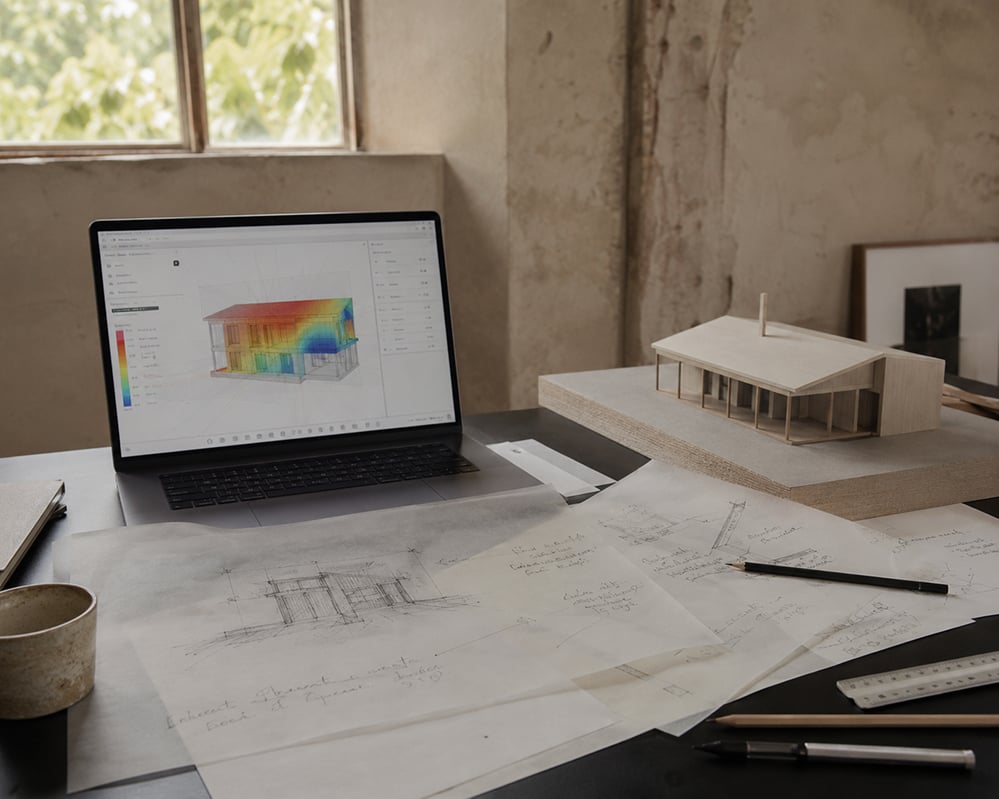
Energy performance modelling on screen alongside hand drawings and a physical scale model in the studio. The tools change. The judgement required to use them well doesn't.
Generative Design
Generative design uses algorithms to explore a solution space defined by parameters the designer sets: spatial requirements, structural constraints, material preferences, energy performance targets, cost limits. The software generates multiple design options within those parameters, far more than a human designer could manually produce, and ranks or filters them against the defined criteria.
The useful thing about this isn't that it replaces design thinking. It's that it expands the range of options tested before a direction is committed to. On a complex massing problem, or a structural optimisation challenge, or a question about how to maximise daylight across a floor plate within planning constraints, generative tools can surface solutions that wouldn't have been reached through conventional iterative design.
The less useful version of this is treating the output as a finished design. Generative tools are good at optimising against quantifiable criteria. They're not good at the judgements that make architecture worth building: spatial quality, material character, the way a building responds to its context, the atmospheric qualities that determine how a space actually feels to inhabit. Those still require human judgement, and they always will.
We use generative approaches selectively, for specific problems where the parameter space is well-defined and the optimisation criteria are clear. We don't use them to generate design directions.
Energy Modelling and Performance Simulation
This is where computational tools, including increasingly AI-assisted ones, are most directly relevant to the way we work at RISE.
Energy modelling software allows us to test a building's thermal performance before it's built: to understand how heat moves through the fabric, where the losses are, how different glazing configurations affect daylight and solar gain, what the effect of shading devices will be across the year. We use the Passivhaus Planning Package for this on projects where we're targeting meaningful energy performance, and the results directly shape design decisions at concept stage rather than being a compliance check at the end.
AI is beginning to accelerate parts of this process. Machine learning tools trained on large datasets of building performance outcomes can provide faster initial performance estimates, which is useful in early-stage option testing where the full modelling workflow is too slow for the pace of design development. They're less reliable for detailed technical analysis, where the specificity of the building's geometry, materials, and construction matters too much for generalised models to handle accurately.
The bigger shift here isn't AI specifically. It's the broader integration of performance analysis into the design process from the outset rather than treating it as a separate technical exercise that happens after the design decisions have already been made. AI tools accelerate that integration. The underlying methodology is what matters.
Construction Site Monitoring
Sensors, cameras, drones, and increasingly computer vision are being used on construction sites to monitor progress, identify clashes between different trades, detect safety issues, and provide project managers with real-time data about what's actually happening on site versus what the programme says should be happening.
On large, complex construction projects this is genuinely valuable. The gap between programme and reality on major construction projects is a persistent and expensive problem, and tools that make that gap visible earlier, rather than when it's already caused delays and cost overruns, have obvious utility.
For the residential and community projects we work on at RISE, the scale doesn't yet justify the infrastructure investment these tools require. But the underlying principle, that better real-time information about construction progress improves decision-making and reduces the cost of problems, is one we apply through conventional means: regular site visits, systematic inspection reports, and a continuous record of instructions and decisions that maintains clarity about what was agreed and when.
Operation and Maintenance
Buildings fitted with smart sensors and connected systems can feed performance data back in ways that weren't possible with conventional construction. Occupancy patterns, energy consumption, air quality, temperature distribution, equipment performance: all of this can be monitored continuously and used to optimise how the building operates.
For the buildings we design, the most relevant application is post-occupancy monitoring of energy performance. There is a well-documented gap between the energy performance modelled at design stage and the performance achieved in use. Understanding that gap, through measured data rather than assumed outcomes, is essential for improving the reliability of design predictions and for demonstrating to clients that the performance claims made at design stage are borne out in practice.
This is also where the relationship between AI and sustainable design becomes most tangible. A building that generates and responds to data about its own performance can be operated more efficiently than one that runs on fixed settings regardless of actual conditions. The potential for ongoing energy savings, without any change to the building's fabric, is real.
Where AI Doesn't Help
It's worth being direct about what AI currently can't do in architecture.
It can't make good design judgements. The qualities that make architecture worth building, spatial intelligence, material honesty, contextual sensitivity, the capacity to produce a building that people feel genuinely well in, are not reducible to optimisable parameters. They require the kind of integrative human judgement that comes from years of designing, building, and inhabiting spaces.
It can't substitute for construction knowledge. A generative tool that produces a structurally novel form without understanding how it would be built, or at what cost, or whether the contractor exists who could execute it, isn't useful. Architecture requires a continuous feedback loop between design ambition and construction reality that AI tools currently don't maintain.
It can't replace the architect-client relationship. The most important conversations in any project are the ones about what a client actually needs, as distinct from what they initially ask for. Those conversations require listening, experience, and judgement. They're not a data processing problem.
How We Think About It at RISE
We use computational tools throughout our work: energy modelling, BIM, structural analysis, daylight simulation. These aren't AI in the current sense of the term, but they're the digital infrastructure on which more sophisticated tools are building.
We're interested in AI applications that make performance analysis faster and more accessible at early design stages, that improve the reliability of post-occupancy monitoring, and that help identify coordination problems in complex construction packages before they become site problems.
We're sceptical of AI applications that position the tool as the designer, or that treat the architectural challenge as primarily a data optimisation problem. The buildings we most admire weren't produced by optimisation algorithms. They were produced by people who understood their sites deeply, listened carefully to their clients, and made thousands of well-judged decisions across the full span of a project.
AI will change how some of those decisions are informed and supported. It won't change what they fundamentally require.
If you're planning a project and want to understand how we integrate technology and design thinking, we're glad to have that conversation.
→ Email us at architects@risedesignstudio.co.uk
→ Or call the studio on 020 3947 5886
RISE Design Studio, Architects, Interior Designers + Sustainability Experts
☉ Architecture for people and planet
☉ Trading since 2011
☉ Company reg no: 08129708
☉ VAT no: GB158316403

Share this
- Sustainable architecture (168)
- Architecture (149)
- Passivhaus (80)
- Sustainable Design (69)
- Design (66)
- Retrofit (61)
- New build (52)
- London (51)
- Renovation (43)
- low energy home (41)
- energy (38)
- interior design (38)
- Building materials (35)
- Planning (34)
- enerphit (34)
- Environment (30)
- climate-change (29)
- Inspirational architects (27)
- Refurbishment (27)
- extensions (27)
- RISE Design Studio (23)
- Building elements (22)
- London Architecture (22)
- Planning permission (22)
- Inspiration (21)
- Residential architecture (20)
- Sustainable Architect (18)
- Low Energy Homes (16)
- Rise Projects (16)
- Sustainable Architecture London (16)
- Embodied Carbon (14)
- Extension (14)
- Innovative Architecture (14)
- net zero (14)
- Carbon Zero Homes (13)
- sustainable materials (13)
- General (12)
- Philosophy (12)
- RIBA (11)
- Working with an architect (11)
- Airtightness (10)
- Awards (9)
- Community Architecture (9)
- Sustainable (9)
- Sustainable Tennis Pavilion (9)
- Tennis Pavilion (9)
- architects (9)
- BIM (8)
- Fabric First Design (8)
- Overheating (8)
- architect (8)
- low carbon (8)
- Biophilic Design (7)
- Deep Retrofit (7)
- Eenergy efficiency (7)
- Low-Energy Design (7)
- Sustainable Natural Materials (7)
- Timber Structures (7)
- Virtual Reality (7)
- natural materials (7)
- AECB CarbonLite (6)
- Adaptive reuse (6)
- Backland Development (6)
- EnerPHit London (6)
- London Architects (6)
- Low Energy Architecture (6)
- Passive house (6)
- Sports Architecture (6)
- Sustainable Housing (6)
- Sustainable Housing London (6)
- Architectural design process (5)
- BIMx (5)
- Basement Extensions (5)
- Carbon Positive Buildings (5)
- Costs (5)
- Kensal Rise (5)
- Low-Energy Buildings (5)
- Notting Hill Architects (5)
- Passivhaus Design (5)
- Permitted development (5)
- Queen's Park Sustainable Architect (5)
- RISE Sketchbook Chronicles (5)
- Sports Pavilion Design (5)
- Uncategorized (5)
- cinema design (5)
- circular economy (5)
- construction (5)
- insulation (5)
- local materials (5)
- modular architecture (5)
- mvhr (5)
- rammed earth (5)
- sustainable building (5)
- sustainable home design (5)
- tennis clubhouse design (5)
- AECB (4)
- ARB (4)
- Architect Fees UK (4)
- CLT (4)
- EnerPHit Retrofit (4)
- Feasibility Study (4)
- Heritage Retrofit (4)
- Home extensions (4)
- House cost (4)
- Low Energy New Build (4)
- Mass Timber (4)
- Natural ventilation (4)
- Padel Court (4)
- Padel court design (4)
- Paragraph 84 (4)
- Passive Design (4)
- Passive cooling (4)
- Sutton Churches Tennis Club (4)
- backland (4)
- building information modelling (4)
- building regulations (4)
- concrete (4)
- constructioncosts (4)
- country house (4)
- listed buildings (4)
- natural materials architecture (4)
- rear extension (4)
- self build (4)
- stoke newington (4)
- structural (4)
- structuralengineer (4)
- working from home (4)
- Artificial Intelligence (AI) (3)
- Barcelona architects (3)
- Brutalist Architecture (3)
- Building in the Green Belt (3)
- Chartered architect (3)
- Choosing an architect (3)
- Clay Plaster (3)
- Conservation area (3)
- Construction Costs (3)
- Contemporary Architecture (3)
- Fees (3)
- Garden plot development (3)
- Heat Pumps (3)
- Home Renovation (3)
- Home extension London (3)
- Home improvement (3)
- London Architect (3)
- Mews House Retrofit (3)
- New Build House (3)
- North London Architects (3)
- Paragraph 79 (3)
- Paragraph 80 (3)
- Passivhaus Architects London (3)
- Property (3)
- Queen's Park (3)
- Rainwater harvesting (3)
- Regenerative Architecture (3)
- Social housing (3)
- Spain (3)
- Sustainable Architect London (3)
- Sustainable Extensions (3)
- Sustainable Interiors (3)
- Sustainable Padel Court (3)
- Sustainable Retrofit (3)
- Timber Construction (3)
- Victorian house extension (3)
- West London Architect (3)
- Whole Life Carbon (3)
- countryside (3)
- furniture (3)
- home extension (3)
- house extension (3)
- infill development (3)
- natural light (3)
- peter zumthor (3)
- plywood (3)
- pre-application advice (3)
- sustainability (3)
- sustainable structure (3)
- victorian terrace (3)
- zero waste (3)
- 3D models (2)
- Airtightness and MVHR (2)
- Archicad (2)
- Architect client relationship (2)
- Architects in Spain (2)
- Architectural Technology (2)
- Architectural process (2)
- Architecture Interior Design (2)
- BREEAM (2)
- Basement extension (2)
- Bespoke lighting (2)
- Bricks (2)
- Brise-soleil (2)
- Building energy (2)
- Building performance (2)
- CLT timber construction (2)
- Chartered Practice (2)
- Climate-resilient design (2)
- Commercial Architecture (2)
- Community building architecture (2)
- Community pavilion (2)
- Conservation Area Architects (2)
- Conservation Areas (2)
- Contractor (2)
- Covid-19 (2)
- Designing with Stone (2)
- Development Feasibility (2)
- Digital Twin (2)
- Domus Nova (2)
- Ecohouse (2)
- Elmwood Lawn Tennis Club (2)
- Fabric First (2)
- Furniture design (2)
- Garden Homes (2)
- Garden studio (2)
- Hackney (2)
- Hampstead Architects (2)
- Heritage (2)
- Heritage Architecture (2)
- Home Retrofit (2)
- Home renovation London (2)
- House Extensions (2)
- House extension London (2)
- INDOI (2)
- Indoor air quality (2)
- Infill housing (2)
- Japanese Archiecture (2)
- Kitchen Design (2)
- Lightwell design (2)
- Listed Building Architects (2)
- Loft conversion (2)
- London Plan (2)
- Low Carbon Future (2)
- Low Carbon Home (2)
- Low embodied carbon (2)
- Low-Carbon Architecture (2)
- Low-energy retrofit (2)
- Material honesty (2)
- Minimalist Design (2)
- Modern House Extension (2)
- Modern Methods of Construction (2)
- Natural Light Architecture (2)
- New Build Architects (2)
- North West London (2)
- Paragraph 84 home (2)
- Passivhaus London (2)
- Pavilion Architecture (2)
- Period Homes (2)
- Period Property Renovation (2)
- Permitted development rights (2)
- Planning strategy (2)
- Poblenou (2)
- Pre-application (2)
- Prefabrication (2)
- Queen's Park architect (2)
- RIBA Plan of Work (2)
- RIBA Plan of Work 2020 (2)
- RIBA Stage 2 (2)
- RIBA work stages (2)
- Reclaimed materials (2)
- Recycling (2)
- Residential Architects London (2)
- Retrofit first (2)
- Roof extension (2)
- Rural New Build (2)
- Scallop House (2)
- Small Site Development (2)
- Social Distancing (2)
- Solar Shading (2)
- Store Design (2)
- Sustainable Affordable Homes (2)
- Sustainable Architect Fees (2)
- Sustainable Architecture Technology (2)
- Sustainable interior design (2)
- Tennis Club Architecture (2)
- Tennis clubhouse (2)
- Urban Infill (2)
- Value Engineering Architecture (2)
- Victorian house retrofit (2)
- Welbeing (2)
- West London architects (2)
- Winter Performance (2)
- architecture visit (2)
- ashp (2)
- backland and small sites (2)
- barcelona (2)
- circular rooflight (2)
- co-working (2)
- countryside architecture (2)
- daylighting (2)
- design&build (2)
- eco home design (2)
- epc (2)
- glazed-extensions (2)
- green architecture (2)
- greenbelt (2)
- hampstead (2)
- health and wellbeing (2)
- historic architecture (2)
- interiorfinishes (2)
- light (2)
- living space (2)
- london landmarks (2)
- londoncinemas (2)
- low-carbon design (2)
- openingupworks (2)
- placemaking (2)
- project management (2)
- renewable energy (2)
- retail interior design (2)
- rural architecture UK (2)
- slow fashion Barcelona (2)
- sustainable architecture Barcelona (2)
- timber architecture (2)
- traditional (2)
- trialpits (2)
- waste (2)
- wooden furniture (2)
- #NLANetZero (1)
- 3D Modelling (1)
- 3D Printing (1)
- 3D Walkthroughs (1)
- AI and Architecture (1)
- AI in Architecture (1)
- ARB registration (1)
- Adam Weismann (1)
- Adaptive Architecture (1)
- Adobe (1)
- Agriculture and Architecture (1)
- Airtight Construction (1)
- Alvar (1)
- Antoni Gaudí (1)
- Appointing an Architect (1)
- Arched glazing (1)
- Architect Barcelona (1)
- Architect cost UK (1)
- Architect vs architectural designer (1)
- Architects Fees UK (1)
- Architectural Concept Design (1)
- Architectural Research (1)
- Architectural Visualisation (1)
- Architectural feasibility (1)
- Architecture Cost Management (1)
- Architecture London (1)
- Architecture Performance Simulation (1)
- Architecture and nature (1)
- Architecture careers (1)
- Architecture explained (1)
- Architecture jobs London (1)
- Architraves (1)
- Area (1)
- Art (1)
- Art and Architecture (1)
- Article 4 direction (1)
- Article 4 directions (1)
- Artorius Faber (1)
- Asland cement factory (1)
- Atmospheric Design (1)
- Audio Visual (1)
- BIM Architecture (1)
- BIM London (1)
- Balconies (1)
- Basement costs London (1)
- Bathurst Mews (1)
- Bayswater (1)
- Berguedà (1)
- Bio-based construction (1)
- Biodiversity (1)
- Biodiversity Net Gain (1)
- Biomimicry (1)
- Biophilic Architecture (1)
- Birmingham Selfridges (1)
- Boat building (1)
- Boats (1)
- Brass (1)
- Breathable buildings (1)
- Breathable walls (1)
- Brent Agents Forum (1)
- Brent Planning (1)
- Brexit (1)
- British stone (1)
- Brixton (1)
- Brownfield Development (1)
- Brutalist London (1)
- Build Costs London (1)
- Builder licensing (1)
- Building Biology (1)
- Building Insulation (1)
- Building Physics (1)
- Building cost certainty (1)
- Building quality (1)
- Building standards (1)
- Buildings Insurance (1)
- CLT and glulam (1)
- CLT construction (1)
- Café Design (1)
- Calm Interiors (1)
- Can Lis (1)
- Cantilevered Roof (1)
- Carpentry (1)
- Castellar de n'Hug (1)
- Casting (1)
- Catalan modernisme (1)
- Catalan vault (1)
- Chailey Brick (1)
- Chapel Restoration (1)
- Chiesa del Gesù Redentore (1)
- Choosing a builder (1)
- Circular construction (1)
- Class E (1)
- Claymoon Studio (1)
- Clayworks (1)
- Climate resilience (1)
- Clot del Moro (1)
- Clubhouse design (1)
- Cold Water Swimming (1)
- Community (1)
- Community Kitchen (1)
- Community and place (1)
- Community sports facilities (1)
- Community-Led Design (1)
- Compact city design (1)
- Computational Design (1)
- Concept sketch (1)
- Concrete Architecture (1)
- Conservation Architecture (1)
- Conservation and sustainability (1)
- Conservation area extension (1)
- Construction Cost Management (1)
- Construction risk management (1)
- Construction standards (1)
- Consumer protection (1)
- Contemporary Architecture Hampstead (1)
- Contemporary Extensions (1)
- Contract administration (1)
- Copper (1)
- Cornices (1)
- Corten (1)
- Cost plan (1)
- Courtyard Housing London (1)
- Cowboy Builders (1)
- Cross ventilation (1)
- Crouch End (1)
- Cultural Architecture (1)
- Custom Build (1)
- Czech Republic, (1)
- Data Centers (1)
- David Hockney (1)
- David Lea (1)
- Daylight Design (1)
- Density and sprawl (1)
- Developed Design (1)
- Digital Twin Architecture (1)
- Digital Twin Construction (1)
- Dormer extension (1)
- Douglas House (1)
- Douglas fir (1)
- EPC Rating (1)
- Early-stage design (1)
- Eco home (1)
- Employer's Liability (1)
- Energy Efficient Home (1)
- Energy Modelling (1)
- Energy Modelling Architecture (1)
- Energy Performance (1)
- Energy-efficient homes (1)
- English speaking architect Barcelona (1)
- EnvironmentalArchitecture (1)
- Eusebi Güell (1)
- Extension costs (1)
- External shading (1)
- Federation of Master Builders (1)
- Flood risk and drainage (1)
- Flooding (1)
- Founding a practice (1)
- Four Peaks Pavilion (1)
- Future of Housing (1)
- Gallery Design (1)
- Gandhi memorial museum (1)
- Garden Development (1)
- Garden extension (1)
- Garden office (1)
- Generative Design (1)
- Georgian Extension (1)
- Georgian Homes (1)
- Georgian House Extensions (1)
- Georgian Renovation (1)
- Glulam structure (1)
- Green Mortgage (1)
- Green Register (1)
- Green infrastructure (1)
- Green roof (1)
- GreenDesign (1)
- Greenbelt and brownfield (1)
- Grey belt (1)
- Guarino Guarini (1)
- Healthy cities (1)
- Healthy homes (1)
- Healthy interiors (1)
- Hempcrete (1)
- Herbert Paradise (1)
- High End Architecture London (1)
- History (1)
- Home office design (1)
- Homeowner Guide (1)
- House Extension Architect (1)
- House renovation (1)
- Housing Development (1)
- Hyde Park (1)
- INDOI Ghar (1)
- India (1)
- Insurance (1)
- Interior Architecture London (1)
- Interior Finishes (1)
- Interior atmosphere (1)
- Internal Wall Insulation (1)
- Italian modernism (1)
- JCT Contract (1)
- Jan Kaplický (1)
- Japandi (1)
- Japandi Design (1)
- Japanese Design (1)
- Joinery (1)
- Jørn Utzon (1)
- Kensal Green architects (1)
- Kensal Rise Architects (1)
- Kensington and Chelsea (1)
- Kilburn (1)
- King's Road (1)
- Kitchen colour schemes (1)
- L-shaped dormer (1)
- La Pobla de Lillet (1)
- Land remediation (1)
- Land value (1)
- Lawful Development Certificate (1)
- Leonardo Da Vinci (1)
- Leonardo Mosso (1)
- Lime plaster (1)
- Lime render (1)
- London Renovation Costs (1)
- London and Surrey housing (1)
- London extension (1)
- London residential architect (1)
- Lord's Media Centre (1)
- Low Carbon Housing UK (1)
- Low Embodied Carbon Housing (1)
- Low Energy Building (1)
- Low carbon construction (1)
- Low-carbon materials (1)
- Low-impact living (1)
- MMC (1)
- MVHR and heat pumps (1)
- Maida Vale (1)
- Mallorca architecture (1)
- Mapping (1)
- Marseilles (1)
- Mary Portas (1)
- Material Culture (1)
- Material reuse (1)
- Matiz Gallery (1)
- Mechanical ventilation heat recovery (1)
- Mediterranean architecture (1)
- Metal (1)
- Micro Generation (1)
- Microcement finishes (1)
- Mid Century Retrofit (1)
- Mirafiori Nord (1)
- Modular construction (1)
- Monuments (1)
- Mouldings (1)
- Museu del Ciment (1)
- Museum Architecture (1)
- Museum Design (1)
- Mycelium Architecture (1)
- NPPF (1)
- NW6 (1)
- Natural building materials (1)
- Natural light in architecture (1)
- Natural stone (1)
- Nature (1)
- Nature-Led Design (1)
- Net Zero Architecture (1)
- New Build Costs UK (1)
- New Build House UK (1)
- New build fees (1)
- New build home (1)
- Nicola Mosso (1)
- North London (1)
- Northwest London architects (1)
- Notting Hill architecture (1)
- Office to Homes (1)
- Office to Hotel Conversion (1)
- Offsite manufacturing (1)
- One Kilburn (1)
- Open water swimming (1)
- Open-plan kitchen design (1)
- Origami (1)
- Outbuildings (1)
- PHPP modelling (1)
- Paddington Old Cemetery (1)
- Part L Building Regulations (1)
- Party Wall Surveyor (1)
- Party wall (1)
- Passivhaus Designer (1)
- Passivhaus Housing (1)
- Passivhaus New Build (1)
- Passivhaus Spain (1)
- Passivhaus ethos (1)
- Passivhaus retrofit (1)
- Passivhaus ventilation (1)
- Pedestrian-first streets (1)
- PeopleFirstDesign (1)
- Place (1)
- Plan of Work stages (1)
- Planning appeal (1)
- Planning feasibility (1)
- Podcast (1)
- Porch (1)
- Prefab (1)
- Previously developed land (1)
- Pro bono (1)
- Procurement (1)
- Professional Indemnity (1)
- Professional indemnity insurance (1)
- Project Architect (1)
- Project stages (1)
- Public Buildings (1)
- Public Housing (1)
- Public Housing Architecture (1)
- Public land development (1)
- QPK at the Chapels (1)
- Quantity Surveyor Architecture (1)
- RBKC architects (1)
- RBKC planning (1)
- RIBA Chartered Practice (1)
- RIBA Part 3 (1)
- RIBA Stage 3 (1)
- RIBA architect (1)
- RIBA stages (1)
- RISE Insight (1)
- RISE Team (1)
- Rafael Guastavino (1)
- Rebuild (1)
- Reclaimed Brick Architecture (1)
- Reclaimed stone (1)
- Red Arches House (1)
- Regent's Park (1)
- Renovation Advice (1)
- Renovation Budget London (1)
- Replacement Dwelling (1)
- ResilientFuture (1)
- Retrofit Architecture (1)
- Retrofit London (1)
- Retrofit vs rebuild (1)
- Ribbon House (1)
- Richard Rogers (1)
- Rogue builders (1)
- SIPs Construction (1)
- SIPs vs Timber Frame (1)
- SPD design guide (1)
- Sand (1)
- Scandinavian Design (1)
- Scandinavian architecture (1)
- Self Build Architecture (1)
- Selfbuild (1)
- Serpentine Lake (1)
- Site analysis (1)
- Site appraisal (1)
- Skirting (1)
- Slow Architecture (1)
- Small Sites Development (1)
- Small sites (1)
- Small-scale housing (1)
- Solar gain (1)
- Solid Wall Insulation (1)
- Spatial Coordination (1)
- Spectator design (1)
- Sports pavilion (1)
- Squire & Partners (1)
- Standing-seam zinc roof (1)
- Steel (1)
- Stone Architecture (1)
- Structural Insulated Panels (1)
- Surveying (1)
- Sustainability strategy (1)
- Sustainable Basement Extension (1)
- Sustainable Building Systems (1)
- Sustainable Lighting (1)
- Sustainable Mews House (1)
- Sustainable Retail Store (1)
- Sustainable architecture jobs (1)
- Sustainable basement (1)
- Sustainable community architecture (1)
- Sustainable urbanism (1)
- Sutton architecture (1)
- Sverre fehn (1)
- Swiss architecture (1)
- Terrazzo islands (1)
- The Department Store (1)
- The Green Register (1)
- The London Society (1)
- Thermal comfort (1)
- Therme Vals (1)
- Timber Frame Construction (1)
- Timber and hemp construction (1)
- Trellick Tower (1)
- Trust in architecture (1)
- Turin architecture (1)
- Two-tone kitchens (1)
- UFH (1)
- Underground extension (1)
- Unfired Clay (1)
- Urban density (1)
- Urban design (1)
- Urban heat island (1)
- Urban regeneration (1)
- VR (1)
- Vernacular Construction (1)
- Victorian Extension (1)
- Victorian townhouse retrofit (1)
- Walkable Cities (1)
- Walkable neighbourhoods (1)
- Water efficiency (1)
- Waterproofing and tanking (1)
- Wellbeing and design (1)
- West london (1)
- White-card model (1)
- Wildlife (1)
- Winston Road N16 (1)
- Wood (1)
- Xalet del Catllaràs (1)
- accessible design (1)
- advertisement consent (1)
- architect Kensington Chelsea (1)
- architect cost Spain (1)
- architect fees (1)
- architect fees Barcelona (1)
- architectural details (1)
- arne jacobsen (1)
- avant garde (1)
- basements (1)
- biophilic design London (1)
- brentdesignawards (1)
- building conservation (1)
- building design (1)
- building restoration (1)
- built environment (1)
- built-in furniture (1)
- carbon sink (1)
- carbonpositive (1)
- catenary arch (1)
- cement (1)
- charles correa (1)
- charles eames (1)
- charlie warde (1)
- charteredarchitect (1)
- climate (1)
- climate action (1)
- codes of practice (1)
- collaboration (1)
- concrete vault (1)
- contemporary country house (1)
- contract works insurance (1)
- courtyard house (1)
- covid (1)
- coworking design (1)
- curved architecture (1)
- deep window reveals (1)
- dezeenawards (1)
- drone (1)
- eco-living (1)
- emissions (1)
- expat renovation Spain (1)
- exposed brick (1)
- extension budget (1)
- finnish architecture (1)
- foundations (1)
- futuristic (1)
- georgian architecture (1)
- glazed envelope (1)
- good working relationships (1)
- green building (1)
- happiness (1)
- home renovation costs (1)
- homesurveys (1)
- house extension cost (1)
- illuminated signage (1)
- imperfection (1)
- independentcinemas (1)
- industrial heritage (1)
- innovation (1)
- inspirational (1)
- internal windows (1)
- jean prouve (1)
- kindness economy (1)
- kintsugi (1)
- kitchen extension (1)
- kitchen extension Notting Hill (1)
- landscape architecture (1)
- lime (1)
- limewash (1)
- local (1)
- lockdown (1)
- london planning (1)
- mansard (1)
- manufacturing (1)
- marés sandstone (1)
- materiality (1)
- modern architecture (1)
- moderninst (1)
- modernism (1)
- modular architect London (1)
- moulded furniture (1)
- natural (1)
- natural cooling (1)
- natural light in homes (1)
- new build Barcelona (1)
- new build architect Sussex (1)
- new build house Spain (1)
- nordic pavilion (1)
- northern ireland (1)
- organic cotton (1)
- palazzo (1)
- passive ventilation (1)
- planning permission Chelsea (1)
- planningpermission (1)
- plywood kitchen (1)
- post-Covid (1)
- poverty (1)
- powerhouse (1)
- preapp (1)
- preapplication (1)
- property owners liability (1)
- rammed earth house (1)
- ray eames (1)
- reclaimed bricks (1)
- recycle (1)
- regenerative cotton (1)
- renovation Barcelona (1)
- reuse (1)
- ricardo bofill (1)
- risedesignstudio (1)
- rooflights (1)
- room reconfiguration (1)
- rural (1)
- satellite imagery (1)
- selfbuildhouse (1)
- shared spaces (1)
- shop fit-out Barcelona (1)
- side return extension (1)
- site-progress (1)
- solarpvs (1)
- space (1)
- stack effect (1)
- stack ventilation (1)
- stone (1)
- structuralsurvey (1)
- sun tunnel (1)
- sustainable clothing (1)
- sustainable men's clothing (1)
- sustainable retail design (1)
- sustainable women's clothing (1)
- terraces (1)
- thegreenregister (1)
- thermal mass (1)
- totality (1)
- wabi-sabi (1)
- September 2026 (7)
- July 2026 (2)
- June 2026 (5)
- May 2026 (7)
- April 2026 (2)
- March 2026 (8)
- February 2026 (7)
- January 2026 (4)
- December 2025 (10)
- November 2025 (14)
- October 2025 (9)
- September 2025 (10)
- August 2025 (13)
- July 2025 (23)
- June 2025 (10)
- May 2025 (22)
- April 2025 (16)
- March 2025 (8)
- February 2025 (12)
- January 2025 (6)
- December 2024 (6)
- November 2024 (7)
- October 2024 (5)
- September 2024 (3)
- August 2024 (2)
- July 2024 (2)
- June 2024 (2)
- May 2024 (1)
- April 2024 (1)
- March 2024 (1)
- February 2024 (1)
- January 2024 (3)
- November 2023 (1)
- October 2023 (5)
- September 2023 (7)
- August 2023 (7)
- July 2023 (6)
- June 2023 (8)
- May 2023 (14)
- April 2023 (11)
- March 2023 (8)
- February 2023 (6)
- January 2023 (5)
- December 2022 (3)
- November 2022 (3)
- October 2022 (3)
- September 2022 (3)
- July 2022 (2)
- June 2022 (1)
- May 2022 (1)
- April 2022 (1)
- March 2022 (1)
- February 2022 (2)
- January 2022 (1)
- November 2021 (1)
- October 2021 (2)
- July 2021 (1)
- June 2021 (1)
- May 2021 (1)
- April 2021 (1)
- March 2021 (1)
- February 2021 (1)
- January 2021 (2)
- December 2020 (1)
- November 2020 (1)
- October 2020 (1)
- September 2020 (2)
- August 2020 (1)
- June 2020 (3)
- April 2020 (3)
- March 2020 (2)
- February 2020 (3)
- January 2020 (1)
- December 2019 (1)
- November 2019 (2)
- September 2019 (1)
- June 2019 (1)
- April 2019 (2)
- January 2019 (2)
- October 2018 (1)
- September 2018 (1)
- August 2018 (2)
- July 2018 (1)
- March 2018 (1)
- February 2018 (2)
- December 2017 (1)
- September 2017 (1)
- May 2017 (1)
- January 2017 (1)
- December 2016 (1)
- November 2016 (1)
- September 2016 (1)
- August 2016 (2)
- June 2016 (2)
- May 2016 (1)
- April 2016 (1)
- December 2015 (1)
- October 2015 (1)
- September 2015 (1)
- August 2015 (1)
- June 2015 (1)
- January 2015 (1)
- September 2014 (2)
- August 2014 (1)
- July 2014 (4)
- June 2014 (9)
- May 2014 (2)
- April 2014 (1)
- March 2014 (1)
- February 2014 (1)
- December 2013 (1)
- November 2013 (5)
- October 2013 (5)
- September 2013 (5)
- August 2013 (5)
- July 2013 (5)
- June 2013 (2)
- May 2013 (2)
- April 2013 (4)
- March 2013 (5)
- February 2013 (2)
- January 2013 (3)