
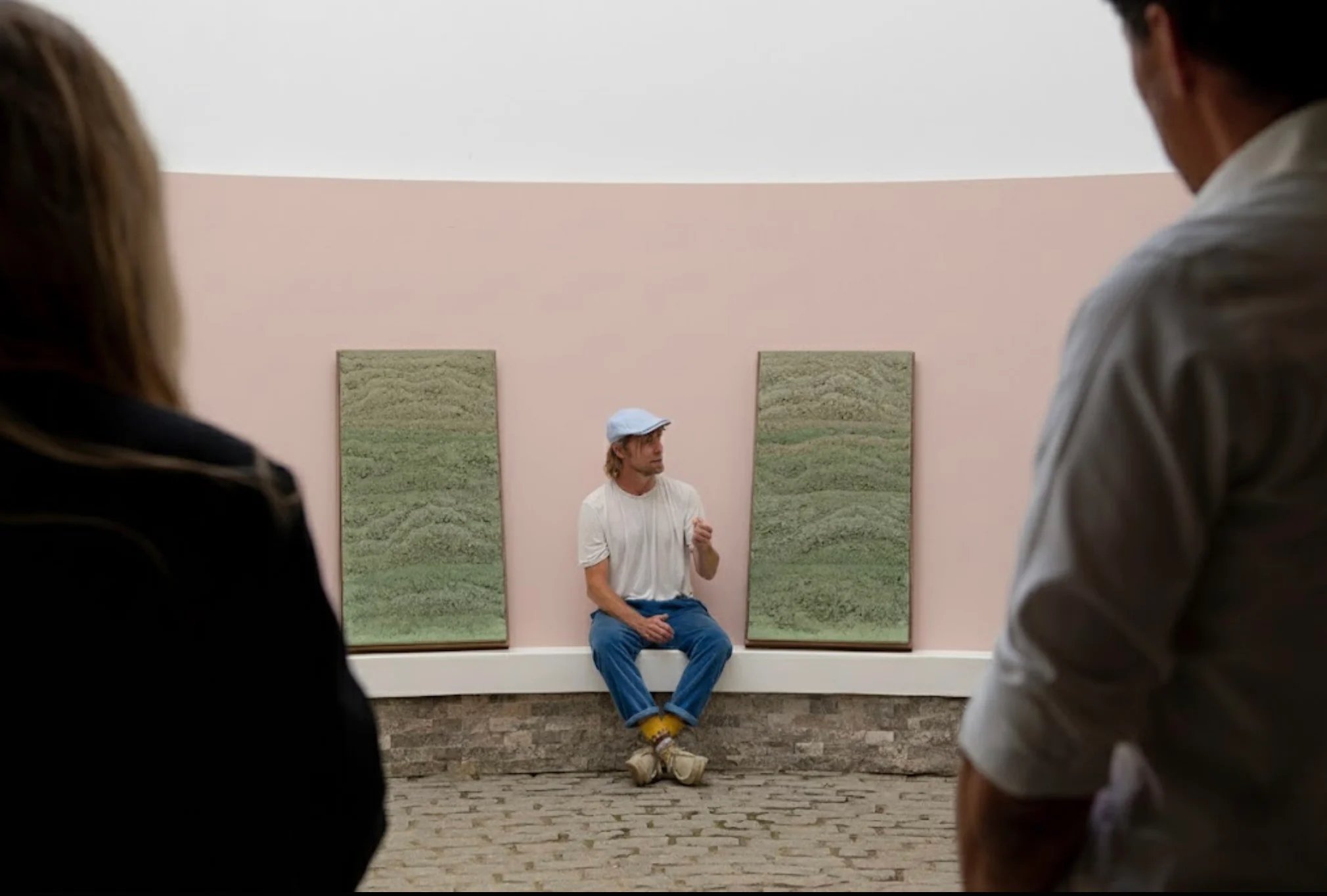
Adam Weismann of Clayworks during a Claymoon Studio presentation, working with earth pigments, clay and natural fibres. RISE Design Studio.
Sean: Adam, it's good to be speaking with you. We've admired Clayworks for a long time, and Birch & Clay Refugio, Douglas House and Herbert Paradise wouldn't be what they are without your plasters. To start, what led you and Katy to clay in the first place?
Adam: Thanks, Sean. It's always a joy to connect with architects who really get what we're about. The path started over two decades ago in the Pacific Northwest. Katy, my wife, and I were learning natural building, cob, straw bale, earth plasters, and we saw just how powerful these traditional materials could be. When we came back to the UK, we started restoring old cottages in Cornwall. That's where Clayworks was born: out of a desire to bring clay into contemporary buildings in a way that felt relevant and modern.
Sean: What drew us to Clayworks for Birch & Clay Refugio was that the walls needed to do more than enclose the space. We wanted texture, breathability and a kind of stillness, and the clay gave us all of it. Visitors often ask what the walls are made of, because they seem to invite touch. How intentional is that tactile quality in your process?
Adam: It's hugely intentional. Clay has a depth and softness that synthetic materials simply can't replicate. When we design our finishes, we're trying to evoke nature, the randomness of sediment, the quiet movement of a tide retreating. And because clay is hygroscopic, it breathes with the building. It moderates humidity, absorbs toxins, and actually improves indoor air quality. It's not just decoration, it's a living surface.
Sean: We felt that living quality again on Herbert Paradise, a deep retrofit of a 1950s house done to EnerPHit principles. We used your plasters in the bedrooms and circulation spaces, where they support the low-energy design. The internal climate feels more stable, less dry in winter and less clammy in summer. The plaster is part of how the building performs, not just how it looks.
Adam: That's exactly the shift we hope to encourage: materials that are not just beautiful, but that work with the building and the people inside it. It's part of a new architecture, one where the materials have agency.
Sean: On Douglas House, a home for a family with chemical sensitivities, we needed finishes with no off-gassing at all, so Clayworks was a natural choice. Knowing their children were sleeping in rooms without hidden toxins mattered a great deal to the clients. I think a lot of people still don't realise how compromised indoor air can be.
Adam: It's a big issue. We spend 90% of our lives indoors, and yet most walls are sealed with petrochemical-based products. Clayworks plasters contain no VOCs, no cement, and we publish third-party sustainability data to back that up. But it's not just about health, it's also about how a space feels. Our surfaces age beautifully, and patina is part of the story.
Sean: You've also made clay into something that speaks to contemporary design. On some newer projects we're exploring pigmented surfaces and custom textures, and there's an elegance to what you offer that doesn't shout "rustic" unless you want it to.
Adam: That's been a key focus, bridging traditional materials with modern interiors. We work with architects and designers on everything from ultra-minimal to wabi-sabi. Clay is infinitely versatile, if you understand it.
Sean: One of the most striking applications we've seen is your personal work through Claymoon Studio. Can you talk about the crossover between architectural plaster and your art practice?
Adam: Sure, Claymoon is where I allow the material to guide me, rather than the other way around. It's deeply meditative. I work with earth pigments, clay, charred wood, ancient stones, natural fibres, and light. It started as a response to the Skyspace installations by James Turrell, spaces that shift your perception and awareness. The goal with Claymoon is similar: to slow people down and draw them into the material's essence.
Sean: Clay used well supports something we care about, which is how a material feels to live with, not just how it photographs. You touch it, you live with it, it grounds you. From a sustainability point of view it lines up with how we work: low embodied carbon, recyclable, biodegradable. And we're seeing more clients actively ask for healthier materials now.
Adam: That's the tipping point we've been waiting for. Once people experience a clay interior, it's hard to go back to painted drywall. We're not offering a trend. We're offering timelessness, rooted in nature.
Sean: It's been a pleasure, Adam. Thank you for helping make our projects feel better as well as look better.
Adam: Thank you, Sean, and thank you for using the material with such care and vision. You're helping people experience it in its best light.
Why we keep coming back to clay
Clay does several useful things at once. It's breathable, so it helps regulate humidity and keeps an internal climate stable through the year. It contains no VOCs and no cement, so it doesn't off-gas into the rooms people sleep in. It has low embodied carbon and is recyclable and biodegradable at the end of its life. And it ages well, which most synthetic finishes don't. For a fabric-first, low-energy approach, that combination of health, performance and longevity is hard to beat.
If you're thinking about a low-energy home built with natural materials, we'd be glad to talk it through.