
Share this
Rewriting the Future of New Homes: What Whole Life Carbon Is Really Telling Us
by Sean Hill on Nov 20, 2025
Every few years, a piece of research lands that quietly resets the direction of an entire industry. The latest benchmarking study on embodied and whole life carbon in UK new homes does exactly that. It offers something we rarely see in housebuilding: grounded, comparable, sector-wide data. Not theory. Not ambition. Actual evidence.
At RISE Design Studio, we see studies like this as more than academic exercises. They are mirrors. They show us where the homebuilding sector is standing today, and where those of us committed to low-carbon, human-centred design need to move next.
This blog distils the lessons we believe matter most for clients, developers, architects and the communities who will live with the decisions we make.
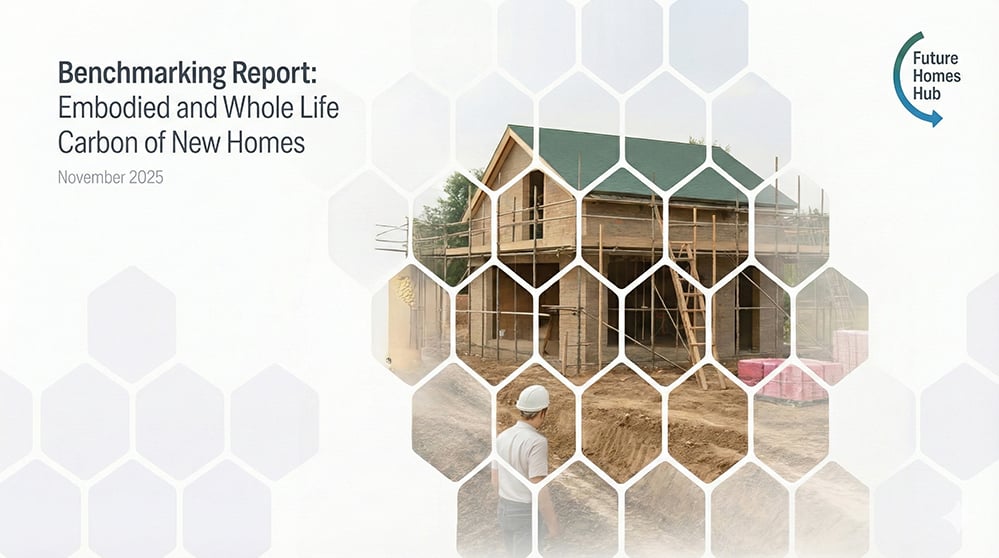
Construction in progress on a sustainable home, highlighting how early material choices shape the lifetime carbon story of every new build.
The Unseen Carbon in Every New Home
Before a single light switches on, every home already carries a heavy carbon legacy. Materials hold memories: minerals extracted, timber processed, steel forged, concrete cured. In the study, around three quarters of all upfront carbon comes simply from bringing these materials into existence.
This aligns with what we see across our own projects. A meticulously designed building envelope often outperforms complex systems later bolted on. When we focus early on the carbon cost of structure, substructure and envelope, we can influence the one thing clients can’t change later → the building’s starting footprint.
The report showed that for most low-rise homes, upfront embodied carbon tends to fall within a surprisingly tight band. This isn’t a limitation. It’s an opportunity. It tells us where the true levers are.
Timber and the Power of Choosing Differently
When the study filtered out everything except the fabric of the building, one insight was impossible to ignore: timber frame construction consistently performed better than masonry in both upfront and whole life terms.
The difference wasn’t dramatic, but it was meaningful. In carbon accounting, every kilogram saved is exponential when multiplied across an entire development.
At RISE, we’ve long believed that natural, renewable materials do more than express a design philosophy. They fundamentally shift the carbon business model of a home. Timber, cork, clay, hempcrete → these materials work for us, not against us. They carry stored carbon, improve wellbeing, and reduce the need for energy-hungry finishes.
This research strengthens something we already know: material choices are not aesthetic decisions alone. They are climate decisions.
The Silent Giant: MEP Carbon Over Time
Most people assume the structure is the biggest driver of long-term impact. The report challenges that assumption.
Once materials are installed, the systems inside the home take over. Heating, plumbing, ventilation, electrical components, finishes → these become the recurring carbon costs. Unlike foundations, they don’t last 60 years. They’re replaced, upgraded, repaired.
According to the study, these systems and finishes take up a much larger share of whole life carbon than upfront numbers suggest.
This is why at RISE we advocate a fabric-first mindset. If a home relies on oversized or overly complex systems to feel comfortable, it’s a sign the architecture isn’t doing enough of the heavy lifting.
A well-designed passive building uses systems sparingly and meaningfully. It doesn’t need to fight its own physics.
Heat Pumps, Gas and the Carbon Paradox
A fascinating tension appears when comparing heating systems. Heat pumps carry slightly higher embodied carbon over 60 years due to refrigerant leakage. But when operational energy is modelled over the same period, they dramatically outshine gas.
The study showed that homes using heat pumps created far lower operational carbon across their lifetime. That gap matters. It’s the operational side of the ledger that accumulates, year after year.
For a homeowner, this is more than a sustainability choice. It’s a resilience choice. As the grid continues to decarbonise, homes designed today will only grow cleaner in operation.
This aligns closely with the future we are designing for: homes that get better with time, not worse.
What We Measure Shapes What We Build
One of the most telling insights wasn’t about carbon at all, but about information.
The report highlighted big differences between assessment tools, largely driven by the proportion of product-specific environmental product declarations (EPDs) used. Projects with richer, more transparent data tended to produce more reliable, and often lower, carbon results.
In other words: uncertainty is a form of carbon.
At RISE, we rely heavily on verified material data because it sharpens the design conversation. When you see the numerical difference between a generic product and a natural or low-carbon alternative, priorities shift. Decision-making becomes clearer.
We believe the industry is moving toward a future where full EPD coverage is not optional. It will be expected. And it will be transformative.
Operational Carbon: The Long Horizon
Over a 60-year life, the operational side of the ledger becomes unavoidable. Energy use intensity varied in the study, but the direction was unmistakable. Homes that combine low-carbon materials, heat pumps and strong passive design principles outperform others significantly over time.
Every building leaves two shadows:
→ What it takes from the planet the day it is built
← What it demands from the planet every day it is lived in
A good architect tries to shorten both.
The Opportunity Ahead: A New Benchmark Culture
The study signals something deeper than data. It signals the emergence of a benchmark culture in British housebuilding. A culture where comparisons are possible, improvements are traceable, and innovation can be measured rather than assumed.
For practices like ours, it encourages a new question for every project:
How do we design a home whose carbon story earns its place in the future?
This is not about compliance. It is about leadership.
What This Means for Clients and Developers
Based on the insights, the next generation of homes will be shaped by a few unavoidable truths:
-
Materials matter early, deeply and permanently
-
Timber and bio-based options are powerful tools
-
MEP carbon is a long-term cost that must be designed down, not compensated for
-
Heat pumps are a long-term win despite small embodied penalties
-
Better data leads to better decisions
-
Whole life thinking must replace short-term thinking
Homes built today must make sense not just for the next handover meeting, but for the next half century.
A Final Thought: Architecture as Legacy
Every project we take on at RISE begins with a simple belief: architecture is a form of leadership. The spaces we design are not static objects. They are long-term citizens of the cities, towns and landscapes they inhabit.
The latest carbon benchmarks offer a rare moment of clarity about the responsibilities we hold. If we embrace the lessons now, we can shape a new era of British housing: low-energy, low-carbon, future-proofed and rooted in thoughtful, purposeful design.
This is not just a technical challenge. It is a cultural one.
And it starts with the decisions we make today.
Building homes that earn their place in the future
At RISE, we see whole life carbon as more than a metric. It is a way of asking better questions about every brick, every beam, every kilowatt hour. A low-carbon home is not just efficient on paper. It is a place that feels good to live in, uses less, wastes less and quietly respects the landscape it sits in.
Designing with whole life carbon in mind means creating homes that stand as evidence of what is possible now - not someday. Homes that are light on the planet, generous to the people who inhabit them, and robust enough to serve the next generation.
Exploring a new build or development and want to understand its true carbon story?
Let’s talk about how your project could cut carbon, raise quality and leave a positive legacy.
→ Email us at architects@risedesignstudio.co.uk
→ Or call the studio on 020 3947 5886
RISE Design Studio, Architects, Interior Designers + Sustainability Experts
☉ Architecture for people and planet
☉ Trading since 2011
☉ Company reg no: 08129708
☉ VAT no: GB158316403

Share this
- Architecture (151)
- Sustainable architecture (149)
- Passivhaus (68)
- Design (67)
- Sustainable Design (65)
- Retrofit (59)
- London (51)
- New build (51)
- Renovation (43)
- energy (39)
- interior design (37)
- Building materials (34)
- Planning (33)
- Environment (31)
- climate-change (30)
- Inspirational architects (27)
- Refurbishment (27)
- enerphit (27)
- extensions (27)
- Building elements (22)
- Inspiration (21)
- Rise Projects (16)
- Extension (15)
- Innovative Architecture (14)
- net zero (14)
- Carbon Zero Homes (13)
- London Architecture (13)
- General (12)
- Philosophy (12)
- sustainable materials (12)
- RIBA (11)
- Sustainable Architect (11)
- Working with an architect (11)
- low energy home (11)
- architects (10)
- Awards (9)
- Sustainable (9)
- Residential architecture (8)
- Sustainable Tennis Pavilion (8)
- architect (8)
- Planning permission (7)
- low carbon (7)
- Airtightness (6)
- BIM (6)
- Eenergy efficiency (6)
- Passive house (6)
- Tennis Pavilion (6)
- Uncategorized (6)
- Virtual Reality (6)
- BIMx (5)
- Backland Development (5)
- Basement Extensions (5)
- Carbon Positive Buildings (5)
- Costs (5)
- Overheating (5)
- RISE Sketchbook Chronicles (5)
- cinema design (5)
- construction (5)
- insulation (5)
- local materials (5)
- sustainable building (5)
- AECB (4)
- ARB (4)
- Feasibility Study (4)
- Home extensions (4)
- House cost (4)
- Paragraph 84 (4)
- concrete (4)
- constructioncosts (4)
- modular architecture (4)
- mvhr (4)
- natural materials (4)
- structural (4)
- structuralengineer (4)
- working from home (4)
- Brutalist Architecture (3)
- Building in the Green Belt (3)
- Chartered architect (3)
- Fees (3)
- Home improvement (3)
- Paragraph 79 (3)
- Paragraph 80 (3)
- Permitted development (3)
- Property (3)
- Social housing (3)
- Spain (3)
- Sustainable Interiors (3)
- Timber Structures (3)
- backland (3)
- circular economy (3)
- country house (3)
- countryside (3)
- furniture (3)
- listed buildings (3)
- plywood (3)
- sustainability (3)
- sustainable structure (3)
- zero waste (3)
- 3D models (2)
- Architects in Spain (2)
- Artificial Intelligence (AI) (2)
- BREEAM (2)
- Bespoke lighting (2)
- Biophilic Design (2)
- Bricks (2)
- Building energy (2)
- CLT (2)
- Chartered Practice (2)
- Commercial Architecture (2)
- Contractor (2)
- Covid-19 (2)
- Ecohouse (2)
- Furniture design (2)
- Garden studio (2)
- Heat Pumps (2)
- Heritage (2)
- Japanese Archiecture (2)
- Kensal Rise (2)
- Loft conversion (2)
- Mews House Retrofit (2)
- Modern Methods of Construction (2)
- Period Homes (2)
- Permitted development rights (2)
- Queen's Park Sustainable Architect (2)
- Recycling (2)
- Roof extension (2)
- Social Distancing (2)
- Store Design (2)
- Sustainable Affordable Homes (2)
- Sustainable Architect Fees (2)
- Sustainable Architect London (2)
- Sustainable Extensions (2)
- Timber Construction (2)
- Welbeing (2)
- West London Architect (2)
- ashp (2)
- barcelona (2)
- building information modelling (2)
- building regulations (2)
- co-working (2)
- design&build (2)
- epc (2)
- glazed-extensions (2)
- green architecture (2)
- greenbelt (2)
- health and wellbeing (2)
- historic architecture (2)
- house extension (2)
- interiorfinishes (2)
- light (2)
- living space (2)
- london landmarks (2)
- londoncinemas (2)
- openingupworks (2)
- peter zumthor (2)
- project management (2)
- rammed earth (2)
- renewable energy (2)
- self build (2)
- traditional (2)
- trialpits (2)
- waste (2)
- wooden furniture (2)
- #NLANetZero (1)
- 3D Printing (1)
- 3D Walkthroughs (1)
- Adobe (1)
- Agriculture and Architecture (1)
- Alvar (1)
- Architect Barcelona (1)
- Architecture Interior Design (1)
- Architraves (1)
- Area (1)
- Art (1)
- Audio Visual (1)
- Balconies (1)
- Biodiversity (1)
- Biophilic Architecture (1)
- Birmingham Selfridges (1)
- Boat building (1)
- Boats (1)
- Brass (1)
- Brent Planning (1)
- Brexit (1)
- Brownfield Development (1)
- Carpentry (1)
- Casting (1)
- Chailey Brick (1)
- Clay Plaster (1)
- Cold Water Swimming (1)
- Community Architecture (1)
- Concrete Architecture (1)
- Construction Costs (1)
- Copper (1)
- Cornices (1)
- Corten (1)
- Cowboy Builders (1)
- Czech Republic, (1)
- Data Centers (1)
- David Hockney (1)
- David Lea (1)
- Designing with Stone (1)
- Digital Twin (1)
- Domus Nova (1)
- Dormer extension (1)
- EnvironmentalArchitecture (1)
- Flooding (1)
- Future of Housing (1)
- Gandhi memorial museum (1)
- Georgian Extension (1)
- Green Register (1)
- Green infrastructure (1)
- GreenDesign (1)
- History (1)
- India (1)
- Jan Kaplický (1)
- Japandi (1)
- Joinery (1)
- Kitchen Design (1)
- L-shaped dormer (1)
- Land value (1)
- Lord's Media Centre (1)
- Mapping (1)
- Marseilles (1)
- Mary Portas (1)
- Metal (1)
- Micro Generation (1)
- Mid Century Retrofit (1)
- Monuments (1)
- Mouldings (1)
- Museum Architecture (1)
- Mycelium Architecture (1)
- NPPF (1)
- Nature (1)
- New Build House (1)
- Office to Homes (1)
- Office to Hotel Conversion (1)
- Offsite manufacturing (1)
- Padel Court (1)
- Party Wall Surveyor (1)
- PeopleFirstDesign (1)
- Place (1)
- Podcast (1)
- Porch (1)
- Prefab (1)
- Procurement (1)
- Public Housing (1)
- Queen's Park (1)
- RISE Team (1)
- Rebuild (1)
- Replacement Dwelling (1)
- ResilientFuture (1)
- Richard Rogers (1)
- Rural New Build (1)
- Sand (1)
- Scandinavian architecture (1)
- Selfbuild (1)
- Skirting (1)
- Small Sites Development (1)
- Solar Shading (1)
- Steel (1)
- Stone Architecture (1)
- Surveying (1)
- Sustainable Basement Extension (1)
- Sustainable Building Systems (1)
- Sustainable Housing (1)
- Sustainable Lighting (1)
- Sustainable Mews House (1)
- Sustainable Natural Materials (1)
- Sustainable Padel Court (1)
- Sverre fehn (1)
- UFH (1)
- VR (1)
- Walkable Cities (1)
- West london (1)
- Wildlife (1)
- Wood (1)
- architect fees (1)
- architectural details (1)
- arne jacobsen (1)
- avant garde (1)
- basements (1)
- brentdesignawards (1)
- building design (1)
- built environment (1)
- carbonpositive (1)
- cement (1)
- charles correa (1)
- charles eames (1)
- charlie warde (1)
- charteredarchitect (1)
- climate (1)
- climate action (1)
- codes of practice (1)
- collaboration (1)
- covid (1)
- dezeenawards (1)
- drone (1)
- eco-living (1)
- emissions (1)
- finnish architecture (1)
- foundations (1)
- futuristic (1)
- georgian architecture (1)
- glazed envelope (1)
- good working relationships (1)
- green building (1)
- hampstead (1)
- happiness (1)
- home extension (1)
- homesurveys (1)
- imperfection (1)
- independentcinemas (1)
- innovation (1)
- inspirational (1)
- internal windows (1)
- jean prouve (1)
- kindness economy (1)
- kintsugi (1)
- landscape architecture (1)
- lime (1)
- local (1)
- lockdown (1)
- mansard (1)
- manufacturing (1)
- materiality (1)
- modern architecture (1)
- moderninst (1)
- modernism (1)
- moulded furniture (1)
- natural (1)
- natural cooling (1)
- natural light (1)
- nordic pavilion (1)
- northern ireland (1)
- palazzo (1)
- placemaking (1)
- planningpermission (1)
- plywood kitchen (1)
- post-Covid (1)
- poverty (1)
- powerhouse (1)
- preapp (1)
- preapplication (1)
- ray eames (1)
- reclaimed bricks (1)
- recycle (1)
- reuse (1)
- ricardo bofill (1)
- risedesignstudio (1)
- rooflights (1)
- room reconfiguration (1)
- rural (1)
- satellite imagery (1)
- selfbuildhouse (1)
- shared spaces (1)
- site-progress (1)
- solarpvs (1)
- space (1)
- stone (1)
- structuralsurvey (1)
- sun tunnel (1)
- terraces (1)
- thegreenregister (1)
- totality (1)
- wabi-sabi (1)
- November 2025 (13)
- October 2025 (7)
- September 2025 (9)
- August 2025 (13)
- July 2025 (23)
- June 2025 (10)
- May 2025 (22)
- April 2025 (16)
- March 2025 (8)
- February 2025 (12)
- January 2025 (6)
- December 2024 (6)
- November 2024 (8)
- October 2024 (5)
- September 2024 (3)
- August 2024 (2)
- July 2024 (2)
- June 2024 (2)
- May 2024 (1)
- April 2024 (1)
- March 2024 (1)
- February 2024 (1)
- January 2024 (3)
- November 2023 (1)
- October 2023 (5)
- September 2023 (7)
- August 2023 (7)
- July 2023 (6)
- June 2023 (8)
- May 2023 (14)
- April 2023 (11)
- March 2023 (8)
- February 2023 (6)
- January 2023 (5)
- December 2022 (3)
- November 2022 (3)
- October 2022 (3)
- September 2022 (3)
- July 2022 (2)
- June 2022 (1)
- May 2022 (1)
- April 2022 (1)
- March 2022 (1)
- February 2022 (2)
- January 2022 (1)
- November 2021 (1)
- October 2021 (2)
- July 2021 (1)
- June 2021 (1)
- May 2021 (1)
- April 2021 (1)
- March 2021 (1)
- February 2021 (1)
- January 2021 (2)
- December 2020 (1)
- November 2020 (1)
- October 2020 (1)
- September 2020 (2)
- August 2020 (1)
- June 2020 (3)
- April 2020 (3)
- March 2020 (2)
- February 2020 (3)
- January 2020 (1)
- December 2019 (1)
- November 2019 (2)
- September 2019 (1)
- June 2019 (1)
- April 2019 (2)
- January 2019 (2)
- October 2018 (1)
- September 2018 (1)
- August 2018 (2)
- July 2018 (1)
- March 2018 (1)
- February 2018 (2)
- December 2017 (1)
- September 2017 (1)
- May 2017 (1)
- January 2017 (1)
- December 2016 (1)
- November 2016 (1)
- September 2016 (1)
- August 2016 (2)
- June 2016 (2)
- May 2016 (1)
- April 2016 (1)
- December 2015 (1)
- October 2015 (1)
- September 2015 (1)
- August 2015 (1)
- June 2015 (1)
- January 2015 (1)
- September 2014 (2)
- August 2014 (1)
- July 2014 (4)
- June 2014 (9)
- May 2014 (2)
- April 2014 (1)
- March 2014 (1)
- February 2014 (1)
- December 2013 (1)
- November 2013 (5)
- October 2013 (5)
- September 2013 (5)
- August 2013 (5)
- July 2013 (5)
- June 2013 (2)
- May 2013 (2)
- April 2013 (4)
- March 2013 (5)
- February 2013 (2)
- January 2013 (3)