
Share this
by Sean Ronnie Hill on Mar 31, 2026
So you've decided to build from scratch. Now comes the question everyone asks and almost nobody answers honestly.
Search online and you'll find ranges so wide they're almost meaningless, "£1,750 to £5,500 per square metre", which tells you very little about your specific plot, your street, or your ambitions. This post won't do that to you.
What follows is an honest breakdown of what building a new home in London actually costs in 2026: what drives those costs up or down, what the planning landscape looks like, and how to think about the investment before you speak to anyone.
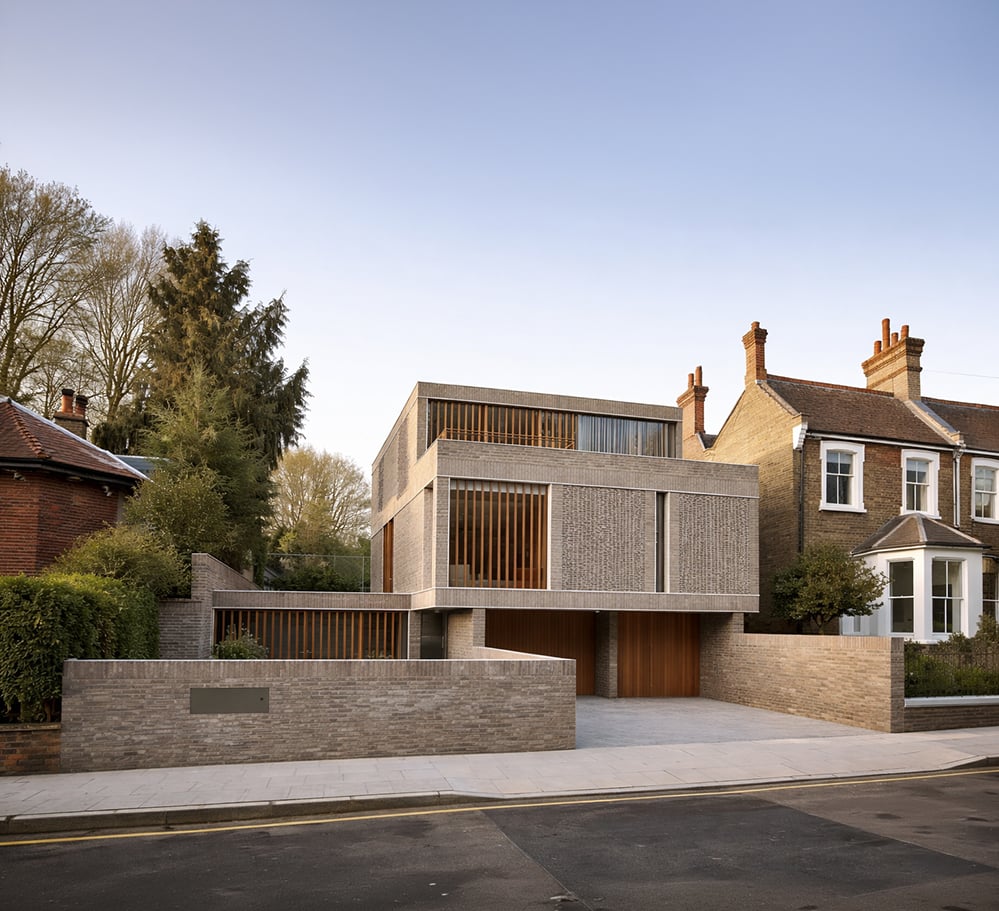
Hampstead House, a new build replacement dwelling in North London. A considered grey brick facade with vertical timber battens sits confidently within an established residential streetscape, demonstrating that contemporary new build architecture can hold its own among period neighbours.
Start with the right number: cost per square metre
The most reliable way to think about new build construction cost is cost per square metre of new internal floor area (GIA, gross internal area).
Construction costs rose sharply through 2021 and 2022, driven by post-COVID supply chain disruption and a significant reduction in available skilled labour following Brexit. The extreme material price shocks of that period have since eased - but costs have not fallen. The driver has shifted: where earlier inflation was led by volatile materials markets, cost pressures in 2026 are increasingly labour-led, with persistent workforce shortages, specialist trade scarcity, and rising wage agreements combining to sustain upward pressure. London consistently ranks as one of the most expensive cities in the world to build in, and that position has not changed. Labour remains the single largest input cost on any residential project - typically the primary variable a contractor is pricing when they return a tender.
In London, a well-specified new build home sits broadly in these ranges:
| Specification level | Cost per m² (construction only) |
|---|---|
| Standard | £2,800 to £3,250 |
| Good quality | £3,250 to £4,000 |
| High specification | £4,000 to £5,500+ |
| Passivhaus or low-energy certified | £4,500 to £6,000+ |
| Basement construction (additional) | From £6,000/m² |
A typical four-bedroom London new build of around 160m² will therefore carry a construction cost of roughly £520,000 to £640,000 at a good quality specification. If you are adding a basement, budget for that element separately. It is a fundamentally different type of construction with its own structural, drainage, and waterproofing challenges.
These figures are for construction only. They do not include land acquisition, architect fees, planning, structural engineering, or any of the other costs explored below.
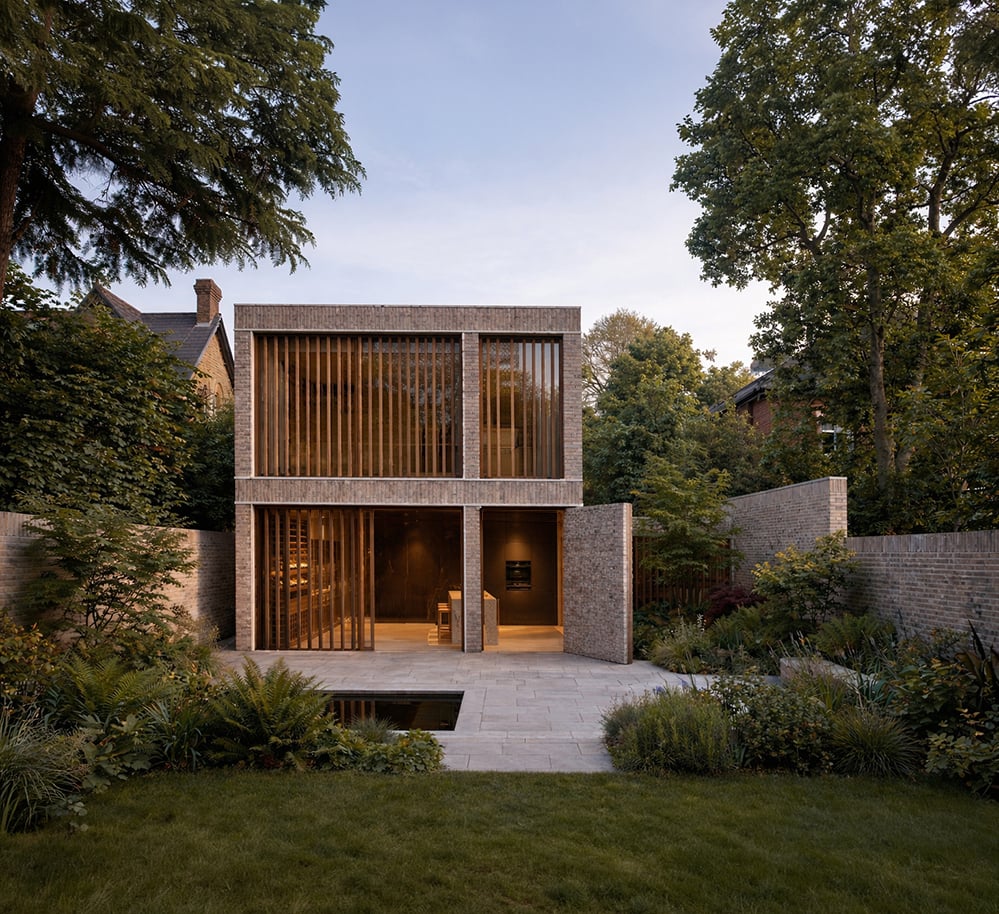
Hampstead House, rear garden elevation at dusk. Full-height glazing and timber battens dissolve the boundary between the kitchen living space and the planted garden beyond. Projects of this specification sit at the higher end of the cost ranges explored in this guide.
Do I need planning permission?
Yes, without exception.
Unlike extensions, new build homes cannot be delivered under permitted development rights. Every new residential dwelling in London requires a full planning application. That process is more complex, time-consuming, and more politically charged than a standard householder application.
Infill and backland plots are the most common route to a new build plot in inner London: former garden land, garage sites, and backland parcels within existing residential areas. Councils scrutinise overlooking, daylight and sunlight impacts, and the loss of garden land intensely. Early pre-application engagement is not optional here. It is essential.
Replacement dwellings, demolishing an existing house and building a new one, are viable where the existing building is beyond economic repair, or where a better-designed, more efficient home can be justified. Councils generally resist significant increases in footprint without strong design justification.
Small sites and windfall development. London's NPPF-aligned local plans increasingly support small-scale residential development on underused or previously developed land. These opportunities require careful identification and a targeted pre-application strategy.
A full planning application for a new dwelling is calculated on site area rather than per dwelling - currently £610 per 0.1 hectare (or part thereof) for sites up to 0.5 hectares, from 1 April 2026. On a typical London infill plot, the statutory fee will sit at around £610. The fee itself is modest. The professional time around it is not. Pre-application advice from the local planning authority typically costs £400 to £1,200 depending on the borough, and is strongly recommended before any application is submitted. A realistic timeline from first instruction to planning decision is 6 to 12 months for a straightforward scheme. Conservation area constraints, significant neighbour objections, or a complex site can extend this considerably.

Hampstead House, the double-height kitchen and living space looking out to the garden through sliding timber-framed doors. Stone floor, bespoke joinery, and vertical timber louvres filtering the light: the quality of the internal environment is the result of decisions made early in the design process, not added at the end.
The full picture: every cost you need to account for
Architect fees
A full architectural service from RIBA Stages 1 to 6 for a new build home in London typically runs 10 to 15% of construction cost, rising towards 15 to 18% for complex sites, conservation area constraints, or projects that combine new build with significant landscape and interior design scope.
For a new build project, the architect's role is broader than on an extension. They lead the design from first principles: site analysis, orientation, massing, materiality, and carry that intent through planning, technical design, and construction. On a tight London infill site, this demands a high level of coordination, including daylight and sunlight modelling, structural and geotechnical input, party wall matters, and potentially acoustic, drainage, and ecology specialist reports.
Be wary of unusually low fees at the early stages. They often reflect a service that ends at planning, leaving you to manage technical design and construction without proper support. That shortfall tends to surface mid-build as additional fees, cut corners, or a client navigating a live construction site alone. It is a more expensive problem to solve than the fee saving that created it.
At RISE, we offer a fixed fee agreed at the close of the feasibility stage, once the scope, site, and brief are properly understood. A full service covers pre-application advice, planning drawings and application management, detailed technical drawings, structural coordination, contractor tendering, contract administration, and site inspections through to practical completion.
Planning and pre-application costs
The planning application fee for a new dwelling is calculated on site area. On a typical London infill plot, expect a statutory fee of around £610 from 1 April 2026. The fee itself is modest. The professional time around it is not.
Pre-application advice from the local planning authority is strongly recommended before any application is submitted - budget £400 to £1,200 depending on the borough. That conversation shapes the application strategy and reduces the risk of a refusal or protracted negotiation with officers.
For complex sites - conservation areas, prior refusals, significant daylight or overlooking concerns - a specialist planning consultant working alongside the architect adds meaningful value. Budget £3,000 to £8,000 for that input where needed.
Allow 6 to 12 months from first instruction to planning decision for a straightforward scheme. Conservation area constraints, significant neighbour objections, or a complex site can extend this considerably.
Structural engineer
New build construction requires structural engineering at multiple stages: substructure and foundation design, superstructure frame, and roof structure. Budget £7,000 to £12,000 depending on complexity. Sites with poor ground conditions, proximity to protected trees, or contamination will require specialist geotechnical investigation, typically £3,000 to £6,000 for trial pits and a written report, before engineering design begins. Where mini piles are needed to reach stable ground or avoid damaging tree roots, this adds meaningful cost at both engineer and contractor stage.
Party wall surveyor
If the new build is constructed within 3 metres of a neighbouring structure, or involves excavation close to a shared boundary, the Party Wall etc. Act 1996 applies. On tight London plots, this is almost always the case. Budget £3,000 to £6,000 per neighbour. You bear the cost if they appoint their own surveyor. Early, transparent communication with neighbours is the single most effective cost-control measure here.
Building control
Building regulations approval is required for all new build work, and is entirely separate from planning permission. Both are needed. Local authority building control fees for a new dwelling typically run £2,000 to £4,500, covering structural, thermal performance, fire safety, drainage, and accessibility requirements.
Quantity surveyor
For projects above £400,000, which covers most new build homes in London, QS involvement from RIBA Stage 2 or 3 is not a luxury. It is prudent. A quantity surveyor reviews your drawings and specification for cost implications as the design develops, before you go to tender. Budget £3,000 to £7,000 for an elemental cost plan at that stage. The fee is usually recovered many times over.
Contractor preliminaries and contingency
A good contractor's quote will include preliminaries: site setup, hoarding, scaffolding, welfare facilities, waste removal, insurance, and project management overhead. On a new build, these typically add 15 to 20% on top of the base labour and materials cost, reflecting the longer programme and greater site complexity compared with a domestic extension.
Hold a 10 to 15% contingency on the total build cost. Ground conditions are unknown until excavation begins, and existing drainage, contamination, and structural surprises are common rather than exceptional on London sites.
Finishes and fittings
Construction cost figures do not include kitchen units, bathroom sanitaryware, floor finishes, lighting, bespoke joinery, or decoration. On a new build, these are specified from scratch, which creates both an opportunity and a risk.
A genuinely good kitchen can be achieved for around £18,000 to £28,000 using quality carcasses with well-specified finishes. Brand-name kitchens at £50,000 or more rarely deliver proportionate value. Bespoke joinery throughout a new build, fitted wardrobes, media walls, boot rooms, a considered home office, can add £40,000 to £90,000 at a comfortable specification. Define your allowances early and hold them.
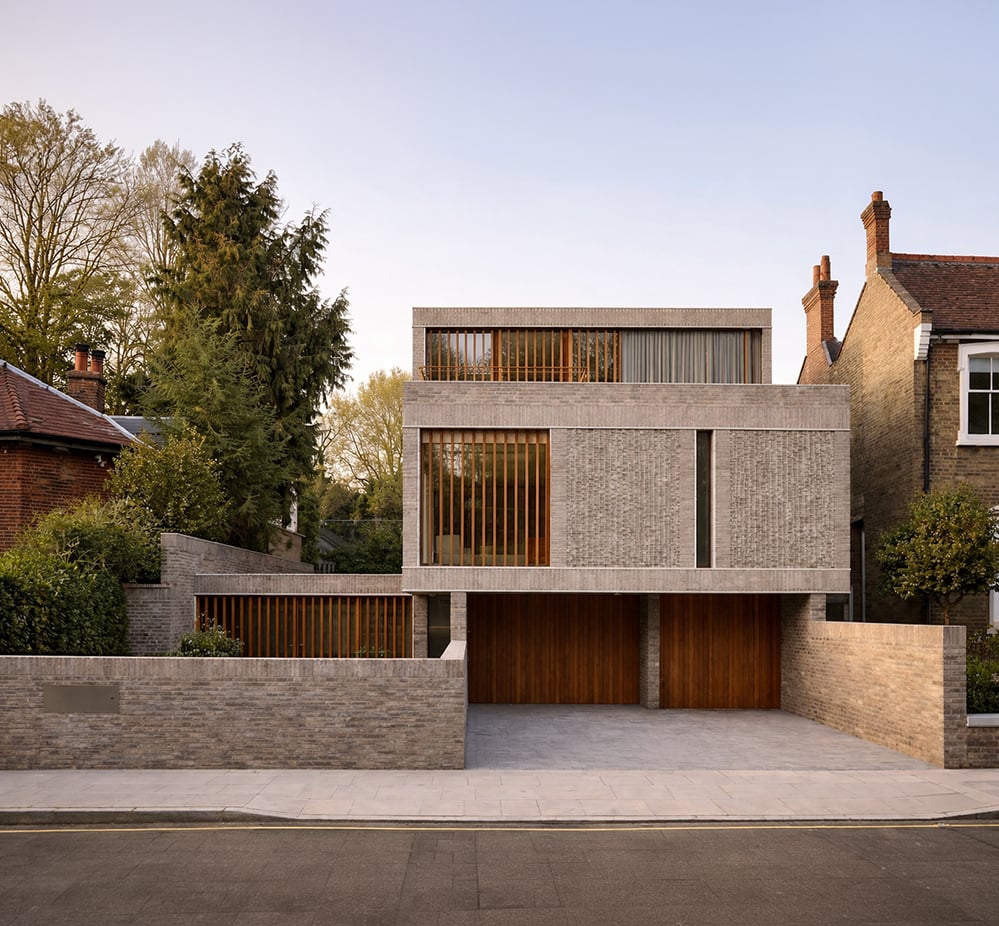
Hampstead House, street elevation. The cantilevered upper volume, flush brickwork, and warm timber louvres read as a cohesive whole, a materiality resolved at design stage and held through to construction.
A worked example: new build family home to Passivhaus standard, North London
A standard new build dwelling is one end of the spectrum. At the other is the type of project we are delivering with increasing frequency: a new build family home designed to certified Passivhaus standard, highly insulated, airtight, mechanically ventilated with heat recovery, and heated entirely by low-carbon systems with no gas connection.
This is not a niche typology. It is simply the right way to build a new home in 2026. The energy cost of heating a Passivhaus home is a fraction of a standard new build. The internal environment, temperature stability, air quality, acoustic performance, is measurably superior. And in a London market where buyers are becoming more discerning about building performance, Passivhaus certification is increasingly a value-add, not a premium vanity.
The figures below are drawn from a new build project on a North London infill plot: a four-bedroom family home of 180m² GIA, constructed to certified Passivhaus standard on a former backland site.
At that scope and specification, the all-in construction cost sits at around £5,000 to £5,400 per m² of GIA, reflecting the high-performance envelope, certified low-energy systems, and the complexity of delivering Passivhaus airtightness within a tight urban site.
Construction works
| Item | Approximate cost |
|---|---|
| Preliminaries (site setup, hoarding, scaffolding, welfare, project management) | £68,000 to £82,000 |
| Demolition and enabling works | £16,000 to £24,000 |
| Substructure (foundations, ground floor slab, drainage below slab) | £62,000 to £78,000 |
| Superstructure (timber frame, external envelope to Passivhaus standard) | £155,000 to £182,000 |
| Roof structure and covering | £42,000 to £54,000 |
| External windows and doors (high-performance, triple-glazed) | £68,000 to £82,000 |
| External cladding and render | £32,000 to £44,000 |
| Drainage (above and below ground, rainwater goods) | £16,000 to £22,000 |
| Electrical (full installation, solar PV, EV charger, home battery) | £58,000 to £72,000 |
| Heating and plumbing (ASHP, UFH, MVHR, wet pipework) | £62,000 to £76,000 |
| Internal carpentry, joinery and kitchen | £125,000 to £150,000 |
| Plastering and drylining | £36,000 to £44,000 |
| Floor finishes (engineered timber, polished concrete, porcelain) | £38,000 to £48,000 |
| Decorating | £26,000 to £34,000 |
| Sanitaryware and brassware | £28,000 to £36,000 |
| External works (landscaping, boundary walls, paths, planting) | £20,000 to £30,000 |
| Construction subtotal | £852,000 to £1,058,000 |
Low-energy systems, broken out separately
These costs sit within the construction subtotal above but are worth understanding individually, both because they transform how the building performs, and because several qualify for reduced VAT at 0% under current HMRC rules:
| System | Scope | Approximate cost |
|---|---|---|
| Air source heat pump (ASHP) | Supply, install, MCS certification, dedicated pipework and fuseboard | £20,000 to £24,000 |
| Mechanical ventilation with heat recovery (MVHR) | Supply, install, full duct routes, terminals, commissioning to Passivhaus standard | £17,000 to £22,000 |
| Airtightness package | Membranes, tapes and grommets throughout; two independent air permeability tests | £13,000 to £17,000 |
| Thermal and acoustic insulation (above standard) | Additional insulation depth to achieve Passivhaus heat loss targets | £11,000 to £15,000 |
| Solar PV, battery storage and EV charger | 8-panel system, inverter, home batteries, 22kW EV charger | £13,000 to £17,000 |
| Underfloor heating | Wet UFH to ground and first floor; electric UFH to bathrooms | £13,000 to £17,000 |
| Low-energy systems subtotal | £87,000 to £112,000 |
These systems deliver the Passivhaus outcome: airtightness below 0.6 ACH, heat recovery above 85%, and a building that requires almost no mechanical heating. Energy bills on completion are typically 80 to 90% lower than a standard new build of equivalent size.
Professional fees and statutory costs
| Item | Approximate cost |
|---|---|
| Architect fees (RIBA Stages 1 to 6, full service) | £85,000 to £135,000 |
| Structural and civil engineer | £7,000 to £12,000 |
| Geotechnical investigation | £3,000 to £6,000 |
| Mechanical and electrical engineer | £5,000 to £10,000 |
| Passivhaus consultant and PHPP modelling | £1,500 to £8,000 |
| Planning consultant (if required) | £3,000 to £8,000 |
| Daylight and sunlight consultant | £2,500 to £4,500 |
| Party wall surveyor | £3,000 to £6,000 |
| Planning application fee | £610 |
| Building control | £2,000 to £4,500 |
| Professional fees subtotal | £114,000 to £195,000 |
Fit-out and finishes
| Item | Approximate cost |
|---|---|
| Kitchen (cabinetry, worktops, integrated appliances) | £18,000 to £28,000 |
| Sanitaryware and brassware (all bathrooms and en-suites) | £26,000 to £34,000 |
| Bespoke bedroom, utility and living joinery | £40,000 to £55,000 |
| Fit-out subtotal | £84,000 to £117,000 |
(Note: floor finishes and decorating are included in the construction subtotal above.)
Contingency
On a project of this complexity, tight London plot, Passivhaus airtightness requirements, unknown ground conditions, a contingency of 10 to 15% of construction cost is appropriate: roughly £85,000 to £145,000.
Total project cost: approximately £1.15m to £1.5m
That figure warrants context. This is a four-bedroom, 180m² certified Passivhaus home built from the ground up on a London infill site, not a developer-grade speculative property. It is a considered, long-term investment in how a family lives, and in the ongoing energy and carbon performance of their home for decades.
Against the cost of purchasing an equivalent property in the same area, plus stamp duty, legal fees, and the inherent uncertainty of opaque build quality, the economics of building your own are often more compelling than they first appear.
What drives costs up
Basement construction from around £6,000/m² for the basement element alone. Piled foundations, specialist waterproofing, and structural complexity make this a categorically different type of work.
Contaminated land. Former garage, industrial, or commercial sites may require ground remediation before construction can begin. A Phase 1 and Phase 2 environmental survey should be commissioned before you exchange contracts.
Constrained or difficult sites. Restricted access, narrow mews streets, limited working hours, parking permit requirements, and the proximity of neighbouring structures all add cost and programme.
Large glazed areas. Full-height sliding doors and generous rooflights significantly outperform a standard window specification on cost. Worth it for the quality of light and spatial experience, but budget for it honestly from the start.
Conservation area or listed curtilage. More exacting material specifications, closer scrutiny from conservation officers, and frequently the need for a heritage impact assessment alongside the planning application.
Non-standard structural systems. CLT or SIPs bring genuine environmental and programme advantages, but typically add around 10% over a standard masonry or timber frame approach.
Passivhaus or low-energy certification adds 5 to 12% above a standard good-quality specification. That premium is largely recovered over the building's lifetime through dramatically lower energy bills.
What keeps costs down
Clear, complete drawings before going to tender. Contractors price risk. A complete technical package, structural, mechanical, electrical, detailed joinery specifications, produces more competitive and more reliable tender returns than a partial set.
Realistic specification from the start. Scope creep mid-construction is the single most consistent driver of cost overrun. Resolve your specification before the frame goes up, not while the roofer is on site.
Simple superstructure. Block and brick cavity construction remains cost-effective in London because the labour pool is familiar with it. Non-standard approaches attract a premium unless the design benefits genuinely justify them.
Fabric-first design. Investing in the building envelope before specifying systems reduces the size and cost of what those systems need to do. A well-built envelope needs a smaller heat pump.
Early QS involvement. A quantity surveyor reviewing cost at Stage 2 or 3 produces reliably better outcomes than one reviewing a completed set. The fee is usually recovered many times over.
A note on VAT and tax
New build residential construction is zero-rated for VAT. You do not pay 20% on the main construction contract. For work to be zero-rated, it must qualify as a genuinely new, self-contained house or flat. This is one of the most significant financial advantages of building new over extending or refurbishing an existing property. On a £900,000 construction contract, the difference versus a refurbishment at 20% VAT is a substantial sum. Note that consultant fees are still subject to VAT at standard rate.
Specific energy-saving measures including heat pumps, MVHR, insulation, and solar PV currently attract 0% VAT even on other project types, making a Passivhaus specification particularly advantageous from a tax standpoint. Always confirm the scope of zero-rating with your contractor and accountant at tender stage.
Community Infrastructure Levy (CIL) contributions in London can be considerable, but self-builders are usually exempt, provided you own and occupy the property as your principal residence for a minimum of three years after completion. Confirm eligibility early in the planning process.
Capital Gains Tax. Assuming the home will be your principal private residence, there is generally no CGT to pay if you sell the property at a profit.
Is it worth it?
That depends on what you're comparing it to.
In London's property market, a well-designed new build home on a good plot, delivered to a high specification and a certifiable performance standard, commands a premium over the existing stock. A Passivhaus-certified new build offers something genuinely difficult to purchase on the open market: a home where you know exactly how it was built, what it will cost to run, and how it will perform for the next fifty years.
Against the cost of purchasing an equivalent home in the same area, plus stamp duty, legal fees, and the uncertainty of opaque build quality, building new often makes more financial sense than it first appears. The margins as a percentage of total costs can be smaller in London than elsewhere, given land values, but the case for building is rarely purely financial.
It gives you something that buying can never quite replicate: a home designed precisely around the way you actually live.
Frequently asked questions
How much does it cost to build a new home in London in 2026?
A good quality new build family home in London will typically cost between £3,250 and £4,000 per m² in construction costs. For a 160m² four-bedroom house, that implies a construction budget of roughly £520,000 to £640,000, before professional fees, planning, land, and contingency. A full project budget including all fees and a sensible contingency is likely to be in the region of £750,000 to £1.1m, depending on specification and site complexity.
Do I pay VAT on a new build house?
No. New build residential construction is zero-rated for VAT. This is a significant financial advantage over extensions and refurbishments, which are charged at 20%. Consultant fees are still subject to VAT at the standard rate. Certain energy-saving measures also qualify for 0% VAT. Always confirm the precise scope of zero-rating with your contractor and accountant.
How long does a new build home in London take?
From first instruction to practical completion, typically 24 to 36 months. Pre-application engagement and planning alone can take 6 to 12 months. Design and technical production takes a further 4 to 6 months. Construction typically runs 12 to 18 months on site.
Is building a new home in London profitable?
It can be, but the margin as a percentage of total cost is typically smaller in London than elsewhere, given land premiums. The primary driver for most people building in London is the ability to create a home tailored precisely to their needs, to a performance standard unavailable in the existing market. The financial case is best made on a like-for-like comparison: what you would spend purchasing an equivalent home plus stamp duty and legal costs, versus what you spend building.
Do I need a planning consultant as well as an architect?
On straightforward infill sites, an experienced architect can manage the planning process directly. On complex sites, conservation areas, prior refusals, significant daylight or overlooking concerns, a specialist planning consultant working alongside the architect adds meaningful value. We advise on whether your site warrants that input at our initial consultation.
Where to start
The most important first conversation is with an architect, not a contractor, not a land agent, because the design shapes everything that follows: what is possible on your site, what it will cost, and whether it will be worth living in.
At RISE, our initial consultations are a genuine two-way conversation. We want to understand your plot, your brief, and your priorities, and give you an honest assessment of feasibility and cost before any commitment is made.
→ Email us at architects@risedesignstudio.co.uk
→ Or call the studio on 020 3947 5886
RISE Design Studio, Architects, Interior Designers + Sustainability Experts
☉ Architecture for people and planet
☉ Trading since 2011
☉ Company reg no: 08129708
☉ VAT no: GB158316403