
Share this
by Sean Ronnie Hill on May 2, 2025
For a long time, shading was treated as an add-on in British housing, a blind or an awning fitted after the fact. That is changing, and it needs to, because the way a home handles the sun is now one of the biggest factors in whether it is comfortable to live in.
We have always designed with the sun in mind, tracing light across a facade before we settle the walls, and thinking about August heat while we plan for February comfort. Shading is part of that from the outset, not something added at the end.
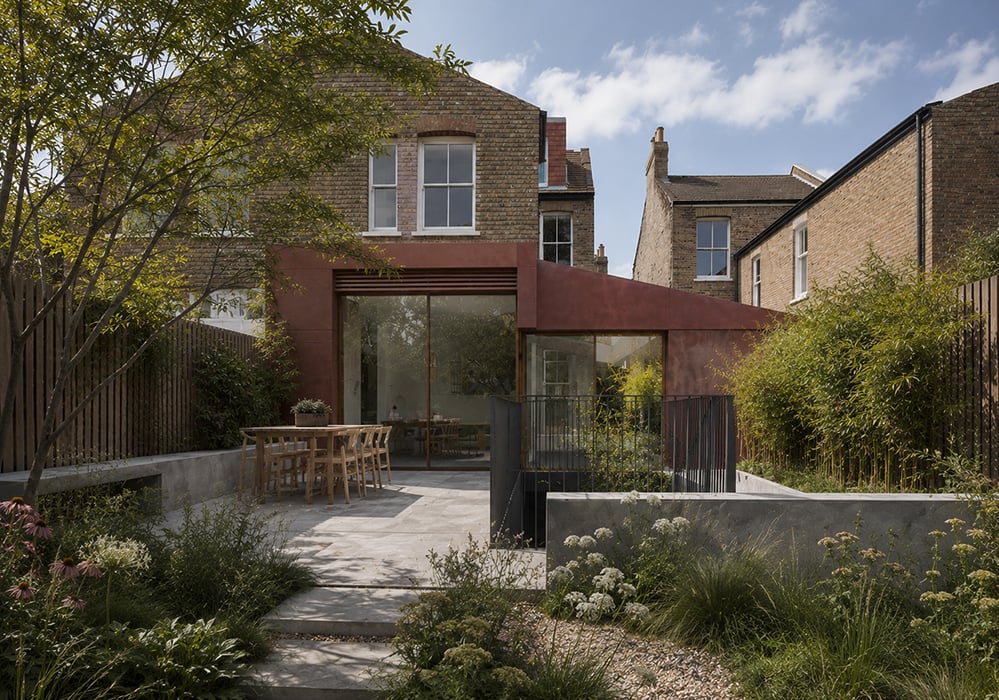
Ribbon House, Chevening Road, Queen's Park. A rear extension in NW London designed with low-energy principles and passive solar shading, reworking Victorian living for a warmer climate. RISE Design Studio.
The homes we have were built for a different climate
Most UK homes were designed for drizzle and cold, not for 40-degree summers. The problem is no longer hypothetical. The Climate Change Committee estimates that more than half of UK homes are already at risk of overheating, and that under 2°C of warming, reached around the middle of the century, roughly 90% of existing homes would overheat in a heatwave. Solving that with more air conditioning means more energy and more emissions, which only feeds the problem. Shading is the passive alternative: built in, designed early, and using no energy at all.
The reason it works is simple physics. External shading stops sunlight before it reaches the glass, where internal blinds and curtains can only deal with heat that has already passed through and become trapped inside. Intercept the sun outside and you keep the bulk of that heat out of the house entirely, which is why external measures do so much more than closing the curtains ever can.
A guide that raises the bar
Some of this thinking has just been made much more accessible. Shading for Housing: A Design Guide, produced by the Good Homes Alliance with the British Blind and Shutter Association, is a genuinely useful document, drawing on input from architects, building physicists and academics. It isn't prescriptive, which is its strength. It gives design teams:
- a clear visual breakdown of shading products, with real-world insight into how each one performs
- a quick-reference shading "cheat sheet" for busy teams
- advice tailored to different UK conditions, urban, suburban, retrofit and new build
- case studies that show shading working in practice
It is aimed at people who want to design better homes, not just build more of them, and it is a good sign that shading is being taken seriously across the industry rather than left to chance.
The main types of shading
Shading isn't one thing, and part of designing it well is choosing the right kind for the situation. The broad split is between fixed shading, which is built into the fabric and works on its own, and adjustable shading, which you operate but can tune to the day. The main options we use:
- Roof overhangs and canopies. A projecting roof or deep soffit over the glazing blocks the high summer sun while letting the lower winter sun pass underneath. Fixed, maintenance-free, and often the defining architectural move on an elevation.
- Brise-soleil and fins. Horizontal blades handle high sun on south-facing glass; vertical fins deal with the lower sun from the east and west. They can be fixed or adjustable, and they read as part of the architecture rather than an addition to it.
- Deep window reveals. Setting the glass back into a thick wall lets the reveal itself shade it. It is the simplest form of shading there is, permanent and free once the wall is built.
- External shutters and louvres. Adjustable, so they can be closed on the hottest afternoons and opened the rest of the time, and louvred versions keep a view and some ventilation while cutting the sun. Useful where you need flexibility.
- External awnings. Retractable fabric shading is seasonal and low-cost, and the newer clamp-on systems make it accessible even to renters. It is the easiest shading to add to a home that already exists.
- Trees and planting. A deciduous tree or a climber on a pergola shades a window in summer and then drops its leaves to let the winter sun back in. Living shading that also cools the air around the house.
The one rule that holds across all of them is that external beats internal every time, because the heat is stopped before it gets in.
Shading by orientation
Which shading works best depends heavily on which way the glass faces.
South-facing glazing is the easiest to get right. The summer sun is high and the winter sun is low, so a horizontal device, an overhang, a canopy or horizontal brise-soleil, can block the harsh summer sun while still letting the welcome winter sun in. Get the geometry right and it works automatically, year after year, with nothing to operate.
West-facing, and to a lesser extent east-facing, glazing is the hard case. The sun is low in the sky in the late afternoon, which is exactly when overhangs are useless, and on a west elevation it arrives at the same time as the peak internal heat from cooking, appliances and people being home. Here you need vertical fins, external shutters or blinds, or planting, and sometimes the most sensible move is simply to reduce the glazing a little without losing the connection to the garden.
North-facing glazing barely needs shading, since it sees little direct sun, but it still loses heat in winter, so the priority there is good glazing and insulation rather than solar control. Shading, in other words, is a whole-building question, not something that applies only to the sunny side.
What shading does in practice
Across our work, from deep retrofits of Victorian terraces to new-build low-energy homes, a well-judged overhang, screen or blind does two things at once. It controls solar gain, keeping a room comfortable in August while still letting the low winter sun in during February, and it changes how light moves through the space. At Ribbon House, the deep reveals and angled overhangs aren't only sculptural, they are the shading: they temper the summer sun, cut overheating, and draw daylight deep into the plan. Good shading shapes both the temperature and the experience of a room in the same move.
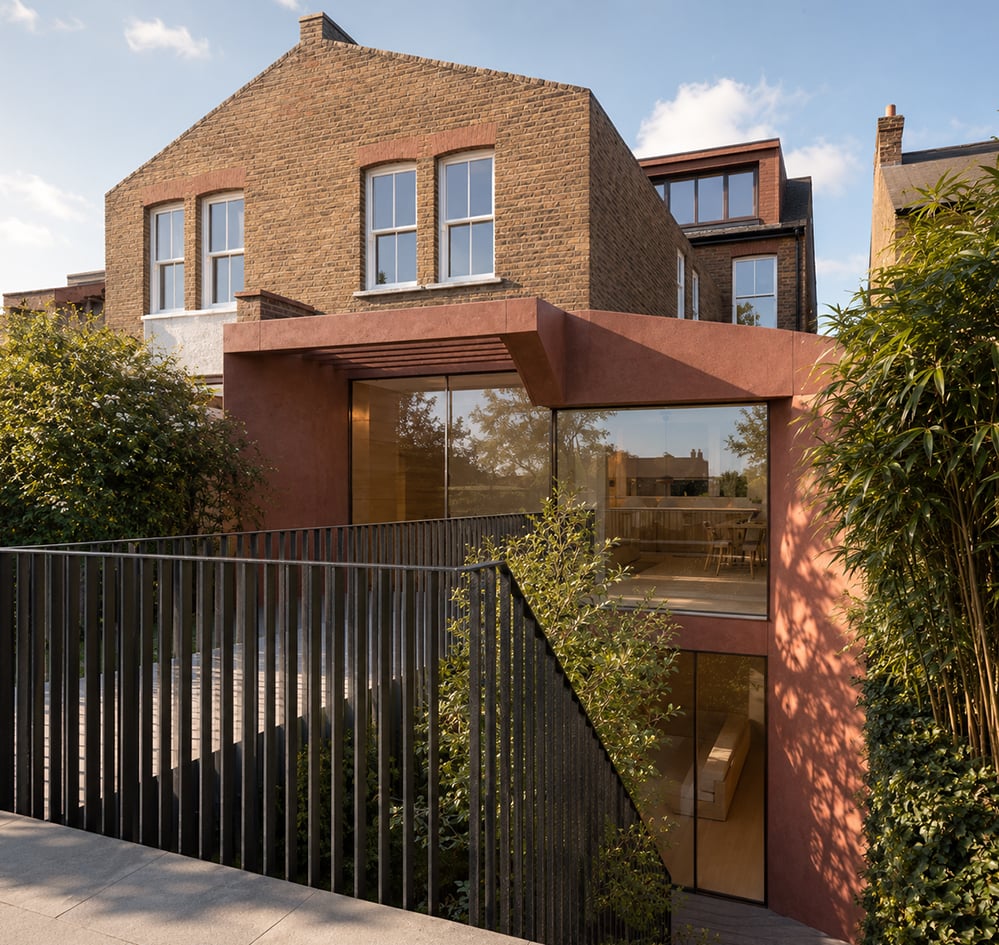
A closer view of Ribbon House, Queen's Park. Deep reveals and angled overhangs work as passive shading, tempering solar gain while drawing daylight into the home. RISE Design Studio.
Frequently asked questions
Does external shading really work in the UK climate? Yes, and more so every year. Our summers are no longer mild enough to ignore, and external shading can block a large majority of the solar heat that would otherwise come through a window, far more than any internal blind. Fixed shading tuned to our latitude also lets the low winter sun through, so you gain summer comfort without losing winter warmth.
Will shading make my rooms dark? Not if it is designed well. Good shading blocks the harsh, high or low-angle direct sun, not the ambient daylight, so a well-shaded room stays bright and even rather than glary. Deep reveals and overhangs still admit plenty of light, and adjustable options let you open things up whenever you want.
Is it worth retrofitting shading to an existing home? Often, yes. External shutters, blinds, awnings, brise-soleil and planting can all be added to a house that already exists, and they are usually cheaper to run and better for the building than installing air conditioning. If the house is listed or in a conservation area, external changes may need planning consent, so it is worth checking early.
Fixed or adjustable, which is better? It depends on the elevation. Fixed shading needs no operating and works automatically, which makes it ideal on south-facing glazing. Adjustable shading gives you control for the harder west and east elevations, or where your needs vary, at the cost of having to operate it. Most homes end up using a mix.
Shading belongs in the basic design of a house, not in a catalogue of extras added later. As architects we have a part to play in getting ahead of the climate rather than reacting to it each summer, and that starts with treating shading, orientation and ventilation as fundamentals. It costs very little to design in early, and a great deal to retrofit badly later.
If you are planning a new home or a retrofit and want to get the sun working for you rather than against you, we'd be glad to talk it through. The Shading for Housing guide is free to download from the Good Homes Alliance website, and it is a good place to start.
→ Email us at architects@risedesignstudio.co.uk
→ Or call the studio on 020 3947 5886
RISE Design Studio, Architects, Interior Designers + Sustainability Experts
☉ Architecture for people and planet
☉ Trading since 2011
☉ Company reg no: 08129708
☉ VAT no: GB158316403