
Share this
Tennis in an English garden: reimagining the Elmwood pavilion
by Imran Jahn on Jul 31, 2025
A few streets from our Lexi Cinema project in Kensal Rise, behind hedges and the back gardens of family homes, Elmwood Lawn Tennis Club has quietly served its members for more than seventy years. It's the kind of place you only find if someone takes you there.
In early 2024 we were invited into a closed competition to design a new clubhouse. It was one of the clearest briefs we've had in years, not because it was architecturally ambitious, but because the club knew exactly what it valued and what it didn't.
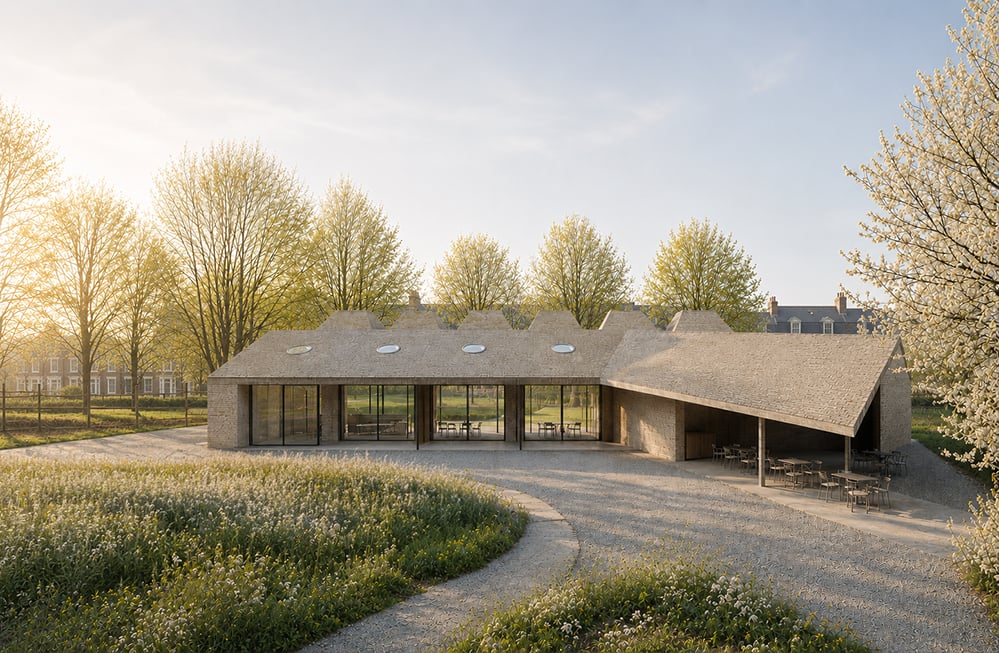
A new low-energy pavilion for Elmwood Lawn Tennis Club in Kensal Rise, designed to sit quietly in its garden setting and support the life of the club through the year. RISE Design Studio.
What Elmwood wanted was not a statement building, and they said so plainly from the start. They wanted something calm, practical, and at home in its setting, a building that felt as though it had always been there. That's a harder brief than architecture usually admits. A building that feels inevitable takes more work than one that asks to be noticed.
Starting with what was already there
Rather than wipe the existing pavilion away, we started by studying it. The modest gabled rooflines, the exposed steel trusses, even the vaulted form of the substation on the site, all became reference points. The new design doesn't copy them, but it reinterprets them, so the building reads as continuous with the club's history rather than cut off from it.
The grounds shaped the design just as much. A tennis club is really an outdoor place, and most of its life happens between matches: beside the courts, under the trees, around the edges. So the pavilion needed to feel less like an object set in a garden and more like part of the garden. Large openings link the main club room to the south-facing terrace, covered areas give shelter through the year, and new planting softens the line between building and garden so it settles into its surroundings.
A building organised around everyday use
At the centre is a flexible club room that can take everything from coaching and committee meetings to finals-day gatherings and community events. Large sliding doors let it open onto the terrace in warmer months, and movable partitions let it shrink when it doesn't need to be at full size. A café and licensed bar form the social heart of the building, with a domestic-scale kitchen built for everyday use rather than commercial show.
The rest of the accommodation covers generous changing facilities, accessible amenities, secure storage, a little administrative space, and dedicated areas for coaching and equipment. The technology, AV and access control are built quietly into the building rather than made into features. The aim throughout was a building that works very well without ever feeling overdesigned.
Life beyond the building
The outdoor spaces had the same attention as the building itself. New seating terraces make room for the simple ritual of watching tennis from the edge of a court. Covered areas and a bit of integrated heating extend the club's use into colder, wetter months. A hitting wall, fold-away table tennis, outdoor cooking and a safe children's play area let the life of the club run well beyond formal matches and coaching. Cycle storage, servicing and maintenance are worked into the grounds so the practical things never take over the setting.
Sustainability as common sense
We don't treat low-energy design as a layer added once the architecture is done. It shapes the project from the start. The pavilion was conceived as a long-term community asset: durable, efficient, comfortable and cheap to run. Good insulation, careful airtightness, passive solar control, cross ventilation, solar PV, low-energy heating and responsibly sourced materials all work in the background to cut the running demand and improve day-to-day comfort.
None of it is technological theatre. A building used on winter mornings, through summer tournaments, at evening events and for children's coaching simply needs to perform. In that context sustainability isn't an aspiration, it's a basic standard of care.
What a project like this is really about
Elmwood is where children learn to serve for the first time, where matches drift into conversation long after the courts have emptied, where a neighbourhood keeps part of its social life going through repetition and familiarity. The building's job isn't to compete with any of that. It's to support it, generously and without getting in the way.
The hope is that over time the pavilion becomes almost unremarkable, in the best sense: familiar, useful, well used, and completely part of the life of the club. A community building earns its place slowly, through daily use and reliability and the accumulation of ordinary moments over years. This one was designed to age well, sit quietly in its garden, and serve its members for decades without asking for attention it hasn't earned.
If you're thinking about upgrading a community or sports building and want a low-energy, people-first approach, we'd be glad to talk it through.
→ Email us at architects@risedesignstudio.co.uk
→ Or call the studio on 020 3947 5886
RISE Design Studio, Architects, Interior Designers + Sustainability Experts
☉ Architecture for people and planet
☉ Trading since 2011
☉ Company reg no: 08129708
☉ VAT no: GB158316403
Share this
- Sustainable architecture (168)
- Architecture (149)
- Passivhaus (79)
- Sustainable Design (69)
- Design (66)
- Retrofit (61)
- New build (52)
- London (51)
- Renovation (43)
- low energy home (40)
- energy (38)
- interior design (38)
- Building materials (35)
- Planning (34)
- enerphit (34)
- Environment (30)
- climate-change (29)
- Inspirational architects (27)
- Refurbishment (27)
- extensions (27)
- Building elements (22)
- London Architecture (22)
- Planning permission (22)
- Inspiration (21)
- Residential architecture (20)
- Sustainable Architect (18)
- Low Energy Homes (16)
- RISE Design Studio (16)
- Rise Projects (16)
- Sustainable Architecture London (15)
- Embodied Carbon (14)
- Extension (14)
- Innovative Architecture (14)
- net zero (14)
- Carbon Zero Homes (13)
- sustainable materials (13)
- General (12)
- Philosophy (12)
- RIBA (11)
- Working with an architect (11)
- Airtightness (10)
- Awards (9)
- Sustainable (9)
- Sustainable Tennis Pavilion (9)
- Tennis Pavilion (9)
- architects (9)
- BIM (8)
- Community Architecture (8)
- Fabric First Design (8)
- architect (8)
- low carbon (8)
- Biophilic Design (7)
- Deep Retrofit (7)
- Eenergy efficiency (7)
- Low-Energy Design (7)
- Overheating (7)
- Sustainable Natural Materials (7)
- Timber Structures (7)
- Virtual Reality (7)
- natural materials (7)
- AECB CarbonLite (6)
- Adaptive reuse (6)
- Backland Development (6)
- EnerPHit London (6)
- Low Energy Architecture (6)
- Passive house (6)
- Sports Architecture (6)
- Sustainable Housing (6)
- Sustainable Housing London (6)
- Architectural design process (5)
- BIMx (5)
- Basement Extensions (5)
- Carbon Positive Buildings (5)
- Costs (5)
- Kensal Rise (5)
- London Architects (5)
- Low-Energy Buildings (5)
- Notting Hill Architects (5)
- Passivhaus Design (5)
- Permitted development (5)
- Queen's Park Sustainable Architect (5)
- RISE Sketchbook Chronicles (5)
- Sports Pavilion Design (5)
- Uncategorized (5)
- cinema design (5)
- circular economy (5)
- construction (5)
- insulation (5)
- local materials (5)
- modular architecture (5)
- rammed earth (5)
- sustainable building (5)
- sustainable home design (5)
- tennis clubhouse design (5)
- AECB (4)
- ARB (4)
- Architect Fees UK (4)
- CLT (4)
- EnerPHit Retrofit (4)
- Feasibility Study (4)
- Heritage Retrofit (4)
- Home extensions (4)
- House cost (4)
- Low Energy New Build (4)
- Mass Timber (4)
- Padel Court (4)
- Padel court design (4)
- Paragraph 84 (4)
- Passive Design (4)
- Passive cooling (4)
- Sustainable Interiors (4)
- Sutton Churches Tennis Club (4)
- backland (4)
- building information modelling (4)
- building regulations (4)
- concrete (4)
- constructioncosts (4)
- country house (4)
- listed buildings (4)
- mvhr (4)
- natural materials architecture (4)
- rear extension (4)
- self build (4)
- structural (4)
- structuralengineer (4)
- working from home (4)
- Artificial Intelligence (AI) (3)
- Brutalist Architecture (3)
- Building in the Green Belt (3)
- Chartered architect (3)
- Choosing an architect (3)
- Clay Plaster (3)
- Conservation area (3)
- Construction Costs (3)
- Contemporary Architecture (3)
- Fees (3)
- Garden plot development (3)
- Heat Pumps (3)
- Home Renovation (3)
- Home extension London (3)
- Home improvement (3)
- London Architect (3)
- Mews House Retrofit (3)
- Natural ventilation (3)
- New Build House (3)
- North London Architects (3)
- Paragraph 79 (3)
- Paragraph 80 (3)
- Passivhaus Architects London (3)
- Property (3)
- Queen's Park (3)
- Rainwater harvesting (3)
- Regenerative Architecture (3)
- Social housing (3)
- Spain (3)
- Sustainable Architect London (3)
- Sustainable Extensions (3)
- Sustainable Padel Court (3)
- Sustainable Retrofit (3)
- Timber Construction (3)
- Victorian house extension (3)
- West London Architect (3)
- Whole Life Carbon (3)
- countryside (3)
- furniture (3)
- home extension (3)
- house extension (3)
- infill development (3)
- peter zumthor (3)
- plywood (3)
- pre-application advice (3)
- stoke newington (3)
- sustainability (3)
- sustainable structure (3)
- victorian terrace (3)
- zero waste (3)
- 3D models (2)
- Airtightness and MVHR (2)
- Archicad (2)
- Architect client relationship (2)
- Architects in Spain (2)
- Architectural Technology (2)
- Architectural process (2)
- Architecture Interior Design (2)
- BREEAM (2)
- Basement extension (2)
- Bespoke lighting (2)
- Bricks (2)
- Brise-soleil (2)
- Building energy (2)
- Building performance (2)
- CLT timber construction (2)
- Chartered Practice (2)
- Climate-resilient design (2)
- Commercial Architecture (2)
- Community building architecture (2)
- Contractor (2)
- Covid-19 (2)
- Designing with Stone (2)
- Development Feasibility (2)
- Digital Twin (2)
- Domus Nova (2)
- Ecohouse (2)
- Elmwood Lawn Tennis Club (2)
- Fabric First (2)
- Furniture design (2)
- Garden Homes (2)
- Garden studio (2)
- Hackney (2)
- Hampstead Architects (2)
- Heritage (2)
- Home Retrofit (2)
- Home renovation London (2)
- House extension London (2)
- Indoor air quality (2)
- Infill housing (2)
- Japanese Archiecture (2)
- Kitchen Design (2)
- Lightwell design (2)
- Listed Building Architects (2)
- Loft conversion (2)
- London Plan (2)
- Low Carbon Future (2)
- Low Carbon Home (2)
- Low embodied carbon (2)
- Low-Carbon Architecture (2)
- Low-energy retrofit (2)
- Material honesty (2)
- Minimalist Design (2)
- Modern House Extension (2)
- Modern Methods of Construction (2)
- New Build Architects (2)
- Paragraph 84 home (2)
- Passivhaus London (2)
- Pavilion Architecture (2)
- Period Homes (2)
- Period Property Renovation (2)
- Permitted development rights (2)
- Planning strategy (2)
- Pre-application (2)
- Prefabrication (2)
- Queen's Park architect (2)
- RIBA Plan of Work (2)
- RIBA Plan of Work 2020 (2)
- RIBA Stage 2 (2)
- RIBA work stages (2)
- Recycling (2)
- Residential Architects London (2)
- Retrofit first (2)
- Roof extension (2)
- Rural New Build (2)
- Small Site Development (2)
- Social Distancing (2)
- Solar Shading (2)
- Store Design (2)
- Sustainable Affordable Homes (2)
- Sustainable Architect Fees (2)
- Sustainable Architecture Technology (2)
- Sustainable interior design (2)
- Tennis Club Architecture (2)
- Tennis clubhouse (2)
- Urban Infill (2)
- Value Engineering Architecture (2)
- Victorian house retrofit (2)
- Welbeing (2)
- West London architects (2)
- Winter Performance (2)
- ashp (2)
- backland and small sites (2)
- barcelona (2)
- circular rooflight (2)
- co-working (2)
- countryside architecture (2)
- daylighting (2)
- design&build (2)
- eco home design (2)
- epc (2)
- glazed-extensions (2)
- green architecture (2)
- greenbelt (2)
- hampstead (2)
- health and wellbeing (2)
- historic architecture (2)
- interiorfinishes (2)
- light (2)
- living space (2)
- london landmarks (2)
- londoncinemas (2)
- low-carbon design (2)
- natural light (2)
- openingupworks (2)
- placemaking (2)
- project management (2)
- renewable energy (2)
- rural architecture UK (2)
- sustainable architecture Barcelona (2)
- traditional (2)
- trialpits (2)
- waste (2)
- wooden furniture (2)
- #NLANetZero (1)
- 3D Modelling (1)
- 3D Printing (1)
- 3D Walkthroughs (1)
- AI and Architecture (1)
- AI in Architecture (1)
- ARB registration (1)
- Adam Weismann (1)
- Adaptive Architecture (1)
- Adobe (1)
- Agriculture and Architecture (1)
- Airtight Construction (1)
- Alvar (1)
- Appointing an Architect (1)
- Arched glazing (1)
- Architect Barcelona (1)
- Architect cost UK (1)
- Architect vs architectural designer (1)
- Architects Fees UK (1)
- Architectural Concept Design (1)
- Architectural Research (1)
- Architectural Visualisation (1)
- Architectural feasibility (1)
- Architecture Cost Management (1)
- Architecture London (1)
- Architecture Performance Simulation (1)
- Architecture and nature (1)
- Architecture careers (1)
- Architecture explained (1)
- Architecture jobs London (1)
- Architraves (1)
- Area (1)
- Art (1)
- Art and Architecture (1)
- Article 4 directions (1)
- Artorius Faber (1)
- Atmospheric Design (1)
- Audio Visual (1)
- BIM Architecture (1)
- BIM London (1)
- Balconies (1)
- Barcelona architects (1)
- Basement costs London (1)
- Bathurst Mews (1)
- Bayswater (1)
- Bio-based construction (1)
- Biodiversity (1)
- Biodiversity Net Gain (1)
- Biomimicry (1)
- Biophilic Architecture (1)
- Birmingham Selfridges (1)
- Boat building (1)
- Boats (1)
- Brass (1)
- Breathable buildings (1)
- Breathable walls (1)
- Brent Agents Forum (1)
- Brent Planning (1)
- Brexit (1)
- British stone (1)
- Brixton (1)
- Brownfield Development (1)
- Brutalist London (1)
- Build Costs London (1)
- Builder licensing (1)
- Building Biology (1)
- Building Insulation (1)
- Building Physics (1)
- Building cost certainty (1)
- Building quality (1)
- Building standards (1)
- Buildings Insurance (1)
- CLT and glulam (1)
- CLT construction (1)
- Café Design (1)
- Calm Interiors (1)
- Can Lis (1)
- Cantilevered Roof (1)
- Carpentry (1)
- Casting (1)
- Chailey Brick (1)
- Choosing a builder (1)
- Circular construction (1)
- Class E (1)
- Claymoon Studio (1)
- Clayworks (1)
- Climate resilience (1)
- Clubhouse design (1)
- Cold Water Swimming (1)
- Community (1)
- Community and place (1)
- Community pavilion (1)
- Community sports facilities (1)
- Compact city design (1)
- Computational Design (1)
- Concept sketch (1)
- Concrete Architecture (1)
- Conservation Area Architects (1)
- Conservation Areas (1)
- Conservation and sustainability (1)
- Conservation area extension (1)
- Construction Cost Management (1)
- Construction risk management (1)
- Construction standards (1)
- Consumer protection (1)
- Contemporary Architecture Hampstead (1)
- Contemporary Extensions (1)
- Contract administration (1)
- Copper (1)
- Cornices (1)
- Corten (1)
- Cost plan (1)
- Courtyard Housing London (1)
- Cowboy Builders (1)
- Cross ventilation (1)
- Crouch End (1)
- Cultural Architecture (1)
- Custom Build (1)
- Czech Republic, (1)
- Data Centers (1)
- David Hockney (1)
- David Lea (1)
- Daylight Design (1)
- Density and sprawl (1)
- Developed Design (1)
- Digital Twin Architecture (1)
- Digital Twin Construction (1)
- Dormer extension (1)
- Douglas House (1)
- Douglas fir (1)
- EPC Rating (1)
- Early-stage design (1)
- Eco home (1)
- Employer's Liability (1)
- Energy Efficient Home (1)
- Energy Modelling (1)
- Energy Modelling Architecture (1)
- Energy Performance (1)
- Energy-efficient homes (1)
- English speaking architect Barcelona (1)
- EnvironmentalArchitecture (1)
- Extension costs (1)
- External shading (1)
- Federation of Master Builders (1)
- Flood risk and drainage (1)
- Flooding (1)
- Founding a practice (1)
- Future of Housing (1)
- Gallery Design (1)
- Gandhi memorial museum (1)
- Garden Development (1)
- Garden extension (1)
- Garden office (1)
- Generative Design (1)
- Georgian Extension (1)
- Georgian Homes (1)
- Georgian House Extensions (1)
- Georgian Renovation (1)
- Glulam structure (1)
- Green Mortgage (1)
- Green Register (1)
- Green infrastructure (1)
- Green roof (1)
- GreenDesign (1)
- Greenbelt and brownfield (1)
- Grey belt (1)
- Healthy cities (1)
- Healthy homes (1)
- Healthy interiors (1)
- Hempcrete (1)
- Herbert Paradise (1)
- Heritage Architecture (1)
- High End Architecture London (1)
- History (1)
- Home office design (1)
- Homeowner Guide (1)
- House Extension Architect (1)
- House Extensions (1)
- House renovation (1)
- Housing Development (1)
- Hyde Park (1)
- India (1)
- Insurance (1)
- Interior Architecture London (1)
- Interior Finishes (1)
- Interior atmosphere (1)
- Internal Wall Insulation (1)
- JCT Contract (1)
- Jan Kaplický (1)
- Japandi (1)
- Japandi Design (1)
- Japanese Design (1)
- Joinery (1)
- Jørn Utzon (1)
- Kensal Green architects (1)
- Kensal Rise Architects (1)
- L-shaped dormer (1)
- Land remediation (1)
- Land value (1)
- Lawful Development Certificate (1)
- Leonardo Da Vinci (1)
- Lime plaster (1)
- Lime render (1)
- London Renovation Costs (1)
- London and Surrey housing (1)
- London extension (1)
- London residential architect (1)
- Lord's Media Centre (1)
- Low Carbon Housing UK (1)
- Low Embodied Carbon Housing (1)
- Low Energy Building (1)
- Low carbon construction (1)
- Low-carbon materials (1)
- Low-impact living (1)
- MMC (1)
- MVHR and heat pumps (1)
- Maida Vale (1)
- Mallorca architecture (1)
- Mapping (1)
- Marseilles (1)
- Mary Portas (1)
- Material Culture (1)
- Material reuse (1)
- Matiz Gallery (1)
- Mechanical ventilation heat recovery (1)
- Mediterranean architecture (1)
- Metal (1)
- Micro Generation (1)
- Mid Century Retrofit (1)
- Modular construction (1)
- Monuments (1)
- Mouldings (1)
- Museum Architecture (1)
- Museum Design (1)
- Mycelium Architecture (1)
- NPPF (1)
- NW6 (1)
- Natural Light Architecture (1)
- Natural building materials (1)
- Natural light in architecture (1)
- Natural stone (1)
- Nature (1)
- Nature-Led Design (1)
- Net Zero Architecture (1)
- New Build Costs UK (1)
- New Build House UK (1)
- New build fees (1)
- New build home (1)
- North London (1)
- North West London (1)
- Northwest London architects (1)
- Notting Hill architecture (1)
- Office to Homes (1)
- Office to Hotel Conversion (1)
- Offsite manufacturing (1)
- Open water swimming (1)
- Origami (1)
- Outbuildings (1)
- PHPP modelling (1)
- Part L Building Regulations (1)
- Party Wall Surveyor (1)
- Party wall (1)
- Passivhaus Designer (1)
- Passivhaus Housing (1)
- Passivhaus New Build (1)
- Passivhaus Spain (1)
- Passivhaus ethos (1)
- Passivhaus retrofit (1)
- Passivhaus ventilation (1)
- Pedestrian-first streets (1)
- PeopleFirstDesign (1)
- Place (1)
- Plan of Work stages (1)
- Planning appeal (1)
- Planning feasibility (1)
- Podcast (1)
- Porch (1)
- Prefab (1)
- Previously developed land (1)
- Pro bono (1)
- Procurement (1)
- Professional Indemnity (1)
- Professional indemnity insurance (1)
- Project Architect (1)
- Project stages (1)
- Public Buildings (1)
- Public Housing (1)
- Public Housing Architecture (1)
- Public land development (1)
- Quantity Surveyor Architecture (1)
- RBKC architects (1)
- RIBA Chartered Practice (1)
- RIBA Part 3 (1)
- RIBA Stage 3 (1)
- RIBA architect (1)
- RIBA stages (1)
- RISE Insight (1)
- RISE Team (1)
- Rebuild (1)
- Reclaimed Brick Architecture (1)
- Reclaimed materials (1)
- Reclaimed stone (1)
- Red Arches House (1)
- Regent's Park (1)
- Renovation Advice (1)
- Renovation Budget London (1)
- Replacement Dwelling (1)
- ResilientFuture (1)
- Retrofit Architecture (1)
- Retrofit London (1)
- Retrofit vs rebuild (1)
- Ribbon House (1)
- Richard Rogers (1)
- Rogue builders (1)
- SIPs Construction (1)
- SIPs vs Timber Frame (1)
- SPD design guide (1)
- Sand (1)
- Scallop House (1)
- Scandinavian Design (1)
- Scandinavian architecture (1)
- Self Build Architecture (1)
- Selfbuild (1)
- Serpentine Lake (1)
- Site analysis (1)
- Site appraisal (1)
- Skirting (1)
- Slow Architecture (1)
- Small Sites Development (1)
- Small sites (1)
- Small-scale housing (1)
- Solar gain (1)
- Solid Wall Insulation (1)
- Spatial Coordination (1)
- Spectator design (1)
- Sports pavilion (1)
- Squire & Partners (1)
- Standing-seam zinc roof (1)
- Steel (1)
- Stone Architecture (1)
- Structural Insulated Panels (1)
- Surveying (1)
- Sustainability strategy (1)
- Sustainable Basement Extension (1)
- Sustainable Building Systems (1)
- Sustainable Lighting (1)
- Sustainable Mews House (1)
- Sustainable Retail Store (1)
- Sustainable architecture jobs (1)
- Sustainable basement (1)
- Sustainable community architecture (1)
- Sustainable urbanism (1)
- Sutton architecture (1)
- Sverre fehn (1)
- Swiss architecture (1)
- The Department Store (1)
- The Green Register (1)
- The London Society (1)
- Thermal comfort (1)
- Therme Vals (1)
- Timber Frame Construction (1)
- Timber and hemp construction (1)
- Trellick Tower (1)
- Trust in architecture (1)
- UFH (1)
- Underground extension (1)
- Unfired Clay (1)
- Urban density (1)
- Urban design (1)
- Urban heat island (1)
- Urban regeneration (1)
- VR (1)
- Vernacular Construction (1)
- Victorian Extension (1)
- Victorian townhouse retrofit (1)
- Walkable Cities (1)
- Walkable neighbourhoods (1)
- Water efficiency (1)
- Waterproofing and tanking (1)
- Wellbeing and design (1)
- West london (1)
- White-card model (1)
- Wildlife (1)
- Winston Road N16 (1)
- Wood (1)
- accessible design (1)
- architect Kensington Chelsea (1)
- architect cost Spain (1)
- architect fees (1)
- architect fees Barcelona (1)
- architectural details (1)
- arne jacobsen (1)
- avant garde (1)
- basements (1)
- biophilic design London (1)
- brentdesignawards (1)
- building conservation (1)
- building design (1)
- built environment (1)
- built-in furniture (1)
- carbon sink (1)
- carbonpositive (1)
- cement (1)
- charles correa (1)
- charles eames (1)
- charlie warde (1)
- charteredarchitect (1)
- climate (1)
- climate action (1)
- codes of practice (1)
- collaboration (1)
- contemporary country house (1)
- contract works insurance (1)
- courtyard house (1)
- covid (1)
- coworking design (1)
- curved architecture (1)
- deep window reveals (1)
- dezeenawards (1)
- drone (1)
- eco-living (1)
- emissions (1)
- expat renovation Spain (1)
- extension budget (1)
- finnish architecture (1)
- foundations (1)
- futuristic (1)
- georgian architecture (1)
- glazed envelope (1)
- good working relationships (1)
- green building (1)
- happiness (1)
- home renovation costs (1)
- homesurveys (1)
- house extension cost (1)
- imperfection (1)
- independentcinemas (1)
- innovation (1)
- inspirational (1)
- internal windows (1)
- jean prouve (1)
- kindness economy (1)
- kintsugi (1)
- kitchen extension (1)
- kitchen extension Notting Hill (1)
- landscape architecture (1)
- lime (1)
- local (1)
- lockdown (1)
- london planning (1)
- mansard (1)
- manufacturing (1)
- marés sandstone (1)
- materiality (1)
- modern architecture (1)
- moderninst (1)
- modernism (1)
- modular architect London (1)
- moulded furniture (1)
- natural (1)
- natural cooling (1)
- natural light in homes (1)
- new build Barcelona (1)
- new build architect Sussex (1)
- new build house Spain (1)
- nordic pavilion (1)
- northern ireland (1)
- palazzo (1)
- planningpermission (1)
- plywood kitchen (1)
- post-Covid (1)
- poverty (1)
- powerhouse (1)
- preapp (1)
- preapplication (1)
- property owners liability (1)
- rammed earth house (1)
- ray eames (1)
- reclaimed bricks (1)
- recycle (1)
- renovation Barcelona (1)
- reuse (1)
- ricardo bofill (1)
- risedesignstudio (1)
- rooflights (1)
- room reconfiguration (1)
- rural (1)
- satellite imagery (1)
- selfbuildhouse (1)
- shared spaces (1)
- side return extension (1)
- site-progress (1)
- solarpvs (1)
- space (1)
- stone (1)
- structuralsurvey (1)
- sun tunnel (1)
- terraces (1)
- thegreenregister (1)
- thermal mass (1)
- timber architecture (1)
- totality (1)
- wabi-sabi (1)
- September 2026 (1)
- July 2026 (2)
- June 2026 (5)
- May 2026 (7)
- April 2026 (2)
- March 2026 (8)
- February 2026 (7)
- January 2026 (4)
- December 2025 (10)
- November 2025 (14)
- October 2025 (9)
- September 2025 (10)
- August 2025 (13)
- July 2025 (23)
- June 2025 (10)
- May 2025 (22)
- April 2025 (16)
- March 2025 (8)
- February 2025 (12)
- January 2025 (6)
- December 2024 (6)
- November 2024 (7)
- October 2024 (5)
- September 2024 (3)
- August 2024 (2)
- July 2024 (2)
- June 2024 (2)
- May 2024 (1)
- April 2024 (1)
- March 2024 (1)
- February 2024 (1)
- January 2024 (3)
- November 2023 (1)
- October 2023 (5)
- September 2023 (7)
- August 2023 (7)
- July 2023 (6)
- June 2023 (8)
- May 2023 (14)
- April 2023 (11)
- March 2023 (8)
- February 2023 (6)
- January 2023 (5)
- December 2022 (3)
- November 2022 (3)
- October 2022 (3)
- September 2022 (3)
- July 2022 (2)
- June 2022 (1)
- May 2022 (1)
- April 2022 (1)
- March 2022 (1)
- February 2022 (2)
- January 2022 (1)
- November 2021 (1)
- October 2021 (2)
- July 2021 (1)
- June 2021 (1)
- May 2021 (1)
- April 2021 (1)
- March 2021 (1)
- February 2021 (1)
- January 2021 (2)
- December 2020 (1)
- November 2020 (1)
- October 2020 (1)
- September 2020 (2)
- August 2020 (1)
- June 2020 (3)
- April 2020 (3)
- March 2020 (2)
- February 2020 (3)
- January 2020 (1)
- December 2019 (1)
- November 2019 (2)
- September 2019 (1)
- June 2019 (1)
- April 2019 (2)
- January 2019 (2)
- October 2018 (1)
- September 2018 (1)
- August 2018 (2)
- July 2018 (1)
- March 2018 (1)
- February 2018 (2)
- December 2017 (1)
- September 2017 (1)
- May 2017 (1)
- January 2017 (1)
- December 2016 (1)
- November 2016 (1)
- September 2016 (1)
- August 2016 (2)
- June 2016 (2)
- May 2016 (1)
- April 2016 (1)
- December 2015 (1)
- October 2015 (1)
- September 2015 (1)
- August 2015 (1)
- June 2015 (1)
- January 2015 (1)
- September 2014 (2)
- August 2014 (1)
- July 2014 (4)
- June 2014 (9)
- May 2014 (2)
- April 2014 (1)
- March 2014 (1)
- February 2014 (1)
- December 2013 (1)
- November 2013 (5)
- October 2013 (5)
- September 2013 (5)
- August 2013 (5)
- July 2013 (5)
- June 2013 (2)
- May 2013 (2)
- April 2013 (4)
- March 2013 (5)
- February 2013 (2)
- January 2013 (3)