
Share this
What Community Sports Clubs Need to Know Before Appointing an Architect
by Imran Jahn on Apr 23, 2026
Lessons from designing Sutton Churches Tennis Club's new low-carbon clubhouse - and what every club committee should ask before the process begins.
News: On 8th April 2026, planning permission was granted by the London Borough of Sutton for our new clubhouse design for Sutton Churches Lawn Tennis Club. The scheme was approved with the full support of the council. It is a project we are enormously proud of - and one that has taught us a great deal about what community sports clubs really need from an architect. This post shares those lessons.
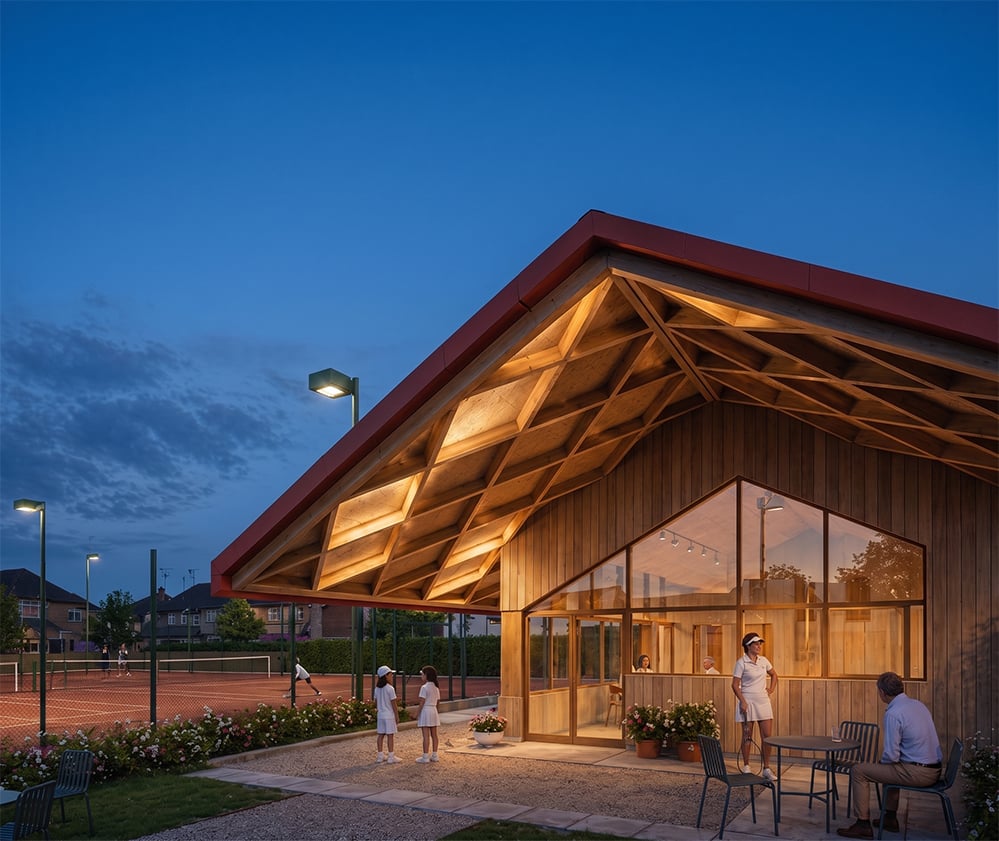
The exposed glulam roof structure at dusk - a lattice of engineered timber that gives the pavilion its distinctive warmth and material honesty. Visuals: Gabriel Spera
Most sports club committees are made up of passionate volunteers. People who love their sport, love their club, and are doing their best to secure its future. They are rarely property developers or construction professionals. And yet, at some point, many of them find themselves responsible for one of the most complex and consequential decisions a club can face: commissioning a new building.
We have been through this process with Sutton Churches Tennis Club over the past several years. Here is what we wish every committee knew before they started.
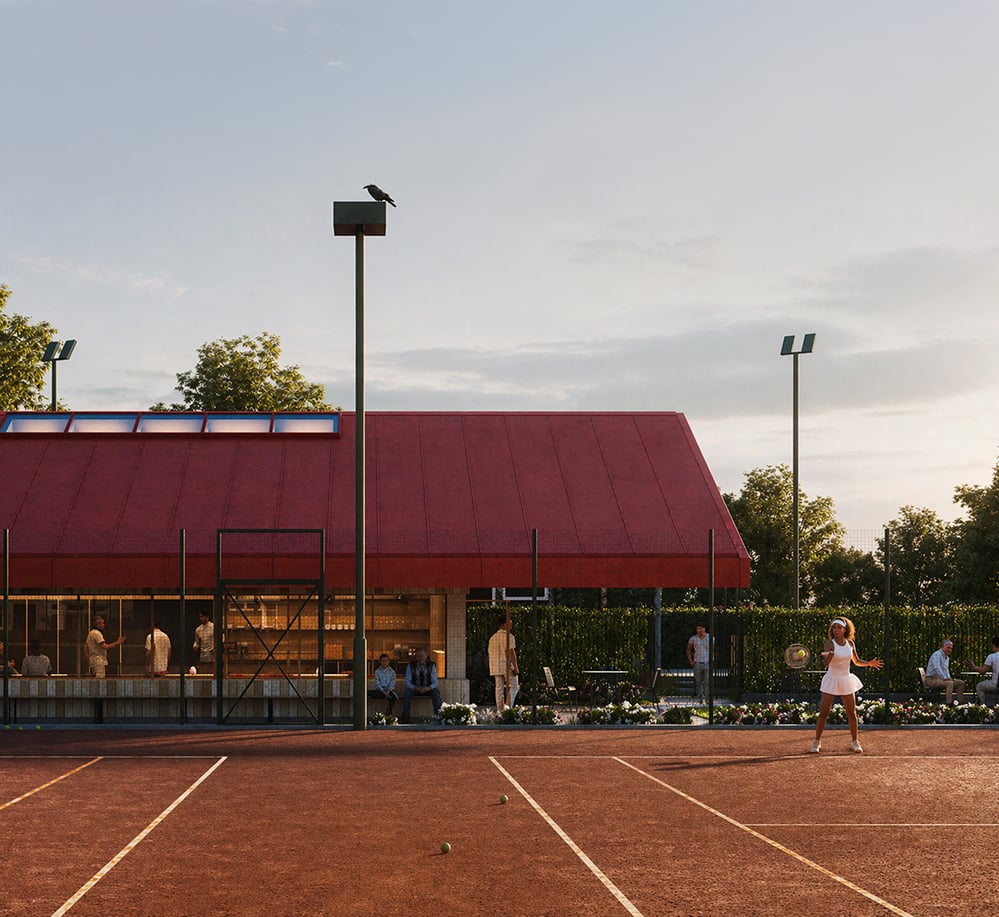
The pavilion sits low and quietly within its setting, its red roof referencing the tiled rooftops of the surrounding neighbourhood.
01 - Your brief is more important than your budget
The first thing most committees ask an architect is: "How much will it cost?" That is understandable. But the more important question - and the one that will shape everything that follows - is: "What do we actually need this building to do?"
A brief that is too vague leads to a design that tries to be everything and ends up serving no one particularly well. A brief that is too prescriptive leaves no room for the architect to bring creative and technical solutions you hadn't considered. The best briefs define outcomes, not rooms. Not "we need a 60-person function room" but "we need a space that feels welcoming to first-time visitors and can host social events after evening matches."
With Sutton Churches, the brief centred on three things: replace the existing dilapidated building, create something genuinely welcoming to the whole community, and do it sustainably. That clarity gave us the framework to make every design decision that followed.
Before your first architect meeting, ask yourselves: Who uses our facility today - and who aren't we reaching that we should be? What does a successful day at our club look, feel and sound like? What is this building for in 25 years, not just next season?
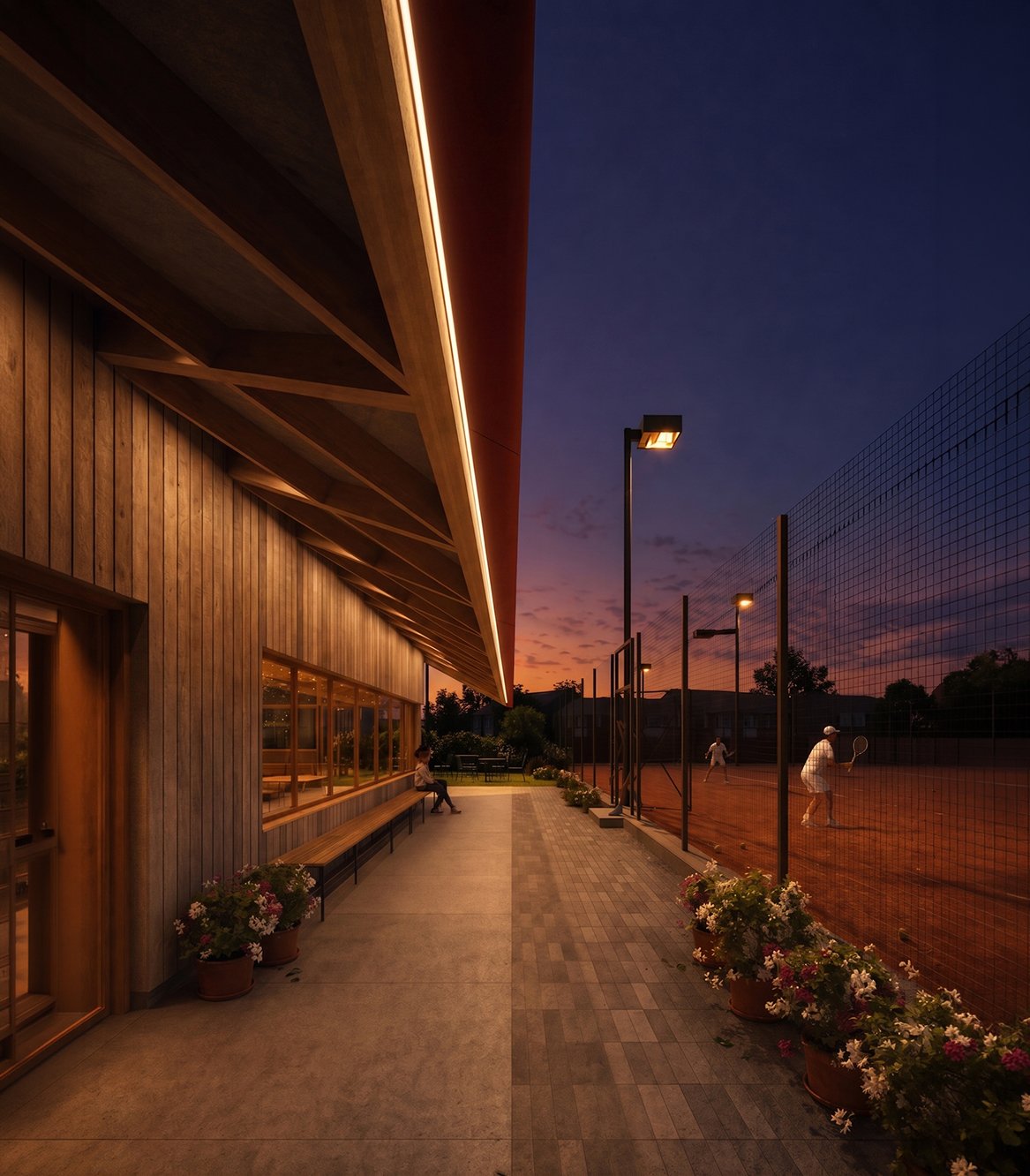
The sheltered walkway running alongside the courts - designed for spectators, for quiet moments, and for the everyday rhythms of club life
02 - Sustainability is not a cost - it is a long-term saving
The word "sustainable" can make committee treasurers nervous. It can sound like an add-on. Something that costs more. In our experience, the opposite is true - particularly for community organisations managing running costs over many decades on tight budgets.
The Sutton Churches clubhouse is designed to the AECB CarbonLite New Build standard. This means high levels of insulation, airtight construction, mechanical ventilation with heat recovery, air source heat pumps and rooftop solar panels. These are not luxury specifications. They are investments that directly reduce what the club pays in energy bills every single year - money that can go back into the sport instead.
We would encourage any club committee to ask their architect not just about build cost, but about projected operational costs. A cheaper building that is expensive to run is not actually cheaper.
The question to ask your architect: What will this building cost to heat, cool and power annually - and how does that compare to what we pay now? What energy standard are you designing to, and why?
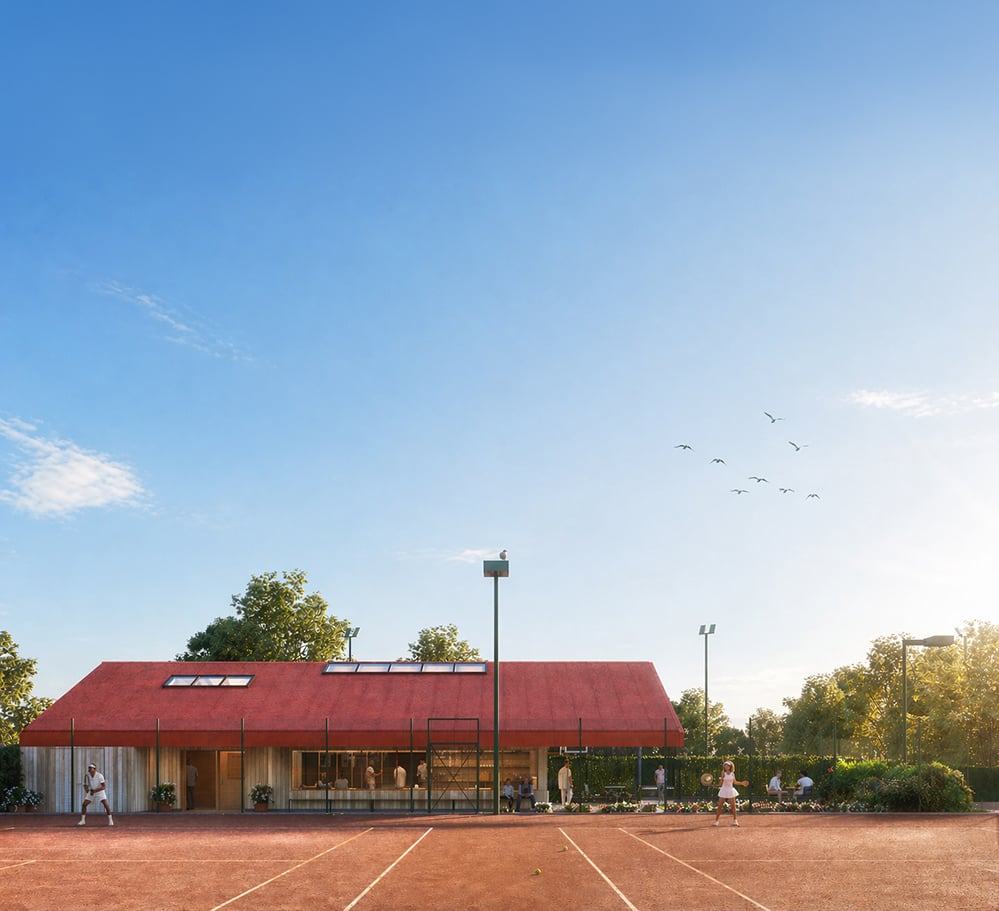
From the courts on a clear day - the clubhouse reads as a confident, considered presence without imposing on its suburban setting
03 - Accessibility cannot be an afterthought
Many older sports facilities were not designed with accessibility in mind. Steps at entrances, narrow doorways, inadequate WC provision - these are not just inconveniences. They are barriers that actively exclude people from participating in sport and community life.
The best time to address accessibility is at the very start of the design process - not at the end, when it becomes expensive to fix. For the Sutton Churches clubhouse, we achieved step-free access throughout by lowering the ground floor level to align naturally with the surrounding landscape. It is a simple section move that costs nothing extra to build, but changes everything about who can use the building.
If your club is applying for funding from Sport England or National Lottery sources, inclusive design is not optional. It is a prerequisite.
The question to ask your architect: How are you achieving step-free access - and is it a design decision or a ramp bolted on at the end? Is the scheme compliant with Part M of the Building Regulations from the first sketch?
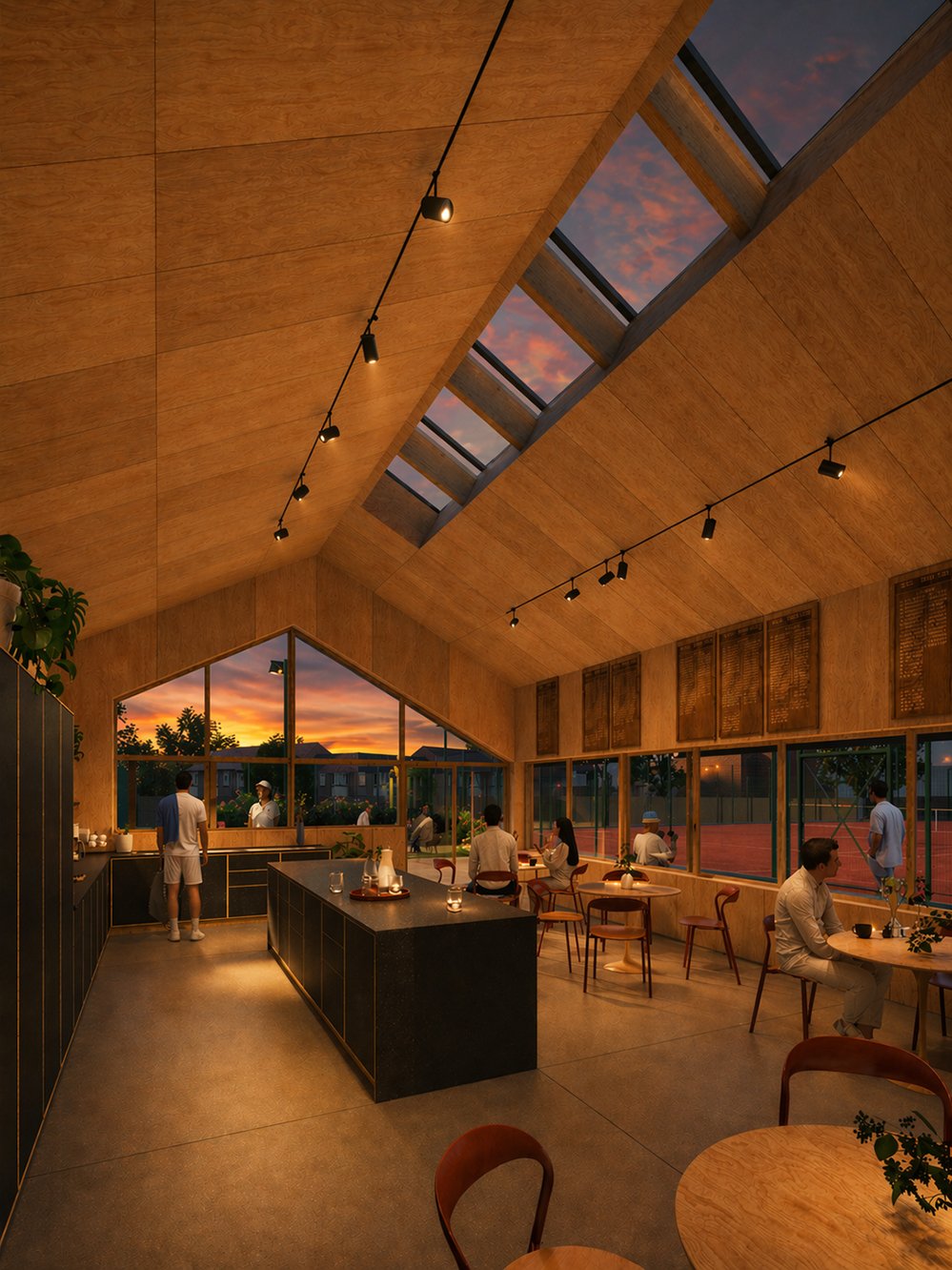
Inside the clubroom: exposed CLT ceiling, a central linear rooflight drawing the sky into the space, and views across the courts from every seat
04 - Planning permission is not a formality - prepare for it properly
Planning is the stage that catches many community projects off guard. Committees often assume that because their project is modest in scale, clearly beneficial, and supported by the local community, consent will follow naturally. It does not always work that way.
A well-prepared planning application - one that responds carefully to local policy, demonstrates community benefit, addresses neighbour concerns proactively, and presents a design that is contextually considered - stands a far better chance of approval, and approval without damaging conditions attached.
The Sutton Churches application was approved with the full support of the council. That did not happen by accident. It happened because the design was developed with planning considerations embedded from the very first stage - not retrofitted at the end. The building's low profile, contextual material palette, careful treatment of the site boundary, and clear community benefit argument all formed part of a coherent planning strategy.
The question to ask your architect: Are you experienced in navigating planning for community and sports buildings specifically? What is your track record - and can you show us examples?
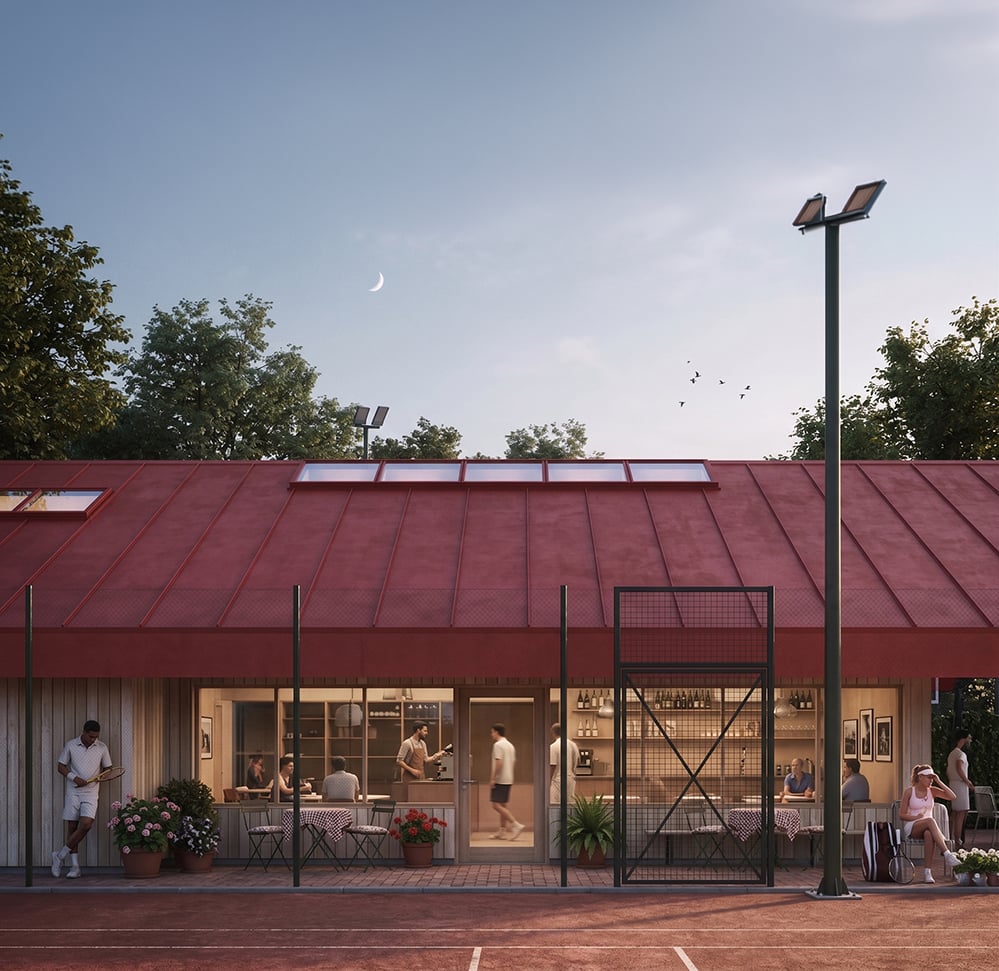
The new clubroom opens directly onto the courts, with full-height glazing creating a seamless connection between social and sporting life
05 - Choose materials for the whole life of the building
The structural and material choices made at the design stage will define how the building performs - financially and environmentally - for decades. This is an area where an experienced architect can add enormous value, and where a less informed choice can be costly.
For the Sutton Churches clubhouse, we chose a hybrid mass timber structure: cross-laminated timber (CLT) walls combined with glulam roof elements. The reasons were straightforward. Mass timber carries a significantly lower embodied carbon footprint than concrete or steel. Components are prefabricated off-site to tight tolerances, which means faster assembly on site, less waste, and - critically for a club managing a tight construction budget - greater cost predictability during the build.
There is also something deeply appropriate about a community building constructed from a natural, honest material. The exposed timber inside the clubroom will warm and age beautifully. It will feel right.
The question to ask your architect: Why are you recommending this structural system - and what does it mean for our build programme, our budget certainty, and our embodied carbon?
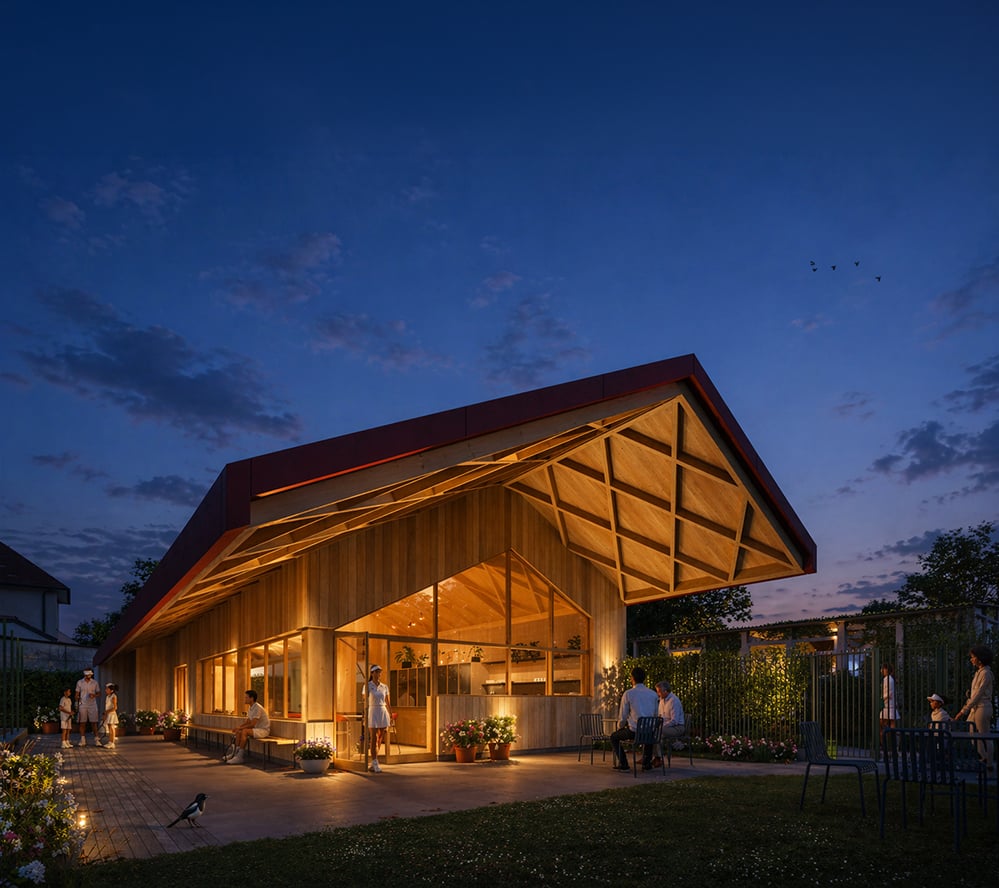
The pavilion at night - a warm lantern in the landscape, its exposed timber structure glowing beneath the red metal roof
06 - Get your governance right before you start
This one is less architectural - but it matters enormously. A project of this scale requires a clear decision-making structure within the club. Who has authority to approve designs? Who signs off on costs? Who is the single point of contact for the architect? Unclear governance leads to slow decisions, contradictory feedback, and cost overruns.
We recommend clubs establish a small project sub-committee - ideally three to five people with clearly defined roles - before any architect is appointed. This group should have the trust of the wider membership and the authority to make decisions on the project's behalf. It makes the entire process faster, cleaner, and less stressful for everyone involved.
Before you appoint anyone: Agree internally on who is on the project committee, what decisions they can make unilaterally, and how you will communicate progress to the wider membership. Put it in writing.
What comes next for Sutton Churches
With planning secured, the project now moves into contractor procurement. Construction is expected to begin in December 2026, with the new clubhouse targeting completion by December 2027. We look forward to sharing the next stages of the project here and on our social channels.
If your club is at the beginning of this journey - considering a new facility, a major extension, or simply wondering whether your existing building is still fit for purpose - we would be very happy to have an initial conversation. Please do get in touch.
→ Email us at architects@risedesignstudio.co.uk
→ Or call the studio on 020 3947 5886
RISE Design Studio, Architects, Interior Designers + Sustainability Experts
☉ Architecture for people and planet
☉ Trading since 2011
☉ Company reg no: 08129708
☉ VAT no: GB158316403

Share this
- Sustainable architecture (157)
- Architecture (151)
- Passivhaus (70)
- Design (67)
- Sustainable Design (66)
- Retrofit (60)
- London (53)
- New build (52)
- Renovation (44)
- energy (39)
- interior design (37)
- Building materials (35)
- Planning (34)
- Environment (31)
- climate-change (30)
- enerphit (28)
- Inspirational architects (27)
- Refurbishment (27)
- extensions (27)
- Building elements (22)
- Inspiration (21)
- low energy home (21)
- London Architecture (16)
- Rise Projects (16)
- Extension (15)
- Innovative Architecture (14)
- Sustainable Architect (14)
- net zero (14)
- Carbon Zero Homes (13)
- General (12)
- Philosophy (12)
- Planning permission (12)
- sustainable materials (12)
- RIBA (11)
- Working with an architect (11)
- architects (10)
- Awards (9)
- Residential architecture (9)
- Sustainable (9)
- Sustainable Tennis Pavilion (8)
- architect (8)
- low carbon (8)
- Airtightness (6)
- BIM (6)
- Eenergy efficiency (6)
- Overheating (6)
- Passive house (6)
- Tennis Pavilion (6)
- Uncategorized (6)
- Virtual Reality (6)
- BIMx (5)
- Backland Development (5)
- Basement Extensions (5)
- Carbon Positive Buildings (5)
- Costs (5)
- RISE Sketchbook Chronicles (5)
- cinema design (5)
- construction (5)
- insulation (5)
- local materials (5)
- modular architecture (5)
- sustainable building (5)
- AECB (4)
- ARB (4)
- Feasibility Study (4)
- Home extensions (4)
- House cost (4)
- Notting Hill Architects (4)
- Paragraph 84 (4)
- concrete (4)
- constructioncosts (4)
- mvhr (4)
- natural materials (4)
- structural (4)
- structuralengineer (4)
- working from home (4)
- Artificial Intelligence (AI) (3)
- Brutalist Architecture (3)
- Building in the Green Belt (3)
- Chartered architect (3)
- Clay Plaster (3)
- Construction Costs (3)
- Fees (3)
- Home improvement (3)
- New Build House (3)
- Paragraph 79 (3)
- Paragraph 80 (3)
- Permitted development (3)
- Property (3)
- Queen's Park Sustainable Architect (3)
- Social housing (3)
- Spain (3)
- Sustainable Architect London (3)
- Sustainable Extensions (3)
- Sustainable Interiors (3)
- Sustainable Natural Materials (3)
- Timber Structures (3)
- backland (3)
- building regulations (3)
- circular economy (3)
- country house (3)
- countryside (3)
- furniture (3)
- hampstead (3)
- house extension (3)
- listed buildings (3)
- plywood (3)
- rear extension (3)
- self build (3)
- stoke newington (3)
- sustainability (3)
- sustainable structure (3)
- victorian terrace (3)
- zero waste (3)
- 3D models (2)
- Architects in Spain (2)
- BREEAM (2)
- Bespoke lighting (2)
- Biophilic Design (2)
- Bricks (2)
- Building energy (2)
- CLT (2)
- Chartered Practice (2)
- Commercial Architecture (2)
- Community Architecture (2)
- Contractor (2)
- Covid-19 (2)
- Designing with Stone (2)
- Ecohouse (2)
- EnerPHit London (2)
- Furniture design (2)
- Garden studio (2)
- Hackney (2)
- Heat Pumps (2)
- Heritage (2)
- Japanese Archiecture (2)
- Kensal Rise (2)
- Loft conversion (2)
- Low Carbon Future (2)
- Low-Energy Design (2)
- Mews House Retrofit (2)
- Modern Methods of Construction (2)
- Passivhaus London (2)
- Period Homes (2)
- Permitted development rights (2)
- Recycling (2)
- Roof extension (2)
- Social Distancing (2)
- Store Design (2)
- Sustainable Affordable Homes (2)
- Sustainable Architect Fees (2)
- Timber Construction (2)
- Welbeing (2)
- West London Architect (2)
- Whole Life Carbon (2)
- Winter Performance (2)
- ashp (2)
- barcelona (2)
- building information modelling (2)
- co-working (2)
- design&build (2)
- epc (2)
- glazed-extensions (2)
- green architecture (2)
- greenbelt (2)
- health and wellbeing (2)
- historic architecture (2)
- home extension (2)
- interiorfinishes (2)
- light (2)
- living space (2)
- london landmarks (2)
- londoncinemas (2)
- openingupworks (2)
- peter zumthor (2)
- project management (2)
- rammed earth (2)
- renewable energy (2)
- traditional (2)
- trialpits (2)
- waste (2)
- wooden furniture (2)
- #NLANetZero (1)
- 3D Printing (1)
- 3D Walkthroughs (1)
- AI and Architecture (1)
- Adobe (1)
- Agriculture and Architecture (1)
- Alvar (1)
- Architect Barcelona (1)
- Architecture Interior Design (1)
- Architraves (1)
- Area (1)
- Art (1)
- Audio Visual (1)
- Balconies (1)
- Biodiversity (1)
- Biophilic Architecture (1)
- Birmingham Selfridges (1)
- Boat building (1)
- Boats (1)
- Brass (1)
- Brent Planning (1)
- Brexit (1)
- Brownfield Development (1)
- Carpentry (1)
- Casting (1)
- Chailey Brick (1)
- Cold Water Swimming (1)
- Concrete Architecture (1)
- Copper (1)
- Cornices (1)
- Corten (1)
- Cowboy Builders (1)
- Czech Republic, (1)
- Data Centers (1)
- David Hockney (1)
- David Lea (1)
- Digital Twin (1)
- Domus Nova (1)
- Dormer extension (1)
- Embodied Carbon (1)
- EnvironmentalArchitecture (1)
- Flooding (1)
- Future of Housing (1)
- Gandhi memorial museum (1)
- Georgian Extension (1)
- Green Register (1)
- Green infrastructure (1)
- GreenDesign (1)
- History (1)
- India (1)
- Interior Finishes (1)
- Jan Kaplický (1)
- Japandi (1)
- Joinery (1)
- Kitchen Design (1)
- L-shaped dormer (1)
- Land value (1)
- Leonardo Da Vinci (1)
- Lime render (1)
- London Architect (1)
- Lord's Media Centre (1)
- Low Energy Homes (1)
- Mapping (1)
- Marseilles (1)
- Mary Portas (1)
- Metal (1)
- Micro Generation (1)
- Mid Century Retrofit (1)
- Monuments (1)
- Mouldings (1)
- Museum Architecture (1)
- Mycelium Architecture (1)
- NPPF (1)
- Nature (1)
- Net Zero Architecture (1)
- North London (1)
- North West London (1)
- Office to Homes (1)
- Office to Hotel Conversion (1)
- Offsite manufacturing (1)
- Origami (1)
- Padel Court (1)
- Party Wall Surveyor (1)
- PeopleFirstDesign (1)
- Place (1)
- Podcast (1)
- Porch (1)
- Prefab (1)
- Pro bono (1)
- Procurement (1)
- Public Housing (1)
- Queen's Park (1)
- RBKC architects (1)
- RISE Insight (1)
- RISE Team (1)
- Rebuild (1)
- Replacement Dwelling (1)
- ResilientFuture (1)
- Richard Rogers (1)
- Rural New Build (1)
- Sand (1)
- Scallop House (1)
- Scandinavian architecture (1)
- Selfbuild (1)
- Skirting (1)
- Slow Architecture (1)
- Small Sites Development (1)
- Solar Shading (1)
- Steel (1)
- Stone Architecture (1)
- Surveying (1)
- Sustainable Basement Extension (1)
- Sustainable Building Systems (1)
- Sustainable Housing (1)
- Sustainable Lighting (1)
- Sustainable Mews House (1)
- Sustainable Padel Court (1)
- Sustainable Retail Store (1)
- Sverre fehn (1)
- UFH (1)
- VR (1)
- Victorian Extension (1)
- Walkable Cities (1)
- West london (1)
- Wildlife (1)
- Winston Road N16 (1)
- Wood (1)
- architect Kensington Chelsea (1)
- architect fees (1)
- architectural details (1)
- arne jacobsen (1)
- avant garde (1)
- basements (1)
- biophilic design London (1)
- brentdesignawards (1)
- building design (1)
- built environment (1)
- carbonpositive (1)
- cement (1)
- charles correa (1)
- charles eames (1)
- charlie warde (1)
- charteredarchitect (1)
- circular rooflight (1)
- climate (1)
- climate action (1)
- codes of practice (1)
- collaboration (1)
- covid (1)
- curved architecture (1)
- dezeenawards (1)
- drone (1)
- eco-living (1)
- emissions (1)
- finnish architecture (1)
- foundations (1)
- futuristic (1)
- georgian architecture (1)
- glazed envelope (1)
- good working relationships (1)
- green building (1)
- happiness (1)
- homesurveys (1)
- imperfection (1)
- independentcinemas (1)
- innovation (1)
- inspirational (1)
- internal windows (1)
- jean prouve (1)
- kindness economy (1)
- kintsugi (1)
- kitchen extension Notting Hill (1)
- landscape architecture (1)
- lime (1)
- local (1)
- lockdown (1)
- mansard (1)
- manufacturing (1)
- materiality (1)
- modern architecture (1)
- moderninst (1)
- modernism (1)
- modular architect London (1)
- moulded furniture (1)
- natural (1)
- natural cooling (1)
- natural light (1)
- new build architect Sussex (1)
- nordic pavilion (1)
- northern ireland (1)
- palazzo (1)
- placemaking (1)
- planningpermission (1)
- plywood kitchen (1)
- post-Covid (1)
- poverty (1)
- powerhouse (1)
- preapp (1)
- preapplication (1)
- ray eames (1)
- reclaimed bricks (1)
- recycle (1)
- reuse (1)
- ricardo bofill (1)
- risedesignstudio (1)
- rooflights (1)
- room reconfiguration (1)
- rural (1)
- satellite imagery (1)
- selfbuildhouse (1)
- shared spaces (1)
- site-progress (1)
- solarpvs (1)
- space (1)
- stone (1)
- structuralsurvey (1)
- sun tunnel (1)
- sustainable home design (1)
- terraces (1)
- thegreenregister (1)
- totality (1)
- wabi-sabi (1)
- April 2026 (1)
- March 2026 (7)
- February 2026 (4)
- January 2026 (4)
- December 2025 (10)
- November 2025 (14)
- October 2025 (9)
- September 2025 (10)
- August 2025 (13)
- July 2025 (23)
- June 2025 (10)
- May 2025 (22)
- April 2025 (16)
- March 2025 (8)
- February 2025 (12)
- January 2025 (6)
- December 2024 (6)
- November 2024 (8)
- October 2024 (5)
- September 2024 (3)
- August 2024 (2)
- July 2024 (2)
- June 2024 (2)
- May 2024 (1)
- April 2024 (1)
- March 2024 (1)
- February 2024 (1)
- January 2024 (3)
- November 2023 (1)
- October 2023 (5)
- September 2023 (7)
- August 2023 (7)
- July 2023 (6)
- June 2023 (8)
- May 2023 (14)
- April 2023 (11)
- March 2023 (8)
- February 2023 (6)
- January 2023 (5)
- December 2022 (3)
- November 2022 (3)
- October 2022 (3)
- September 2022 (3)
- July 2022 (2)
- June 2022 (1)
- May 2022 (1)
- April 2022 (1)
- March 2022 (1)
- February 2022 (2)
- January 2022 (1)
- November 2021 (1)
- October 2021 (2)
- July 2021 (1)
- June 2021 (1)
- May 2021 (1)
- April 2021 (1)
- March 2021 (1)
- February 2021 (1)
- January 2021 (2)
- December 2020 (1)
- November 2020 (1)
- October 2020 (1)
- September 2020 (2)
- August 2020 (1)
- June 2020 (3)
- April 2020 (3)
- March 2020 (2)
- February 2020 (3)
- January 2020 (1)
- December 2019 (1)
- November 2019 (2)
- September 2019 (1)
- June 2019 (1)
- April 2019 (2)
- January 2019 (2)
- October 2018 (1)
- September 2018 (1)
- August 2018 (2)
- July 2018 (1)
- March 2018 (1)
- February 2018 (2)
- December 2017 (1)
- September 2017 (1)
- May 2017 (1)
- January 2017 (1)
- December 2016 (1)
- November 2016 (1)
- September 2016 (1)
- August 2016 (2)
- June 2016 (2)
- May 2016 (1)
- April 2016 (1)
- December 2015 (1)
- October 2015 (1)
- September 2015 (1)
- August 2015 (1)
- June 2015 (1)
- January 2015 (1)
- September 2014 (2)
- August 2014 (1)
- July 2014 (4)
- June 2014 (9)
- May 2014 (2)
- April 2014 (1)
- March 2014 (1)
- February 2014 (1)
- December 2013 (1)
- November 2013 (5)
- October 2013 (5)
- September 2013 (5)
- August 2013 (5)
- July 2013 (5)
- June 2013 (2)
- May 2013 (2)
- April 2013 (4)
- March 2013 (5)
- February 2013 (2)
- January 2013 (3)